


Call Center Smart Action Plan BPO Call Center Organizational Structure Ppt Icon Design Inspiration




Try Before you Buy Download Free Sample Product
 Impress Your
 Audience
 100%
100% Editable
 Save Hours
 of Time


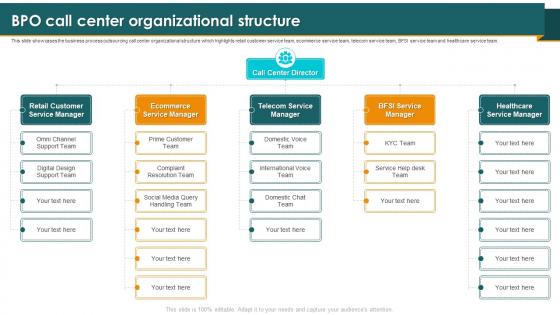
This slide showcases the business process outsourcing call center organizational structure which highlights retail customer service team, ecommerce service team, telecom service team, BFSI service team and healthcare service team.
People who downloaded this PowerPoint presentation also viewed the following :
Call Center Smart Action Plan BPO Call Center Organizational Structure Ppt Icon Design Inspiration with all 6 slides:
Use our Call Center Smart Action Plan BPO Call Center Organizational Structure Ppt Icon Design Inspiration to effectively help you save your valuable time. They are readymade to fit into any presentation structure.





FAQs for Call Center Smart Action Plan BPO Call Center Organizational Structure Ppt
Key roles include call center agents handling customer interactions, team leaders supervising daily operations, quality analysts monitoring service standards, workforce management specialists optimizing staffing, and operations managers overseeing departmental performance. These positions work collaboratively to streamline customer service delivery, enhance operational efficiency, and maintain service quality standards, with many BPO organizations finding that clear role definition ultimately delivers faster resolution times and improved customer satisfaction.
Call center BPO hierarchical structures significantly influence performance through clear reporting lines, defined career progression paths, and structured accountability measures that streamline operations and goal alignment. While rigid hierarchies can limit autonomy, many organizations find that balanced structures with empowerment at operational levels enhance employee engagement, reduce turnover, and ultimately deliver improved customer service quality and operational efficiency.
Flat organizational structures in call center BPOs deliver faster decision-making, enhanced communication flow, reduced operational costs, increased employee empowerment, and improved customer response times. This streamlined approach enables agents to escalate issues directly to decision-makers, reduces management overhead expenses, and creates more agile operations, with many BPOs finding that flatter hierarchies ultimately enhance both employee satisfaction and client service quality.
Call center BPO organizational structures significantly impact service delivery through clear escalation pathways, specialized team divisions, defined accountability chains, and streamlined communication protocols. Well-designed hierarchies enable faster issue resolution, consistent quality standards, and improved first-call resolution rates, with many financial services and healthcare organizations finding that structured teams deliver enhanced customer experiences while reducing operational costs.
Technology integration streamlines call center BPO organizational structures by automating routine tasks, enabling cross-functional team capabilities, and reducing management layers through AI-powered workforce optimization. These solutions eliminate traditional department silos, with many organizations finding that cloud-based platforms and intelligent routing systems deliver enhanced operational efficiency while minimizing administrative overhead.
Effective communication strategies include regular cross-departmental meetings, standardized reporting systems, open-door policies, digital collaboration platforms, and structured feedback mechanisms. These approaches streamline information flow by connecting frontline agents with management, facilitating real-time updates, and ensuring transparent performance discussions, with many call center organizations finding that consistent communication channels ultimately enhance operational efficiency and employee engagement.
Employee training integrates across all organizational levels in call center BPOs, from onboarding new agents to developing supervisors and managers into strategic roles. Training departments collaborate closely with operations, quality assurance, and HR teams to deliver role-specific programs, compliance updates, and skill enhancement initiatives, ultimately ensuring consistent service quality and career progression pathways that reduce turnover.
Quality assurance operates as a critical oversight function within call center BPO hierarchies, monitoring agent performance, ensuring compliance standards, and maintaining service quality through systematic evaluations and feedback mechanisms. QA teams typically report directly to operations management while collaborating with training departments, ultimately delivering improved customer satisfaction, reduced operational risks, and enhanced competitive positioning for BPO organizations.
Call center BPOs can effectively scale by implementing flexible hierarchical frameworks, establishing standardized processes, investing in workforce management systems, and creating specialized teams for different service lines. This strategic combination enables seamless capacity expansion while maintaining service quality, with many organizations finding that modular organizational designs allow rapid adaptation to client demands, ultimately delivering operational efficiency and sustainable growth in an increasingly competitive marketplace.
Call center BPOs face challenges including high agent turnover, scalability pressures during demand fluctuations, maintaining service quality across multiple client requirements, and balancing cost efficiency with operational effectiveness. These organizational complexities require strategic workforce planning, flexible management hierarchies, and robust training systems, with many BPOs finding that adaptive structures and cross-functional teams ultimately deliver improved client satisfaction and competitive advantage.
Cultural factors significantly influence global call center BPO structures through communication styles, hierarchical preferences, decision-making processes, and workforce management approaches. Organizations adapt by implementing region-specific reporting structures, culturally-aligned training programs, and localized management practices, with many multinational BPOs finding that flexible organizational designs enhance employee engagement, reduce turnover, and ultimately deliver more effective customer service across diverse markets.
Essential metrics include first-call resolution rates, average handle time, customer satisfaction scores, agent utilization rates, and employee turnover percentages. These indicators reveal structural efficiency by measuring operational flow, resource allocation, and workforce stability, with many call center BPOs finding that well-structured teams consistently deliver faster resolutions and enhanced customer experiences.
Flexibility in organizational structure enhances call center BPO adaptability through cross-functional teams, dynamic role assignments, decentralized decision-making, and scalable management layers that respond quickly to client demands. This approach enables rapid workforce reallocation during peak periods, seamless integration of new technologies, and faster response to market changes, with many BPOs finding that flexible structures ultimately deliver improved operational efficiency and competitive advantage.
Leadership style is critically important to call center BPO organizational structure success, as it directly influences employee engagement, operational efficiency, and customer satisfaction outcomes. Effective leaders who emphasize coaching, clear communication, and performance recognition create environments where agents feel supported and motivated, ultimately delivering lower turnover rates, higher quality scores, and improved customer experiences across all service levels.
Emerging trends shaping call center BPO organizational structures include AI-driven automation, hybrid workforce models, specialized skill-based teams, cloud-first operations, and data analytics integration. These developments enable organizations to streamline customer interactions, reduce operational costs, and enhance service quality, with many financial services and retail companies finding that flexible structures deliver faster response times and improved customer experiences.
-
I had them make a presentation for an office retirement party. They were very helpful in understanding what we wanted and delivered the perfect presentation. Highly recommended!
-
Fantastic and innovative graphics with useful content. The templates are the best and latest in the industry.