

Change management introduction powerpoint presentation slides





Try Before you Buy Download Free Sample Product
 Impress Your
 Audience
 100%
100% Editable
 Save Hours
 of Time


Manage the imposed or unplanned change with the help of professionally designed ready-made Change Management Introduction PowerPoint Presentation Slides. Drive an effective change within an organization using Change management introduction powerpoint presentation slides. Get practical organizational change methodologies, frameworks, steps, processes and implement a successful change. Add change management ppt covers topics like change management implementation drivers, identify the change, types of change management, forces for change, gap analysis, organization change readiness checklist, etc. These change management introduction PPT slide layouts are editable. You can utilize them as per your organizational need. Make your employees ready for the change and go through a successful transition. Add organizational change management PowerPoint templates to control and improve processes for the betterment of an organization as whole. It becomes necessary in the business cycle of an organization to have business process reengineering. Adopt a change and go through a smooth transition with change management introduction PPT slideshow. Break it all down with our Change Management Introduction Powerpoint Presentation Slides. Allow every element to emerge effectively.
People who downloaded this PowerPoint presentation also viewed the following :
Content of this Powerpoint Presentation
Slide 1: This slide presents Change Management Introduction. State Your Company Name and get started.
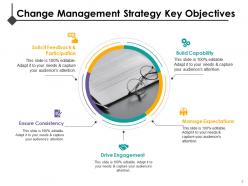
Slide 2: This slide shows Change Management Strategy Key Objectives such as- Manage Expectations, Drive Engagement, Ensure Consistency, Build Capability, Solicit Feedback & Participation.
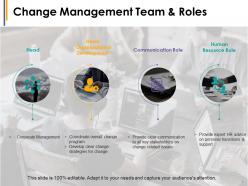
Slide 3: This slide shows Change Management Team & Roles showing- Head: Corporate Management. Head: Organizational Development Coordinate overall change program, Develop clear change strategies for change. Communication Role: Provide clear communication to all key stakeholders on change related issues. Human Resource Role: Provide expert HR advice on personal transitions & support.
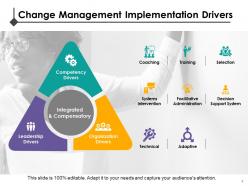
Slide 4: This slide showcases Change Management Implementation Drivers divided into- Competency Drivers: Coaching, Training, Selection. Organization Drivers: Systems Intervention, Facilitative Administration, Decision Support System. Leadership Drivers: Technical, Adaptive.
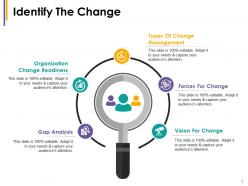
Slide 5: This slide shows Identify The Change with the following subheadings- Types Of Change Management, Forces For Change, Vision For Change, Gap Analysis, Organization Change Readiness.
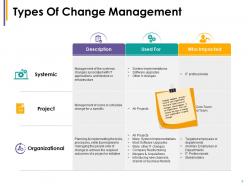
Slide 6: This slide presents Types Of Change Management showcasing- Description, Used For, Who Impacted. Change happens at every level of your organization. We have listed common changes which happen in an organization. You can choose the type of change your organization is going through.
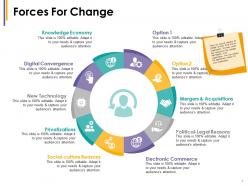
Slide 7: This slide showcases Forces For Change such as- Mergers & Acquisitions, Political-Legal Reasons, Electronic Commerce, Knowledge Economy, Digital Convergence, New Technology, Privatizations, Social-culture Reasons. There are several reasons for change at every level of your organization. We have listed few reasons for the changes that happen in an organization. You can choose the appropriate reason for your organization.
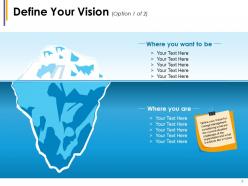
Slide 8: This slide shows Define Your Vision with a creative iceberg imagery. Define your Vision for change management considering what are the current situation/ challenges of the organization and what it will look like in future
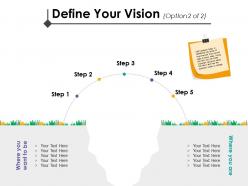
Slide 9: This slide shows Define Your Vision with a creative semi circular imagery. GAP analysis helps in identifying key areas of improvement from current state to future state. Using this tool, you can make important decisions about the future and how the business needs to change.
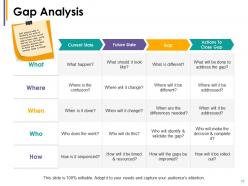
Slide 10: This slide shows Gap Analysis displaying- Current State, Future State, Gap, Actions To Close Gap. GAP analysis helps in identifying key areas of improvement from current state to future state. Using this tool, you can make important decisions about the future and how the business needs to change.
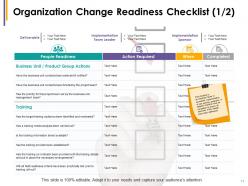
Slide 11: This slide presents Organization Change Readiness Checklist showing- Deliverable, Implementation Team Leader, Implementation Sponsor, Action Required, When, Completed, People Readiness. This checklist is an important factor in successful implementation of new policies, programs. A detailed checklist must be completed to ensure all elements of the change have been addressed.
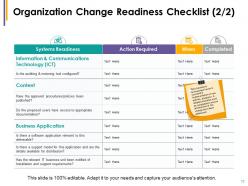
Slide 12: This slide presents Organization Change Readiness Checklist showing- Systems Readiness Action Required When Completed This checklist is an important factor in successful implementation of new policies, programs. A detailed checklist must be completed to ensure all elements of the change have been addressed.
Slide 13: This is a Change Management Introduction Icon Slide. Use the icons as per need.
Slide 14: This slide is titled Additional Slides. You may change content as per your need.
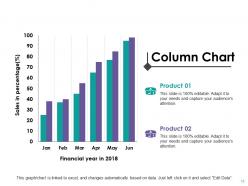
Slide 15: This slide showcases a Column Chart for two product/entity comparison, information, specifications etc.
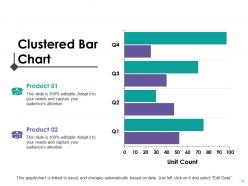
Slide 16: This slide showcases a Clustered Bar Chart for two product/entity comparison, information, specifications etc.
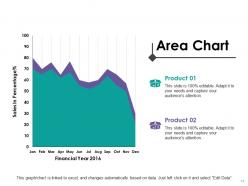
Slide 17: This slide showcases an Area Chart for two product/entity comparison, information, specifications etc.
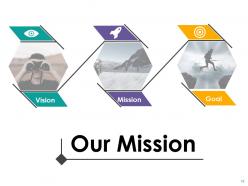
Slide 18: This slide contains Our Mission with Vision and Goal. State them here.
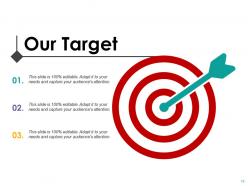
Slide 19: This is Our Target slide. State them here.
Slide 20: This is an About Us slide. State your position, facts or anything business here.
Slide 21: This slide presents Our Team with designation, image text holder and text boxes to fill information.
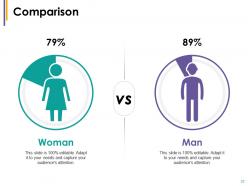
Slide 22: This slide shows Comparison in a creative manner displaying male and female imagery. State comparing aspects here.
Slide 23: This is a Puzzle image slide with text boxes to state information, specifications etc.
Slide 24: This is an Idea or Bulb image slide. Present any new information, data here.
Slide 25: This is a Thank You slide with Address # street number, city, state, Contact Numbers, Email Address to be put and displayed.
Change management introduction powerpoint presentation slides with all 25 slides:
Adapt to ever evolving demands with our Change Management Introduction Powerpoint Presentation Slides. They are designed for flexibility.


FAQs for Change management introduction
Okay so here's what actually works - you need to nail the communication first. Like, seriously explain WHY this change is happening because most leaders just dump it on people and wonder why everyone's confused. Get your executives fully on board, then find those informal leaders in each team who can help sell it to their coworkers. Oh and don't forget proper training and support throughout. I've seen so many companies mess this up by skipping straight to implementation. The truth is, if people don't get why it matters, you're basically fighting an uphill battle for everything else.
Honestly, your team usually knows first when stuff's broken - they're the ones dealing with it daily. Watch for the obvious red flags: metrics tanking, customers bitching more, people constantly finding workarounds just to do their jobs. That last one's a dead giveaway something's wrong. New regulations or competitors doing things differently can also force your hand. I'd set up regular check-ins where people can actually speak up about what sucks. Don't wait until it's a total disaster - track this stuff so you can fix things before they blow up.
Dude, leadership makes or breaks everything here. Your team's watching to see if you actually believe in this change - and trust me, they can smell fake enthusiasm from a mile away. Be super clear about WHY you're doing this and don't stop talking about it. Show up, deal with their complaints directly, and throw little celebrations when things go right. People hate change by default, so you've got to remove whatever's making it harder for them. Oh and get your own head straight first about the reasons behind it all. Can't lead what you don't understand yourself.
Look, resistance happens when people don't get the "why" - so explain it clearly first. Get the biggest skeptics involved in planning if you can, because honestly? People buy into stuff they helped build. Listen to their pushback too, sometimes they catch things you missed. Training helps with the skills gap, and celebrating quick wins keeps momentum going. Oh, and find your cheerleaders early - they'll do half the convincing for you. My advice? Map out your top resisters and grab coffee with each one this week. One-on-ones work way better than group meetings for this stuff.
Honestly? Start with ADKAR - it's way more straightforward than most frameworks and actually focuses on the human side (awareness, desire, knowledge, ability, reinforcement). Kotter's 8-Step Process is solid too for building momentum. Here's the thing though - I've watched so many changes crash and burn because people skip explaining the "why" and just dive into execution. Big mistake. You'll need impact assessments to figure out who gets hit by the changes, plus communication that actually reaches people. Oh, and some feedback system to spot pushback before it kills everything. ADKAR's probably your best bet starting out.
Honestly, culture pretty much determines if your change stuff will work or totally bomb. Got a rigid, "we've always done it this way" vibe? People will fight you on everything. But when your team actually likes trying new things and learning, they'll be way more open to whatever you're proposing - makes life so much easier. I'd definitely figure out what kind of culture you're dealing with first. Then you can work with what's already there instead of trying to force something that'll never stick. Way smarter approach.
Honestly, the worst thing you can do is rush it and leave people in the dark. Nobody likes getting blindsided at work, you know? Don't skip explaining WHY you're making changes - seriously, that's where most rollouts die. People will push back hard if they think it's just change for change's sake. Leadership needs to actually show up and support it too, not just send an email and disappear. Oh, and you'll probably think adoption takes like 2 weeks when it's more like 2 months. Map out everyone who's affected first, then communicate way more than feels necessary. I'd rather annoy people with updates than have them feel forgotten.
Okay so first thing - explain the "why" or people will just freak out and resist everything. I'd hit multiple channels too: town halls, emails, those awkward one-on-ones. The office rumor mill is honestly brutal and spreads faster than wildfire, so beat it to the punch. Don't pretend you have all the answers when you don't - people see right through that BS. Set up ways for folks to actually give feedback instead of just talking at them. Oh, and tailor your messaging! What keeps your frontline workers up at night is totally different from what executives obsess over.
Track adoption rates first - are people actually using the new stuff? Check your performance metrics too like productivity and error rates before/after. Employee surveys are honestly where you'll learn the most though. Nobody talks about that enough. Training completion rates, timeline stuff, budget variance - all matters. But here's the thing: pick maybe 3-4 metrics max that match what you're trying to do. Otherwise you'll get buried in spreadsheets and lose sight of what's working. Oh, and check them regularly so you can course-correct if needed.
Honestly, just talk to people early and often - like, way more than you think you need to. Figure out who's actually affected and what they care about, then craft your message around that. I've seen too many people just blast generic updates and wonder why nobody's on board. Set up real conversations, not just email dumps. Get feedback and actually do something with it (this part's huge). Oh, and if you can swing it, bring your key players into the planning phase - people will fight for something they helped build. Maybe start with your biggest influencers? Schedule some quick one-on-ones this week and see what happens.
First, figure out what your people actually don't know - don't waste time on generic stuff they already get. Mix up how you teach it too. Videos work for some folks, hands-on for others. Role-playing feels super weird at first but honestly it's the best way to practice tricky conversations. Keep groups small or people won't speak up. Here's the thing though - one training session never sticks. You'll need follow-ups once they're actually doing the work because that's when real questions come up. Oh, and give them someone specific to bug when they're confused later!
Honestly, tech makes change management way less painful. Slack keeps everyone updated during transitions - no more "wait, what's happening?" moments. Tools like Asana are clutch for tracking who's actually adopting new stuff and hitting deadlines. The data side is where it gets really useful though - you can see exactly where people get stuck instead of wondering why things aren't working. Oh, and digital training lets people go at their own speed, which cuts down on pushback big time. I'd say pick whatever fixes your biggest headache first, whether that's communication or just keeping track of progress.
So basically there's two types of change. Incremental is like your everyday tweaks - updating processes, small tech improvements, that kind of stuff. Transformational is the massive overhauls that flip everything upside down. New business models, complete digital makeovers, you know? Here's the thing though - most companies are doing way more incremental changes than they think! It's just less scary for everyone. People can actually handle those small shifts. But when you're asking them to completely change how they work? Yeah, that needs real planning and tons of communication. My advice? Figure out which one you're actually dealing with first, because honestly your whole strategy depends on it.
Don't wait until the end to ask for feedback - bake it right into every step. Weekly check-ins work great during rollouts. Mix up how you gather input too - some people love surveys, others will only open up during random coffee conversations (honestly, those informal chats often give you the best intel). Try pulse surveys, focus groups, or just block out office hours for people to drop by. The biggest mistake? Not closing the loop. Tell people what you heard and what you're actually doing about it. Otherwise they'll stop bothering to give feedback at all. Make it feel safe and adjust how often you check in based on what's working.
Look, your people's well-being during change isn't just nice to have - it literally determines if your whole thing succeeds or crashes. Stressed, confused employees will either fight you or mentally disappear. I've watched teams basically shut down when leadership dropped the ball on this. You've got to watch for stress signals and throw extra support at people. Be ridiculously clear about what's happening and why. Mental health always takes a hit during big transitions, so maybe offer flex schedules or bring someone in to talk through stuff. Oh, and those leadership office hours? Game changer. Basically, take care of them first and they'll actually work with you instead of against you.
-
Awesome presentation, really professional and easy to edit.
-
It saves your time and decrease your efforts in half.