


Construction Project Engineering KPI Dashboard




Try Before you Buy Download Free Sample Product
 Impress Your
 Audience
 100%
100% Editable
 Save Hours
 of Time


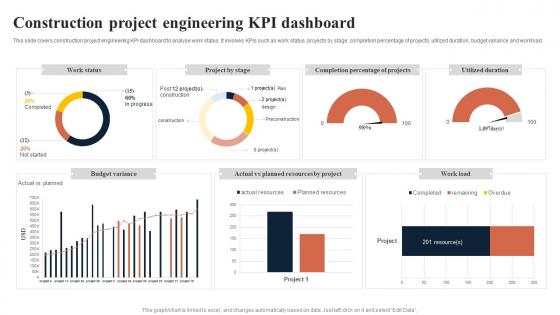
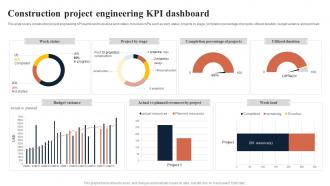
This slide covers construction project engineering KPI dashboard to analyse work status. It involves KPIs such as work status, projects by stage, completion percentage of projects, utilized duration, budget variance and workload.
People who downloaded this PowerPoint presentation also viewed the following :
Construction Project Engineering KPI Dashboard with all 7 slides:
Use our Construction Project Engineering KPI Dashboard to effectively help you save your valuable time. They are readymade to fit into any presentation structure.





FAQs for Construction Project
Honestly, just focus on the basics first. Schedule performance is huge - are you actually hitting deadlines? Budget variance too, because going over sucks. Safety incidents are non-negotiable obviously. Quality stuff like rework rates will save your ass - redoing work is expensive and annoying. I'd watch productivity rates and how often change orders pop up since those derail everything. Oh, and labor hours for resource planning. Don't go crazy though. Pick like 5-6 max or you'll never actually look at them. These will catch most disasters before they happen.
So KPIs basically make safety measurable instead of just crossing your fingers. Track stuff like near-miss reports, training completion rates, incident-free days, PPE compliance - you know, the basics. What's cool is it forces you to spot patterns. Maybe accidents spike during night shifts or with certain crews. Workers actually start caring more when they see you're tracking real data and talking about it regularly. Oh, and don't go crazy at first - pick 2-3 simple metrics you can actually keep up with. You'll thank yourself later.
So basically these KPIs are like taking your project's pulse - gotta know if you're actually making money or bleeding cash. Track your cost variance and budget performance weekly (trust me on this one). Material costs love to creep up when you're not watching. Cash flow's probably the biggest thing since construction eats money fast, especially when clients drag their feet on payments. Profit margins tell the real story though. Catch problems early with weekly check-ins before they turn into those "oh shit" moments that cost you big time.
Look, first thing you gotta do is connect your construction KPIs to whatever your company actually cares about. Profitability-focused? Track cost variance and budget stuff. Growth mode? Focus on delivery speed and how happy clients are. Safety companies will obviously want incident rates - duh. Here's the thing though - those regular check-ins where you review if these metrics actually matter? Super important. Your project teams need to get why they're tracking this stuff too, otherwise you're just collecting random numbers. Trust me, I've seen too many companies drowning in data that doesn't connect to anything meaningful.
Honestly, mobile apps are your best bet here. Procore and PlanGrid work great - your crew can just punch in updates, safety stuff, quality issues right from their phones. IoT sensors are pretty sweet too, they handle all the boring tracking automatically - equipment usage, deliveries, weather conditions. Way better than hoping someone remembers to write it down (spoiler: they won't). Oh and drones are clutch for progress photos and measurements. The trick is making it stupid simple to use. Just build it into whatever they're already doing daily so it doesn't feel like extra work.
Weekly reviews work best for the day-to-day stuff - safety incidents, progress tracking, that kind of thing. Then monthly for the bigger picture metrics like budget variance and schedule delays. Daily's way too much unless something's seriously broken. Honestly, smaller projects can probably get away with every two weeks, but major builds need that weekly check-in. The trick is just being consistent about it - pick a schedule your team won't flake on. Oh, and focus on the warning signs (near-misses, early delays) instead of just counting what already went wrong. Way more useful that way.
Honestly, schedule adherence is huge - are they actually hitting their milestones or just making excuses? Quality scores from inspections matter too, plus safety incidents (nobody wants that headache). Budget variance is obvious but communication responsiveness? That's where subs either make or break you. Nothing worse than chasing someone down for basic updates. Cost per unit and rework percentages will show you who's worth keeping around versus who's just burning through your money. Oh, and set up some kind of weekly dashboard thing - catching problems early beats scrambling later when everything's already sideways.
Honestly, going digital with KPI tracking is a game changer. Project management software automatically pulls data on schedules, budgets, safety stuff - all in real-time. IoT sensors and drones are actually pretty sweet for monitoring equipment and progress photos. Your field crews can log everything instantly on mobile apps instead of doing paperwork later. The trick is finding tools that play nice together so you're not switching between ten different screens all day (been there, it sucks). I'd start with one solid platform that handles your biggest KPIs first, then build from there.
Honestly, the biggest mistake I see is trying to measure absolutely everything - you'll drown in data and waste time on spreadsheets instead of actual work. Bad data quality is surprisingly common too, so you might be making decisions off garbage numbers. Here's the thing that really bugs me: when people start gaming the system to hit their targets instead of genuinely improving. Like, what's the point? Pick maybe 4-5 KPIs that actually matter for your project and check if they're still useful every few months. Don't overcomplicate it.
Really depends on what you're building and who's breathing down your neck about it. Residential? Cost per square foot and staying on schedule - margins are brutal there. Commercial gets trickier with safety incidents and change orders. Infrastructure projects are their own beast though, all that environmental compliance tracking... honestly such a pain but you can't ignore it. I'd figure out what's most likely to blow up on your specific job, then pick maybe 4-5 metrics that'll flag problems early. Way better than scrambling after things go sideways.
Dude, tracking KPIs poorly is like driving with your eyes closed - you're gonna crash. When you don't monitor the right metrics, problems pile up before you even notice. Labor costs spike, materials get expensive, timelines slip. I've watched teams blow their budget by 30% just because nobody was paying attention to the data that actually mattered. You're always playing catch-up instead of staying ahead. Honestly, it's such an easy fix though. Just pick 5-7 solid metrics and review them every week with your team. That's it.
KPIs are basically your project's smoke detector - they'll catch problems while you can still fix them. Track stuff like schedule slips, budget overruns, safety issues, and quality problems. Honestly, most people wait way too long to set these up and then wonder why everything goes sideways. You'll spot patterns before they turn into disasters. Set up some simple dashboards for the metrics that matter most to your project. Review them weekly with your team - don't let it slide. It's way better than playing catch-up after things have already gone wrong.
Honestly, stick with dashboards that have color-coded charts showing trends - way better than static snapshots. Keep it to 5-7 key metrics tops because nobody has time for more than that. Group similar stuff together like safety, schedule, and budget so it makes sense at a glance. Bar charts work well for budget variance, line graphs for productivity trends. Heat maps are clutch for spotting problem areas across multiple projects. The main thing? Your team needs to actually understand this stuff without feeling like they're solving calculus problems. Auto-updating visuals are a game changer if you can swing it.
Dude, you really need everyone's input on KPIs because they all want different stuff. Clients obsess over deadlines and budgets. Your crew? They're thinking safety and whether they've got the tools they need. Then there's the community - and trust me, piss them off with noise complaints and you'll regret it. Map out who matters first, then just ask each group what they'd actually measure success by. It's way easier than guessing wrong and having to backtrack later.
FMI and McKinsey put out solid industry reports with profit margins, safety stats, delivery times - all that good stuff. Your trade association probably has data too, broken down by project type. Honestly, the best intel comes from actually talking to other contractors in forums or peer groups where people share real numbers, not the BS marketing metrics. Oh and the Construction Industry Institute is worth checking out. Figure out what KPIs actually matter for your business first, then compare against companies your size in your area. Don't try to benchmark everything at once - you'll drive yourself crazy.
-
Design layout is very impressive.
-
Informative presentations that are easily editable.