


Creating strategy for supply chain management powerpoint presentation slides




Try Before you Buy Download Free Sample Product
 Impress Your
 Audience
 100%
100% Editable
 Save Hours
 of Time


Our Creating Strategy For Supply Chain Management Powerpoint Presentation Slides are topically designed to provide an attractive backdrop to any subject. Use them to look like a presentation pro.
People who downloaded this PowerPoint presentation also viewed the following :
Content of this Powerpoint Presentation
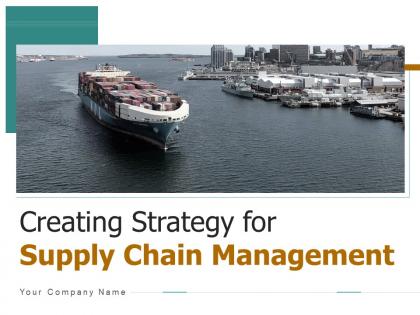
Slide 1: This title slide introduces Creating Strategy for Supply Chain Management. Add the name of your company here.
Slide 2: This is the Agenda slide of Creating Strategy for Supply Chain Management
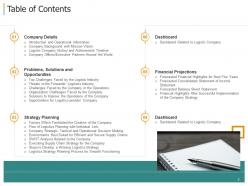
Slide 3: This slide contains the Table of Contents. It includes - Company Details, Problems, Solutions and Opportunities, Strategy Planning, etc.
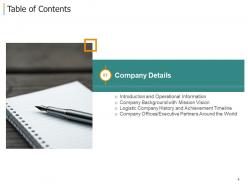
Slide 4: This is a table of content slide showing the Company Details.
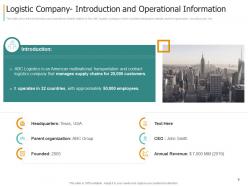
Slide 5: This slide shows the introduction and operational details related to the ABC logistic company which includes headquarter details, parent organization, founding year, etc.
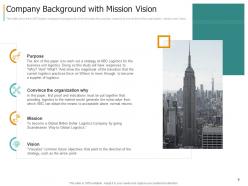
Slide 6: This slide presents the Company's Background with Mission Vision. It shows the ABC logistic company’s background which includes the purpose, reasons to convenience the organization, mission, and vision.
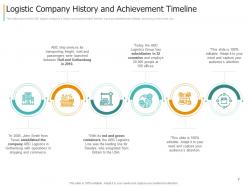
Slide 7: This slide presents the Logistic Company History and Achievement Timeline. It shows the ABC logistic company’s history and achievement timeline such as establishment details, launching of services, etc.
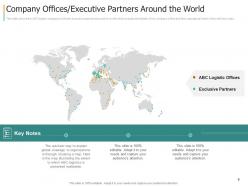
Slide 8: This slide presents the Company Offices/Executive Partners Around the World. It shows the ABC logistic company’s offices/ executive partners around the world which include the details of the company office and their operational head office with keynotes.
Slide 9: This is a table of content slide showing the Problems, Solutions, and Opportunities.
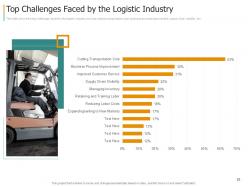
Slide 10: This slide presents the Top Challenges Faced by the Logistic Industry. It shows the top challenges faced by the logistic industry such as cutting transportation costs, business process improvement, supply chain visibility, etc.
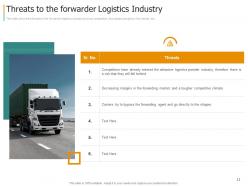
Slide 11: This slide presents the Threats to the forwarder Logistics Industry. It shows the threats to the forwarder logistics industry such as competition, decreasing margins in the market, etc.
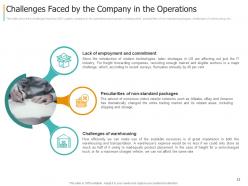
Slide 12: This slide presents the Challenges Faced by the Company in the Operations. It shows the challenges faced by ABC Logistic company in the operations such as lack of employment, peculiarities of non-standard packages, challenges of warehousing, etc.
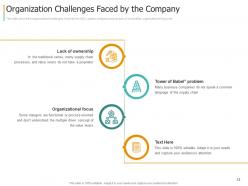
Slide 13: This slide presents the Organization Challenges Faced by the Company. It shows the organizational challenges faced by the ABC Logistic company such as lack of ownership, organizational focus, etc.
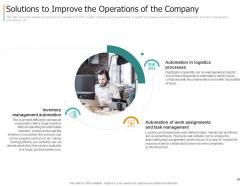
Slide 14: This slide presents the Solutions to Improve the Operations of the Company. It shows the solutions to improve the operations in ABC Logistic company such as automation in logistic processes, automation of work assignments, inventory management automation, etc.
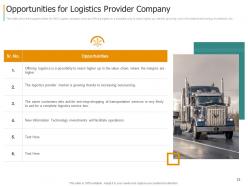
Slide 15: This slide presents the Opportunities for the Logistics Provider Company. It shows the opportunities for ABC Logistic company such as offering logistic in a possible way to reach higher up, market growing, new informational technology investment, etc.
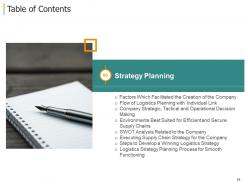
Slide 16: This is a table of content slide showing the Strategy Planning
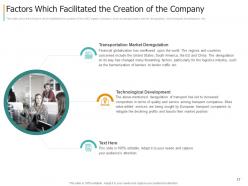
Slide 17: This slide presents the Factors Which Facilitated the Creation of the Company. It shows the factors which facilitated the creation of the ABC logistic Company such as transportation market deregulation, technological development, etc.
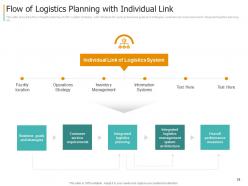
Slide 18: This slide presents the Flow of Logistics Planning with Individual Link. It shows the flow of logistic planning of ABC Logistic Company with an individual link such as business goals and strategies, customer services requirements, integrated logistics planning, etc.
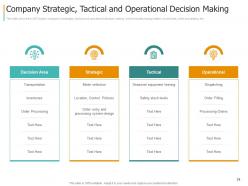
Slide 19: This slide presents the Company's Strategic, Tactical, and Operational Decision Making. It shows the ABC logistic company’s strategies, tactical and operational decision making which includes transportation, inventories, order processing, etc.
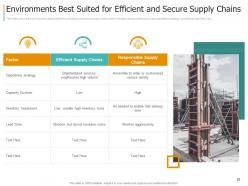
Slide 20: This slide presents the Environments Best Suited for Efficient and Secure Supply Chains. It shows the environment best suited for an efficient and secure supply chain which includes various factors such as operations strategy, investment lead time, etc.
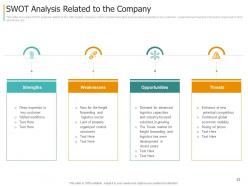
Slide 21: This slide presents the SWOT Analysis Related to the Company. It shows the SWOT analysis related to the ABC logistic company which includes strengths such as deep expertise in key customers, weakness such as lack of properly organized control structures, etc.
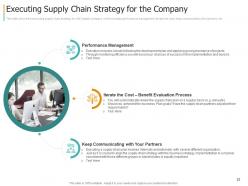
Slide 22: This slide presents the Executing Supply Chain Strategy for the Company. It shows the executing supply chain strategy for ABC logistic company which includes performance management, iterating the cost, keep communicating with the partners, etc.
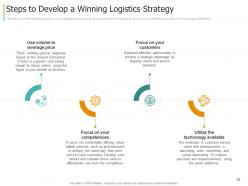
Slide 23: This slide presents the Steps to Developing a Winning Logistics Strategy. It shows the steps to develop a winning logistic strategy such as using volume to leverage price, focusing on your competencies, utilizing the technology available, etc.
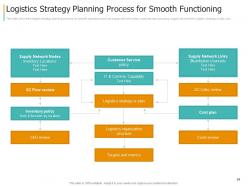
Slide 24: This slide presents the Logistics Strategy Planning Process for Smooth Functioning. It shows the logistic strategy planning process for smooth operations such as supply network nodes, customer service policy, supply network links, logistic strategy or plan, etc.,
Slide 25: This is a table of content slide showing the Launch Plan and ROI.
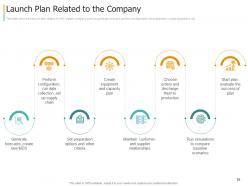
Slide 26: This slide presents the Launch Plan Related to the Company. It shows the launch plan related to ABC logistic company such as generating the forecast, performing configuration, set preparation, creating equipment, etc.
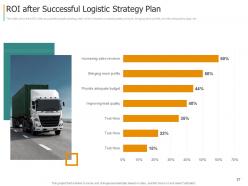
Slide 27: This slide presents the ROI after the Successful Logistic Strategy Plan. It shows the ROI after a successful logistic strategy plan which includes increasing sales revenue, bringing more profits, providing an adequate budget, etc.
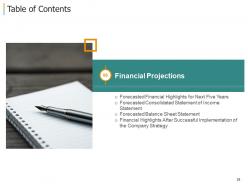
Slide 28: This is a table of content slide showing the Financial Projections.
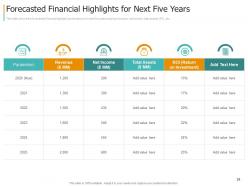
Slide 29: This slide presents the Forecasted Financial Highlights for the Next Five Years. It shows the forecasted financial highlight performance for the next five years such as revenue, net income, total assets, ROI, etc.
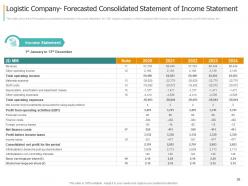
Slide 30: This slide presents the Logistic Company- Forecasted Consolidated Statement of Income Statement. It shows the Forecasted consolidated statement of the income statement for ABC logistic company which includes total revenue, material expenses, profit after taxes, etc.
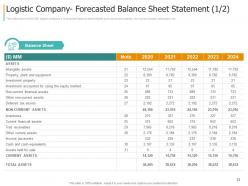
Slide 31: This slide presents the Logistic Company- Forecasted Balance Sheet Statement (1/2). It shows the ABC logistic company’s forecasted balance sheet details such as current assets, non-current assets, total assets, etc.
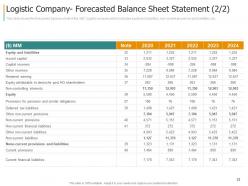
Slide 32: This slide presents the Logistic Company- Forecasted Balance Sheet Statement (2/2). It shows the forecasted balance sheet of the ABC logistic company which includes equity and liabilities, non-current provisions and liabilities, etc.
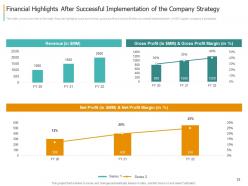
Slide 33: This slide presents the Financial Highlights After Successful Implementation of the Company Strategy. It covers the overview of the major financial highlights such as revenue, gross profit, and net profit after successful implementation of ABC logistic company’s strategies.
Slide 34: This is a table of content slide showing the Dashboard.
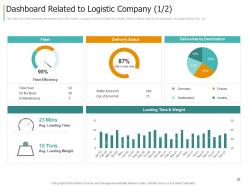
Slide 35: This slide presents the Dashboard Related to the Logistic Company (1/2). It shows the dashboards related to the ABC logistic company which includes fleet details, delivery status, delivery by destination, average loading time, etc.
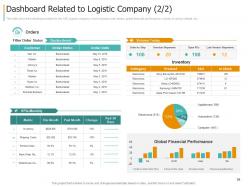
Slide 36: This slide presents the Dashboard Related to the Logistic Company (2/2). It shows the dashboard related to the ABC logistic company which includes order status, global financial performance, volume, inventory details, etc.
Slide 37: This is the Creating Strategy for Supply Chain Management Icons Slide.
Slide 38: This slide presents the Additional Slides.
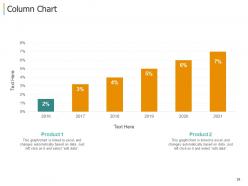
Slide 39: This slide shows a Column Chart that compares 2 products’ data over a timeline of years.
Slide 40: This slide provides the Mission for the entire company. This includes the vision, the mission, and the goal.
Slide 41: This slide contains the information about the company aka the ‘About Us’ section. This includes the Our Company, the Target Audience, and Preferred by Many.
Slide 42: This slide shows the members of the company team with their name, designation, and photo.
Slide 43: This slide contains Post It Notes that can be used to express any brief thoughts or ideas.
Slide 44: This is a slide with a 30 60 90 Days Plan to set goals for these important intervals.
Slide 45: This is a Thank You slide where details such as the address, contact number, email address are added.
Creating strategy for supply chain management powerpoint presentation slides with all 45 slides:
Use our Creating Strategy For Supply Chain Management Powerpoint Presentation Slides to effectively help you save your valuable time. They are readymade to fit into any presentation structure.


FAQs for Creating strategy for supply chain management
Key components of an effective supply chain management strategy include demand forecasting, supplier relationship management, inventory optimization, logistics coordination, and risk mitigation planning. These elements work together by streamlining operations, reducing costs, and enhancing responsiveness, with many organizations finding that strategic integration across manufacturing, retail, and distribution sectors ultimately delivers improved customer satisfaction and competitive advantage.
Businesses can assess supply chain effectiveness through key performance indicators like delivery times, inventory turnover, cost per unit, supplier performance metrics, and customer satisfaction scores. Many organizations leverage analytics platforms to track these metrics across procurement, manufacturing, and distribution stages, while conducting regular audits and benchmarking against industry standards to identify optimization opportunities.
Technology revolutionizes supply chain management by enabling real-time visibility, predictive analytics, automated inventory management, and seamless integration across vendors and logistics partners. Through AI-powered demand forecasting and IoT tracking, organizations streamline operations, reduce costs, and enhance customer experiences, with manufacturing and retail companies finding that digital transformation ultimately delivers competitive advantage and operational resilience.
Companies can integrate sustainability into their supply chain management by adopting green procurement practices, implementing carbon footprint tracking, establishing supplier sustainability standards, and optimizing transportation routes for efficiency. These strategic approaches enable organizations to reduce environmental impact while enhancing operational efficiency, with many retailers and manufacturers finding that sustainable practices ultimately deliver cost savings and stronger stakeholder relationships.
Common supply chain challenges include demand forecasting inaccuracies, supplier reliability issues, inventory optimization difficulties, transportation disruptions, and visibility gaps across operations. These obstacles can be overcome through advanced analytics for demand planning, diversified supplier networks, automated inventory systems, and integrated technology platforms, with many organizations finding that strategic partnerships and real-time monitoring ultimately deliver enhanced resilience and competitive advantage.
Global market trends significantly impact supply chain strategies through shifting consumer demands, geopolitical changes, technological advancements, and sustainability requirements. These evolving factors compel organizations to redesign their networks, diversify suppliers, and enhance agility, with many companies finding that adaptive strategies reduce risks, improve resilience, and deliver competitive advantages in increasingly volatile markets.
Organizations should evaluate supply chain performance using metrics like order fulfillment rates, inventory turnover, cost per order, delivery accuracy, and supplier reliability scores. These measurements enable companies to streamline operations, reduce costs, and enhance customer satisfaction, with many manufacturing and retail businesses finding that comprehensive tracking ultimately delivers competitive advantage and operational efficiency.
Risk management integrates into supply chain strategies through diversified supplier networks, real-time monitoring systems, contingency planning, and predictive analytics for demand forecasting. These approaches enable organizations to identify vulnerabilities early, maintain operational continuity during disruptions, and build resilient networks, with many manufacturers and retailers finding that proactive risk assessment ultimately delivers competitive advantage and cost savings.
Best practices for fostering supply chain collaboration include establishing shared performance metrics, implementing integrated technology platforms, creating transparent communication channels, developing joint planning processes, and building long-term strategic partnerships. These approaches enhance coordination by aligning incentives, streamlining information flow, and reducing operational silos, with many organizations finding that collaborative partnerships ultimately deliver improved efficiency, reduced costs, and stronger competitive advantage.
Demand forecasting improves supply chain efficiency by enabling accurate inventory planning, reducing stockouts and overstock situations, and optimizing production schedules to match market needs. Through predictive analytics and historical data analysis, manufacturers and retailers streamline operations, minimize waste, and enhance customer satisfaction, ultimately delivering cost savings and competitive advantage in increasingly dynamic markets.
Supply chain transparency significantly enhances customer satisfaction by providing real-time visibility into product origins, delivery timelines, and quality standards, enabling informed purchasing decisions and building trust. Companies like Patagonia and Walmart leverage transparent tracking systems to deliver accurate order updates, ethical sourcing information, and proactive issue resolution, ultimately strengthening customer loyalty and competitive differentiation.
Automation streamlines supply chain processes through inventory management systems, demand forecasting algorithms, warehouse robotics, automated procurement platforms, and real-time tracking technologies. These solutions enhance operational efficiency by reducing manual errors, accelerating order fulfillment, and optimizing resource allocation, with many manufacturers and retailers finding that automated systems ultimately deliver faster delivery times and significantly lower operational costs.
Supply chain management adapts to changing consumer behavior through real-time data analytics, flexible sourcing strategies, omnichannel distribution networks, and agile inventory management systems. These approaches enable retailers and manufacturers to respond quickly to shifting preferences, personalize product offerings, and optimize delivery methods, while banks and financial services increasingly leverage similar adaptive frameworks to enhance customer experiences and maintain competitive advantage.
Data analytics enables supply chain optimization by providing demand forecasting, inventory management insights, supplier performance monitoring, risk assessment capabilities, and operational efficiency analysis. Through predictive modeling and real-time tracking, organizations streamline procurement processes, reduce carrying costs, and enhance delivery performance, with many manufacturers and retailers finding that analytics-driven strategies deliver significant competitive advantages.
Businesses ensure compliance with international supply chain regulations through comprehensive supplier auditing, regulatory mapping across jurisdictions, automated compliance monitoring systems, and strategic partnerships with local legal experts. These approaches streamline regulatory adherence by providing real-time visibility, reducing compliance costs, and minimizing regulatory risks, with many global manufacturers finding that integrated compliance platforms ultimately deliver operational efficiency and competitive advantage.
-
Graphics are very appealing to eyes.
-
I discovered this website through a google search, the services matched my needs perfectly and the pricing was very reasonable. I was thrilled with the product and the customer service. I will definitely use their slides again for my presentations and recommend them to other colleagues.