

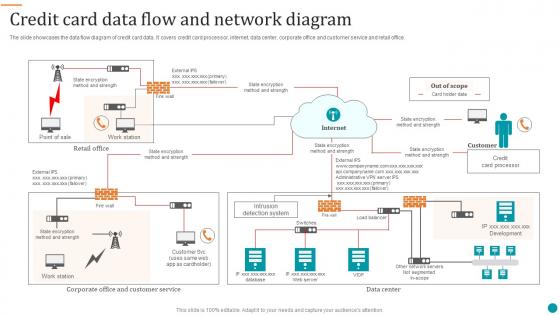
Credit Card Data Flow And Network Diagram




Try Before you Buy Download Free Sample Product
 Impress Your
Audience
 100%
Editable
 Save Hours
of Time


The slide showcases the data flow diagram of credit card data. It covers credit card processor, internet, data center, corporate office and customer service and retail office.
People who downloaded this PowerPoint presentation also viewed the following :
Credit Card Data Flow And Network Diagram with all 6 slides:
Use our Credit Card Data Flow And Network Diagram to effectively help you save your valuable time. They are readymade to fit into any presentation structure.






FAQs for Credit Card Data Flow
So when someone swipes their card, four things happen. First is authorization - basically checking if they've got enough money or credit. Then authentication verifies the card details aren't sketchy. Here's where it gets annoying though - clearing comes next, where transactions get bundled together and sent through card networks. Takes way longer than it should honestly. Finally there's settlement, which is when you actually see the money hit your account (usually 1-3 days). Oh and watch those processing fees - they pile up at each step.
Yeah, payment gateways totally affect both. Speed's mostly about their infrastructure - Stripe and Square usually process in 2-3 seconds, others take like 5-10. Security-wise, most big ones are PCI compliant now (honestly kind of a baseline at this point). The real difference is fraud detection and how they tokenize data. I've found Stripe's faster but PayPal catches sketchy transactions better. Oh, and definitely test a few with small volumes first - what works for one business doesn't always work for another. You'll figure out pretty quick which one vibes with your customers.
So basically your credit card info gets scrambled into gibberish while it's traveling between systems. Hackers can intercept it but they can't actually read or use it - kinda like having a locked box only the payment company can open. The scrambling happens right at checkout, stays protected the whole journey, then gets unscrambled once it hits the secure payment system. Pretty slick honestly, you don't even notice it happening. Just make sure whatever payment system you're looking at has end-to-end encryption. That part's absolutely crucial for staying compliant.
Ugh, so basically your customer goes crying to their bank about a charge, and the bank just yanks the money right back from you. Super annoying part? You still pay that $15-25 fee even if you prove you're right. When it happens, gather everything - receipts, shipping proof, any emails with the customer. Send it all back fast. Too many of these and your payment company might dump you or raise your fees, which sucks. Honestly though, just save everything from day one. Makes fighting these way easier.
So basically credit cards tap into someone's credit line that they pay off later, but debit yanks money straight from their checking account. Credit fees are way higher - like 2-3% because there's more risk for the card company. Debit's usually under 1% which is nice. Your customers won't really notice much difference though. Oh and settlement times are different too - credit takes a day or two while debit can be almost instant. Honestly I'd just compare what your processor charges for each and go with whatever saves you more cash.
Honestly, your processor probably has better rates they won't offer unless you ask - so definitely shop around and negotiate. Try getting customers to use debit instead of credit when you can, the fees are way lower. Those fancy rewards cards are the worst for fees btw. Make sure you're not stuck on tiered pricing either, that stuff adds up fast. Interchange-plus is usually better. Oh, and ask them to actually break down what each transaction type costs you - sometimes seeing the numbers spelled out helps you figure out where you're getting hit the hardest.
Ugh, payment processing has so many ways things can go wrong. Data breaches are probably your biggest nightmare - hackers love targeting stored card info. Then you've got skimming devices and those sneaky man-in-the-middle attacks that grab data while it's traveling to processors. Identity theft is getting crazy sophisticated too, especially with all the social engineering tactics now. Oh, and don't get me started on chargeback fraud - people disputing legit purchases left and right. Honestly, just get PCI DSS compliant ASAP and use tokenization. Trust me on this one.
So mobile payments aren't really replacing credit cards - they just sit on top of your current setup. Apple Pay, Google Pay, whatever... they still run through your same merchant account behind the scenes. You get better security with tokenization though, which is actually pretty neat. Processing fees are about the same, but checkout goes way faster since people don't have to fumble around for their wallet. That usually means more sales honestly. If you haven't set it up yet, definitely do it - most processors make the integration super easy these days.
So PCI DSS is your main thing - that's the global standard for card data security. California has super strict breach notification laws, honestly way more than other states. GDPR in Europe treats payment info as personal data, so there's that whole mess to deal with. Singapore's regulations are tough too if you're doing business there. Each region basically has its own quirks on top of the PCI requirements. Get your PCI compliance sorted first, then dig into whatever local laws apply where you're processing payments. Trust me, you don't want to get blindsided by some random regulatory requirement later.
So basically your bank's watching every purchase you make and comparing it to how you normally spend. If you suddenly buy something expensive in another state when you're usually just grabbing coffee locally, red flags go up instantly. Machine learning picks up on weird patterns - different stores, strange amounts, odd timing. Each transaction gets a risk score. High scores either get blocked automatically or they'll text you that "was this really you?" thing. Honestly it's kind of creepy how well they know your habits, but it works pretty well against scammers.
Contactless payments are everywhere now - tap-to-pay is just the beginning though. AI fraud detection has gotten ridiculously good at catching sketchy transactions without blocking your legit customers all the time. Mobile wallets and fingerprint auth make checkout so much smoother. Real-time payments are finally happening too, which is honestly about time. Blockchain's still finding its footing but cross-border stuff should get way cheaper. Oh and voice payments are coming - Amazon's already testing it so you know everyone else will jump on that bandwagon. If you're doing retail or e-commerce, probably worth keeping an eye on.
So basically, international payments are way more complicated than domestic ones. They have to verify everything with foreign banks, convert currencies, run extra fraud checks - the works. Takes like 1-3 extra days to actually settle, which is annoying when you're waiting for money. Fees are higher too, usually 1-3% more because of all the extra steps involved. Cross-border stuff is just riskier I guess. If you're planning to do a lot of international business, definitely factor in those delays and extra costs when you're thinking about cash flow. It's honestly a bit of a headache but what can you do.
So integrated payment processing connects your POS, accounting, and inventory all together. Everything syncs automatically - no more manual data entry mistakes. Your customers check out faster since you can take any payment type. Real-time transaction data is clutch, and reconciliation happens by itself. Honestly the reporting alone makes it worth it - you'll actually see your sales patterns and cash flow right away instead of hunting through different systems. Oh and definitely shop around for quotes because transaction fees vary like crazy between providers. Trust me on that one.
Your merchant account provider controls pretty much everything - fees, approval rates, how fast you get your money. Some are super picky about who they'll take on. Others accept more businesses but hit you with higher rates. Pricing structures vary too (flat rate vs interchange-plus). Customer service is honestly make-or-break here. The bargain providers usually end up costing you more in frustration, trust me. I'd shop around with 2-3 different ones. Ask about their approval rates for your specific type of business before you commit to anything.
Credit card data is basically a real-time peek into how people spend money. When everyone started shopping online during COVID? Boom - card-not-present transactions went crazy. People get nervous about the economy and suddenly they're making lots of small purchases instead of dropping cash on expensive stuff. It's wild how fast these shifts happen now compared to like 2019. Holiday shopping and back-to-school seasons still create predictable spikes, but honestly you need to check your transaction volumes weekly these days, not monthly. Monthly reports won't catch the rapid changes anymore - things move too fast.
-
Easily Understandable slides.
-
World-class PowerPoint designs that are fully customizable!