


Decision making styles and characteristics in management powerpoint presentation slides




Try Before you Buy Download Free Sample Product
 Impress Your
 Audience
 100%
100% Editable
 Save Hours
 of Time


Incorporate decision-making process PowerPoint presentation slides to solve the business problems by weighing and evaluating the alternatives. Gather the information and examine the alternatives using creatively designed templates on decision making. SlideTeam presents you professionally designed how to make a decision PowerPoint presentation to make it easy for your business meetings. This readymade decision making styles and characteristics In management has slides on decision-making process, contingency plan, evaluation of alternatives, analyse results and more. This PPT sample on how to decide covers everything you need to make the right decision. These decision making styles and characteristics In management presentation templates support a decision maker, manager or even an employee to overcome the roadblocks to ultimately lead to a decision that is necessary for a company to grow. Apart from this, using this presentation deck, you can also discuss various decision-making methods or decision-making models. Get your hands on this content ready decision making PPT templates to avoid the crossroads you may face while taking a business decision.
People who downloaded this PowerPoint presentation also viewed the following :
Content of this Powerpoint Presentation
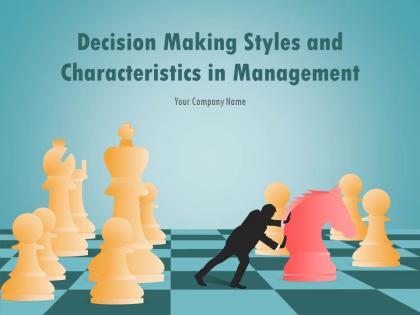
Slide 1: This slide introduces Decision Making Styles and Characteristics in Management. Add your company name and begin.
Slide 2: This is an Agenda slide. State your agendas here.
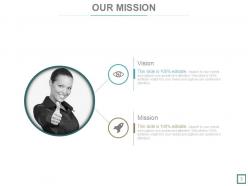
Slide 3: This slide represents OUR MISSION with icon imagery. State your mission and vision here.
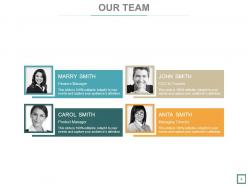
Slide 4: This slide depicts Our Team with name, designation etc. State company/ team specifications and information here.
Slide 5: This is an About Us slide. Introduce company/ team in a professional manner here.
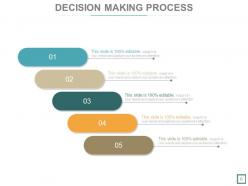
Slide 6: This slide showcases Decision Making Process with text boxes. State its prospects, information etc. here.
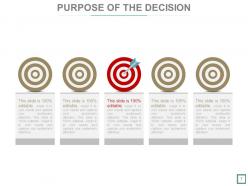
Slide 7: This slide states the Purpose Of The Decision with arrow and target imagery. In this slide one of the target is coloured red which you can use to show your primary purpose and secondary purposes can be shown in the text boxes corresponding to it.
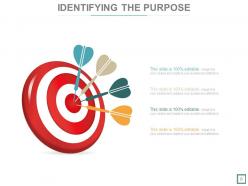
Slide 8: This is Identifying The Purpose slide with target imagery and text boxes to state.
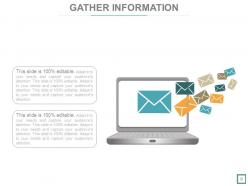
Slide 9: This is Gather Information slide with relevant imagery and text boxes.
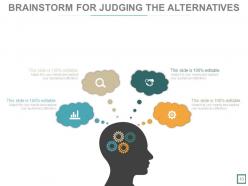
Slide 10: This slide presents Brainstorm For Judging The Alternatives with human brain imagery. Use it as per your requirement.
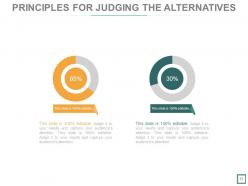
Slide 11: This slide shows Principles For Judging The Alternatives.
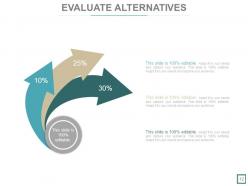
Slide 12: This is Evaluate Alternatives slide with three arrows and text boxes to state your alternatives.
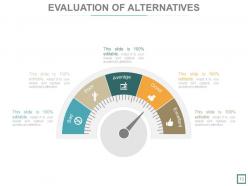
Slide 13: This slide presents Evaluation Of Alternatives with metric imagery. This meter consists of the following five parameters- Bad, Poor, Average, Good, Excellent.
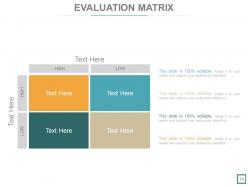
Slide 14: This slide shows Evaluation Matrix with High and Low ranges. Present relative aspects etc. here.
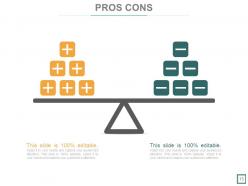
Slide 15: This slide shows PROS CONS with balancing scale imagery. State advantages, disadvantages and relative aspects here.
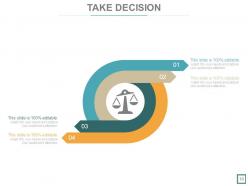
Slide 16: This is Take Decision slide with arrow imagery. State your decisions in the given text boxes.
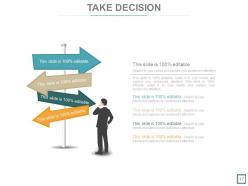
Slide 17: This is also Take Decision slide.
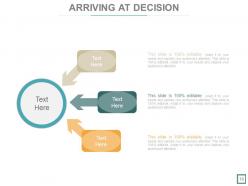
Slide 18: This is Arriving At Decision slide with text boxes. State your final decisions etc. here.
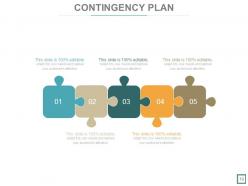
Slide 19: This slide shows a Contingency plan to be implemented.
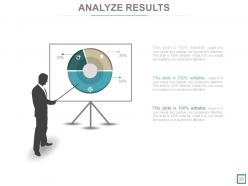
Slide 20: This is Analyze Results slide with relevant imagery.
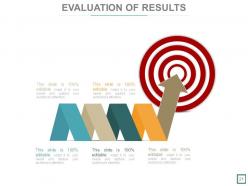
Slide 21: This slide showcases Evaluation of Results with arrow and target imagery.
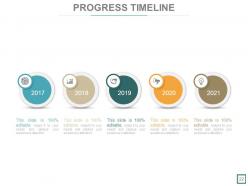
Slide 22: This is a Progress Timeline slide. Present journey, process, milestones etc. here.
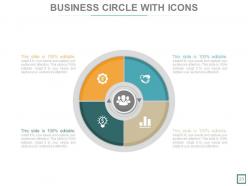
Slide 23: This slide displays Business Circle with Icons. Alter the icons as per requirement.
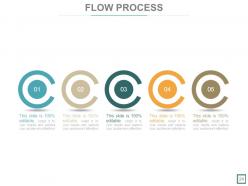
Slide 24: This slide showcases Process Flow to be adopted or followed.
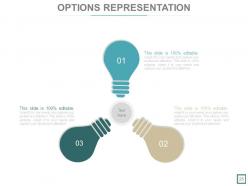
Slide 25: This slide shows Options Representation with three bulb images and text boxes.
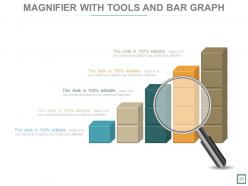
Slide 26: This slide shows Magnifier With Tools and Bar Graph with imagery.
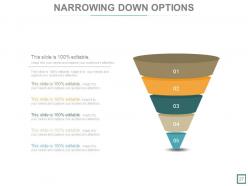
Slide 27: This slide presents Narrowing Down Options in a funnel form.
Slide 28: This slide shows Critical Notes to post important information or to highlight anything specific.
Slide 29: This is a Newspaper slide to show important information etc. You may alter/ modify the slide content as per need.
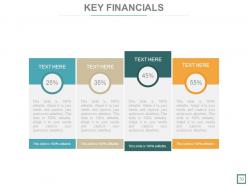
Slide 30: This is Key Financials Score slide. State financial aspects etc. here.
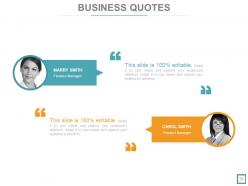
Slide 31: This is a Business Quotes slide. Convey message, beliefs etc. here. You may change the slide content as desired.
Slide 32: This is a Location slide of world map top show global marketing, growth, presence etc.
Slide 33: This slide displays Critical Areas in a Venn diagram form. State information, specifications etc. here.
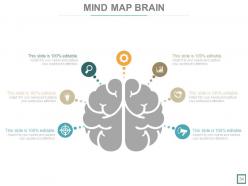
Slide 34: This is a Mind Map Brain image slide to show information, specifications etc.
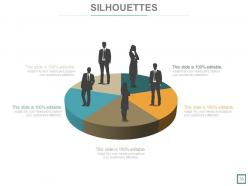
Slide 35: This is a Silhouettes slide to show people-related information etc.
Slide 36: This is a Thank You slide for acknowledgement and ending the presentation.
Decision making styles and characteristics in management powerpoint presentation slides with all 36 slides:
Indulge in the high jinks with our Decision Making Styles And Characteristics In Management Complete Powerpoint Deck With Slides. Involve yourself in fun and frolic.





FAQs for Decision making styles and characteristics in management
There are three main styles you'll run into: autocratic (you decide alone), democratic (team weighs in), and laissez-faire (you delegate the call). Smart managers mix these up based on what's happening. Crisis mode? Go autocratic. Big strategic stuff? Definitely get input from everyone. I swear, the worst managers I've worked with just pick one style and stick with it no matter what. You've also got consensus-building and consultative approaches - honestly there are like a million variations. But really it comes down to matching urgency, your team's knowledge, and how big the stakes are. Figure out your default style first, then force yourself to try the others.
Oh totally, your personality is huge for this stuff. Like if you're super analytical, you'll probably overthink every decision with spreadsheets and data - which isn't always bad but can slow things down. Gut-instinct people decide way faster. Detail folks need to check everything twice first. Risk tolerance is big too - some managers will jump on anything while others need like three backup plans. Extroverts usually want the whole team weighing in, but introverts prefer thinking it through alone first. Just gotta know your style so you can switch it up when needed.
Look, autocratic leadership is all about speed - you can dodge those soul-crushing committee meetings and just make the call. Great for crises or when deadlines are breathing down your neck. But here's the thing: your team will probably feel shut out after a while. You're also missing tons of good ideas from people who actually do the work day-to-day. I've seen it create some serious resentment too. My advice? Use it sparingly. Save the dictator mode for genuine emergencies, then switch back to getting everyone's input on the bigger stuff.
Okay so democratic decision-making is clutch when you need your team actually bought in and you've got time to hear everyone out. Use it for the messy stuff - process changes, big picture planning, anything that'll mess with how people work day-to-day. Also really good when your team knows their domain better than you do (which happens more than we like to admit lol). You need time though - can't rush these discussions. Skip it when things are urgent or you're clearly the expert in the room. Basically, only do it when the collaboration will genuinely make things better, not just for the warm fuzzies.
Match your style to what's happening - crisis mode needs quick calls, but bigger stuff affecting tons of people? Get their input first. Here's what works: be super clear upfront about your process. Tell them "I'm gathering thoughts for 48 hours then making the call" instead of leaving everyone wondering if they actually matter. Honestly, people just want to know where they stand. Set boundaries around when you'll collect feedback, stick to your timeline, then explain your decision in a way that shows you listened. You can still be decisive without making people feel steamrolled.
Honestly, data analytics is a total game-changer for decisions. You get actual evidence instead of just winging it with your gut feelings. Patterns become obvious. You can predict what'll happen and measure risks before jumping in. I mean, intuition still matters, but now you're backing it up with real numbers - which feels way more solid, you know? Just don't get trapped overthinking everything (I've been there). Pick one decision you make all the time and see what data might help. Start there and build up.
Honestly, just watch your team first. Data people need numbers and time - don't rush them or they'll hate it. Creative folks want to brainstorm everything together (can be exhausting but whatever). Some people actually prefer when you just decide and tell them what's up, which is kinda nice sometimes. Oh, and if you've got people from different cultures, heads up - some expect you to be the boss while others want everyone's input. Really depends. Best move? Ask each person straight up how they like being involved in decisions. Then adjust from there.
Oh man, this is huge in management! So in places like the US, decisions happen fast and from the top down. But collectivist cultures? They want everyone's input first - can drag on forever but honestly the buy-in is usually worth it. Communication's weird too. Some cultures read between the lines while others need everything super explicit. And don't get me started on time perspectives - some teams want results yesterday, others are playing the long game. My advice? Just ask your team how they prefer making decisions. Way easier than guessing.
Look, emotional intelligence is huge for leadership - it's like having a superpower honestly. You'll avoid those crappy decisions you make when you're pissed off or overwhelmed because you actually recognize your triggers first. Reading your team becomes way easier too. People rarely say what they're really thinking, so you've got to pick up on the subtext and body language stuff. Oh, and here's what actually works: trust your gut on big calls, but don't ignore the data either. When you can predict how people will react to your decisions instead of just focusing on spreadsheets, that's when you start leading instead of just managing.
Honestly, the biggest thing is getting different people to weigh in - like someone who'll actually push back on your ideas. Set your criteria beforehand so you don't keep changing what "success" looks like (guilty of this myself). Data's obviously important, but sometimes your gut knows something the numbers don't. Map out what could go wrong and have a Plan B ready. Oh, and give yourself actual deadlines or you'll overthink forever. I'd pick one of these to try this week - maybe start with the diverse perspectives thing since that's usually the easiest win.
Honestly, the right tech can speed up team decisions so much. Instead of those painful email threads, try Slack or shared docs where everyone can jump in at once. Miro's great for visual stuff too. Digital dashboards help you see all your options laid out clearly, and polling tools are clutch for quick consensus checks. Don't overthink the tool choice though - I've seen teams waste weeks debating platforms. Just pick something simple that fits how you already work. Start with one tool and add more later if you need them.
Honestly? Start with the "would this look bad in the newspaper" test - it's weirdly effective. Think about whether you're being fair to everyone involved, not just chasing profits. Are you being straight with people about your reasoning? What happens to the folks who get affected by this choice? I always try to respect people's dignity in the process too, even when making tough calls. Oh and definitely write down why you decided what you decided - covers your ass later and proves you actually thought about it. When I'm really stuck, I bounce it off someone I trust first.
Honestly, getting your team involved in decisions just makes everything better. People throw out way more creative stuff when they're not worried about looking stupid. You get all these different backgrounds and experiences mixing together - way more than you'd think of alone. The best part? Once someone helps build a solution, they actually want it to succeed instead of just going along with it. I've noticed diverse groups naturally question things that seem "obvious" and find angles you'd never see coming. Maybe try pulling together like 3-4 people from different departments next time you're stuck on something big. You'll be surprised what comes up.
Honestly, you'll know when your team starts pushing back constantly or when you're the bottleneck for literally everything. Missed deadlines are another dead giveaway. If people zone out in meetings or you keep having to revisit the same decisions over and over - that's your cue. Quick decisions that backfire? Been there, done that. Look, sometimes you need to match your style to what's actually happening. Urgent stuff needs faster calls, complex problems need more input. Just ask your team straight up what would work better - they'll probably have thoughts (and might be relieved you asked).
Look, first you gotta make people feel safe to actually speak up and admit when they screw up. I always try to own my mistakes out loud - sets the tone, you know? Also, figure out who's making what decisions beforehand because nothing's worse than everyone sitting around confused about who's actually in charge. Actively ask the quiet people what they think too. Oh and this is key - celebrate when someone makes a good decision even if it doesn't work out. That's honestly how you get people to keep taking smart risks instead of just playing it safe all the time.
-
Illustrative design with editable content. Exceptional value for money. Highly pleased with the product.
-
Very well designed and informative templates.