

Distribution plan producer agent wholesaler retailer consumer




Try Before you Buy Download Free Sample Product
 Impress Your
 Audience
 100%
100% Editable
 Save Hours
 of Time


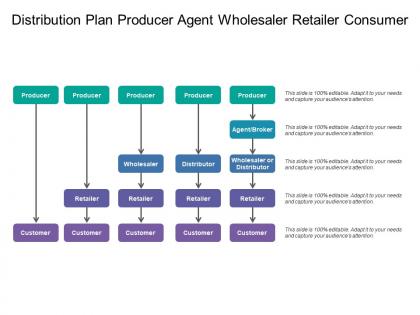
With the Distribution Plan Producer Agent Wholesaler Retailer Consumer PowerPoint model, you can pitch your market plan much more effectively. Make the right choice in selecting the ideal marketing channel by studying through this distribution plan PPT template. Alternative routes between a solo distribution and dual distribution can be consecutively studied on this well-planned PowerPoint layout. This professionally designed PPT theme has multiple flow charts juxtaposed for a comprehensive comparative study between different marketing avenues available to your firm. You can make more efficient timelines and better manage the supply chains after understanding the roles played at different levels of distribution. Producer, broker, wholesaler, retailer, the customer are all cardinal stages of market presence. Make a compelling strategy with our market channel PowerPoint layout. The user can very simply alter the dimensions of any and all elements of this fully customizable PPT template to support their data. This PowerPoint theme includes adequate space to add keynotes about every stage of market study to further enhance your sales pitch.
People who downloaded this PowerPoint presentation also viewed the following :
Distribution plan producer agent wholesaler retailer consumer with all 5 slides:
Confidently counter challenges with our Distribution Plan Producer Agent Wholesaler Retailer Consumer. You will feel fully equipped.



FAQs for Distribution plan producer agent
Primary distribution channels include direct sales, retail partnerships, wholesalers, e-commerce platforms, and agent networks, each offering distinct reach and cost profiles. While direct sales deliver higher margins but limited scale, wholesale and retail partnerships significantly expand market reach at reduced per-unit costs, with many organizations finding that strategic channel combinations ultimately enhance customer accessibility while optimizing operational efficiency.
Businesses can effectively choose distribution channels by analyzing customer preferences, market reach requirements, cost structures, and competitive positioning within their specific industry. Companies in sectors like consumer electronics or fashion often combine direct online sales with retail partnerships, ultimately delivering broader market coverage and enhanced customer experiences while maintaining optimal profit margins.
Technology and digital platforms revolutionize modern distribution channels by enabling real-time inventory management, automated order processing, predictive analytics, and seamless multi-channel integration. Through e-commerce platforms and IoT systems, retailers streamline supply chain operations, enhance customer experiences, and reduce operational costs, while manufacturers gain direct consumer access, ultimately delivering competitive advantage in increasingly digital markets.
Distribution channel efficiency significantly impacts company performance by reducing operational costs, accelerating product delivery, and enhancing customer satisfaction through streamlined logistics and inventory management. Companies with optimized channels often experience improved profit margins, faster market penetration, and stronger competitive positioning, with many retail and manufacturing organizations finding that efficient distribution directly correlates with revenue growth and customer loyalty.
Companies should prioritize clear communication protocols, establish mutually beneficial performance metrics, provide comprehensive partner training, maintain consistent brand standards, and implement regular relationship reviews. These practices streamline operations by fostering transparency, alignment, and accountability, with many organizations finding that strategic partner development ultimately delivers enhanced market reach and competitive advantage.
Cultural differences significantly influence distribution strategies by affecting consumer shopping preferences, retailer relationships, payment methods, and supply chain expectations across international markets. Companies must adapt their approaches through localized partnerships, culturally appropriate marketing channels, and region-specific logistics networks, with many global retailers finding that successful expansion requires balancing standardized operations with cultural customization to deliver competitive advantage.
**INPUT**: What metrics should be used to evaluate the performance of different distribution channels? **OUTPUT**: Key metrics for evaluating distribution channels include sales volume, cost per acquisition, customer lifetime value, market penetration rates, and channel profitability margins. These measurements enable organizations to optimize resource allocation across retail, digital, and partner networks, with many companies finding that multi-channel analytics ultimately deliver enhanced customer experiences and competitive advantage. [Word count: 54 words]
Companies optimize logistics by implementing advanced inventory management systems, leveraging data analytics for demand forecasting, establishing strategic warehouse locations, and integrating automated sorting technologies. Through real-time tracking and AI-powered route optimization, organizations streamline delivery times, reduce operational costs, and enhance customer satisfaction, with many retail and manufacturing companies finding that these improvements deliver significant competitive advantages.
Direct distribution channels enable complete brand messaging control, customer relationship management, and pricing strategy oversight, while indirect channels offer broader market reach and reduced operational costs but limit brand control. This strategic trade-off means companies like Apple balance both approaches, with many finding that hybrid models deliver market expansion and selective brand control, ultimately optimizing customer experiences.
Changes in consumer behavior drives distribution channel evolution by demanding greater convenience, personalization, and seamless omnichannel experiences across touchpoints. Companies increasingly adopt direct-to-consumer models, mobile-first platforms, and flexible fulfillment options like same-day delivery, with retail and e-commerce sectors finding that adaptive distribution strategies ultimately deliver competitive advantage and enhanced customer satisfaction.
Multi-channel distribution strategies face challenges including channel conflict, inventory management complexity, inconsistent customer experiences, increased operational costs, and coordination difficulties across platforms. While these obstacles require strategic planning and investment, organizations increasingly find that streamlined integration systems, clear channel differentiation, and unified customer data management ultimately deliver enhanced market reach and competitive advantage.
Inventory management significantly impacts distribution channel effectiveness by ensuring optimal stock levels, reducing carrying costs, and minimizing stockouts across multiple touchpoints. Proper inventory optimization enables faster order fulfillment, improved customer satisfaction, and enhanced operational efficiency, with many retailers and manufacturers finding that strategic inventory allocation ultimately delivers competitive advantage and streamlined supply chain performance.
Companies face intellectual property protection, contract law compliance, antitrust regulations, product liability standards, and international trade requirements in their distribution strategies. These legal frameworks vary significantly across jurisdictions, with many organizations finding that proactive compliance streamlines market entry, minimizes operational risks, and ultimately delivers competitive advantage through trusted partnerships and regulatory transparency.
Emerging trends include omnichannel integration, direct-to-consumer expansion, AI-powered logistics, sustainable delivery methods, and digital marketplace proliferation. These developments streamline operations by reducing intermediaries, enhancing customer experiences, and optimizing inventory management, with retailers, manufacturers, and e-commerce platforms finding that strategic channel diversification delivers competitive advantages and operational efficiency.
Partnerships with distributors enhance market presence by expanding geographic reach, leveraging established customer relationships, and accessing specialized industry knowledge. Through strategic distributor networks, brands can penetrate new markets more efficiently, reduce direct sales costs, and benefit from localized expertise, with many companies finding that strong distributor partnerships accelerate market entry while minimizing operational complexity.
-
Really like the color and design of the presentation.
-
Informative presentations that are easily editable.