


Employee lifecycle procedure example ppt presentation





Try Before you Buy Download Free Sample Product
 Impress Your
 Audience
 100%
100% Editable
 Save Hours
 of Time


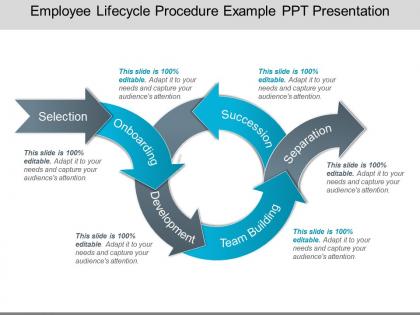
Here is our professionally drafted employee life cycle procedure example PPT presentation template. This life cycle management and capability maturity model depicts the overall corporation of any employee with the organization. From talent acquisition and boarding stage to the exit phase, you can display different kinds of phases that every employee undergoes during their stay in any firm. HR managers use this employee life cycle and engagement design for managing the employee life cycle at their organization. Now, with the help of this comprehensive recruitment life cycle template, you can make others understand the overall employee life cycle in an organization and achieve productive results. Integrate different dynamics of the life cycle to demonstrate every major driving factor. From providing decisive knowledge to your team members to training other professionals, you can perform diverse tasks by taking the help of these high-quality graphics. So, don’t wait for it, download this employee life cycle and engagement PPT template and use it in your presentations. Appropriately answer any criticism with our Employee Lifecycle Procedure Example Ppt Presentation. Be able to display a firm jaw.
People who downloaded this PowerPoint presentation also viewed the following :
Employee lifecycle procedure example ppt presentation with all 5 slides:
Give birth to feelings of charity with our Employee Lifecycle Procedure Example Ppt Presentation. Encourage helping hands to emerge.


FAQs for Employee lifecycle procedure
So basically you've got six main stages to think about. First is attraction - getting people to actually want to work for you. Then recruitment and onboarding to bring them in and get them settled. Development is honestly where most places either crush it or totally mess up - that's your growth and skills investment phase. After that, retention keeps your good people around and happy. Oh, and offboarding at the end so people don't leave hating you. I'd look at your current setup and find the gaps - that's probably where you'll see the biggest wins.
Look, recruitment is basically your first impression with future employees, so it sets the whole vibe. When you're upfront about expectations, culture, all that stuff - you actually get people who fit and stick around. I've watched so many companies just rush to fill positions (which, I get it, pressure's real) but then they're shocked when people bail. Being transparent from day one means candidates know what they're getting into. They show up excited instead of confused. Short version: treat hiring like it's part of keeping people engaged, because it totally is.
Look, onboarding is huge - it literally shapes how new people feel about your company from day one. Get it right and they'll be engaged and confident right off the bat. Screw it up? Good luck fixing that mess later (assuming they don't just bail). The whole thing should help them actually understand their job and connect with everyone, not just be some boring HR checklist. I've seen companies where people are still confused months later because nobody bothered to properly welcome them. Make them feel like they belong and you'll see the difference way beyond those first few weeks.
Honestly, you can't just send the same survey to everyone - what a new hire cares about is totally different from someone who's been there 5 years. Quick pulse checks work great for onboarding stuff like "do you actually understand your role?" Growth-stage people? Ask about career development and whether their manager sucks (because let's be real, bad managers kill retention). For your veterans, focus on purpose and work-life balance. Exit interviews are obvious, but try "stay interviews" with your top performers too. Map out what success looks like at each stage first, then build questions around that.
Growth opportunities are huge - that's what actually keeps people around. Mentoring programs work great, along with stretch assignments and skill workshops. Cross-functional projects are honestly my favorite because people get bored doing the same thing forever (and it breaks down those stupid department walls). Don't wait for annual reviews to talk careers - have those conversations regularly. People want to know where they're going and that you actually care about getting them there. Individual development plans are key, but you've got to follow through. Nothing kills morale like making promises you won't keep.
So with performance management, you gotta switch things up depending on where someone's at. New hires need constant check-ins and clear expectations - like, what do you actually want from me here? Once they're settled, it's all about goals and feedback. This is honestly where most managers either kill it or totally suck. Senior people? They want leadership stuff and career growth, otherwise they'll get bored and leave. Oh, and don't use the same approach for everyone - that never works. You'll just end up frustrating people at different stages.
Dude, culture affects everything - literally every part of hiring and keeping people. Good culture pulls in the right candidates. Bad culture? They won't even bother applying. I've watched talented people quit jobs they loved just because the vibe was off - it's wild how much that matters. New hires either gel with your culture or they're mentally checking out within weeks. It drives how engaged people are, whether they'll grow with you, and if they'll recommend you to their friends or secretly browse LinkedIn during lunch. Seriously, get your culture right first because everything else flows from there.
Do it within the first week after they give notice - they're still somewhat invested but honest since they're already out the door. Don't use their direct manager though, that's awkward. Get someone neutral to ask open-ended stuff like what made them leave and what could've been different. People will actually tell you the truth when they're leaving! Document everything properly and look for patterns in the feedback. I learned this the hard way - the themes that keep coming up are pure gold for fixing your retention problems. Way better than those generic surveys nobody fills out honestly.
Dude, just map out where your HR processes are most painful right now - that's your starting point. HRIS systems can handle all that boring onboarding paperwork automatically. Learning management platforms work great for employee development, and feedback tools let you do performance check-ins without the awkward formal meetings. Mobile apps are clutch because people want to check their benefits or career stuff from their phones anyway. Oh, and make sure whatever tools you pick actually integrate with each other. Nothing's worse than having five different systems that don't talk. Honestly, anyone still doing paper forms in 2024 is just making life harder than it needs to be.
So for tracking this stuff, start with your basic recruiting metrics - how long it takes to hire someone and whether they actually accept your offers. Then look at onboarding completion rates (honestly, most companies are terrible at this) and how quickly new people get productive. Engagement scores matter too, plus internal mobility and promotion rates - you want to see if people are actually growing. Exit interviews are huge, especially tracking "regrettable losses" since those sting the worst. The trick is connecting all these dots together instead of looking at each metric separately. They'll show you exactly where your employee experience is falling apart.
Dude, just ask people what they actually need right now instead of guessing. New hires obviously want onboarding stuff and job basics. Your mid-level people? They're hungry for leadership training and chances to work across different departments. But here's what kills me - most places just blast everyone with the same boring workshops. Senior folks usually want to mentor others or share what they know, not sit through another PowerPoint. I'd start with a quick survey about development goals. Way better than throwing random training at people and hoping something sticks.
Honestly, the biggest mistake is thinking transitions just happen on their own. They don't. Managers constantly forget to do proper handoffs when someone starts, or they'll promote people without changing what's expected of them. And don't get me started on offboarding - I swear some people just vanish from Slack like they never existed. Here's the thing though: each stage connects to the next one. How you onboard someone totally affects how they'll do in reviews later. Make checklists for everything and assign someone to own each step. Otherwise you're just crossing your fingers and hoping it works out.
Honestly, feedback systems are only as good as what you actually do with them. I'd start with onboarding surveys since new hires are brutally honest about what's broken. Then add regular 1:1s and project retrospectives. Exit interviews too, though people are already gone by then so... limited help there. The real trick? Actually fix stuff based on what people tell you. Nothing kills trust faster than asking for input then ignoring it completely. Review feedback themes every quarter and make visible changes. Employees notice when their suggestions turn into real improvements. Don't try to build everything at once - nail one area first, then expand from there.
So basically you've gotta follow employment laws through the whole process - hiring, managing people, firing, all of it. Don't ask sketchy questions during interviews (seems obvious but you'd be surprised). Pay people correctly, handle overtime right, document literally everything because that'll save your butt later. Honestly, most managers suck at the documentation part. Be consistent with disciplinary stuff and follow your own policies. When people quit or get fired, deal with final paychecks and benefits properly. Oh and if you're ever unsure about something, just ask HR or a lawyer before you mess up.
So D&I stuff basically touches your whole hiring process - job posts, interviews, onboarding, the works. You'll want blind resume reviews, diverse interview panels, mentorship programs. Even your exit interviews should ask about this. The point is cutting out bias at every step so you're not just checking boxes. Honestly, most companies mess this up by trying to fix everything at once. Pick one area first - like scrubbing your job descriptions for weird exclusionary language (you'd be surprised what's in there). Then move to the next stage. Way more manageable that way.
-
Topic best represented with attractive design.
-
Best Representation of topics, really appreciable.
-
Use of icon with content is very relateable, informative and appealing.
-
Very unique and reliable designs.