


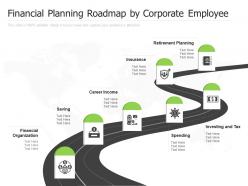
Financial planning roadmap by corporate employee





Try Before you Buy Download Free Sample Product
 Impress Your
 Audience
 100%
100% Editable
 Save Hours
 of Time


Our Financial Planning Roadmap By Corporate Employee are topically designed to provide an attractive backdrop to any subject. Use them to look like a presentation pro.
People who downloaded this PowerPoint presentation also viewed the following :
Financial planning roadmap by corporate employee with all 2 slides:
Use our Financial Planning Roadmap By Corporate Employee to effectively help you save your valuable time. They are readymade to fit into any presentation structure.
FAQs for Financial planning roadmap
Okay so there are basically six things you need for a good financial plan: budgeting/cash flow, emergency fund (like 3-6 months of expenses), paying off debt, retirement stuff, insurance, and diversifying investments. Super overwhelming right? Don't stress about doing it all at once though. I'd start with just tracking where your money goes and building up that emergency fund first - seriously, most people don't even have that covered. Once you've got those down, you can slowly add the other pieces. The retirement planning part always trips me up too, but baby steps work better than trying to be perfect from day one.
Okay so first thing - write down everything you want money-wise. Emergency fund, vacation, whatever. Break it into timelines: under 2 years, 2-5 years, and 5+ years. High-interest debt comes first though, that stuff's bleeding you dry daily. Emergency fund beats investing, investing beats fancy stuff. Here's what really works - get specific with actual numbers and dates. Like "save $10k by December" instead of just "save more." That vague goal thing never works for me. Oh and medium-term goals are honestly the trickiest to prioritize sometimes.
Honestly, you can't hit any financial goals without knowing where your money actually goes first. Track everything for a month - even that random coffee run (trust me, those add up). Once you see the real picture, you'll spot where you can cut back. Like, maybe you're spending $200 on takeout when you thought it was $100. Your budget shows you what's possible. Can't invest $500 monthly if you don't have $500 sitting around, right? It's literally your roadmap for everything - emergency fund, retirement, paying off debt. Start there.
Honestly, every 6 months is ideal but at minimum do it yearly. Life throws curveballs constantly - job changes, relationships, kids, whatever. I totally screwed myself by ignoring mine for like two years and had to completely restart my goals. Super annoying. Set a phone reminder tied to something you'll actually remember - your birthday works, or tax time. Even just 30 minutes of looking things over can prevent you from realizing you're way off track later. Trust me on this one.
Honestly, most people mess up by being way too vague about their goals. Like saying "I want to retire comfortably" instead of "I need $2 million by 65." Also, they forget life happens - you might get married, divorced, have kids, whatever. Don't set crazy unrealistic timelines either. Oh and emergency funds! So many people obsess over retirement savings but have literally nothing saved for when their car dies. That's just dumb. Inflation's another killer - $50k today won't buy much in 20 years. Set real numbers, review quarterly, and accept that you'll probably need to adjust things as life gets weird.
Honestly, these apps are game-changers for budgeting. You can link all your accounts and it'll automatically sort your spending into categories - no more spreadsheet hell. The coolest part? You can play around with different scenarios, like "what if I put an extra $200 toward my student loans" and see the actual impact. Sure, the notification reminders can be super annoying (I turned mine off after a week). But having everything update in real-time is clutch. I'd say start small - just connect your checking account first. You'll be shocked at where your money actually goes.
So first things first - grab any 401k match your company offers because that's literally free money sitting there. After that, you'll want to figure out roughly how much you need (most people say around 70-80% of what you make now). IRAs are great too once you've maxed the match. Your age matters a ton here - younger means you can take bigger risks. Don't forget Social Security will help, and honestly I always forget about pensions but check if you have one. Just review everything once a year and adjust when life gets crazy.
Build your emergency fund first - 3-6 months expenses. Get proper insurance too (health, disability, life) even though it's boring as hell. Diversify your investments across different stuff so you're not putting all eggs in one basket. Your job stable? Maybe think about a side hustle just in case. The whole point is figuring out what could mess up your money situation and preparing for it ahead of time. I learned this the hard way when I didn't have enough saved during my last job switch. Don't skip the basics for flashy investments.
Dude, you absolutely need an emergency fund before doing anything else with your money. Like 3-6 months of expenses saved up. Car breaks down? Job disappears? Without that cushion, you're stuck draining your 401k or maxing out credit cards - which is honestly the worst feeling ever. I made that mistake once and it set me back like two years. Look, if the full amount seems impossible right now, just start with $1,000. Better than zero, right? It's basically insurance so your other financial goals don't get completely wrecked when life happens.
Honestly, the biggest thing is being super specific about your goals - actual dollar amounts and dates, not just "save for retirement someday." Once you know that, match your investments to the timeline. Need cash in 2 years? Don't touch growth stocks, they're way too unpredictable. Long-term stuff like retirement? Go aggressive. Short-term goals need boring, safe options you can access quickly. I learned this the hard way actually. Create separate buckets for each goal instead of throwing everything together. Check in every few months to rebalance and you'll be good.
Dude, inflation is gonna crush that $100k retirement dream if you're not careful. Think about it - remember when gas was like $2? Now look at us. Your money loses buying power every single year, usually around 2-4%. So whatever you think you need for retirement, probably double it honestly. Stock market and real estate have historically beaten inflation, which is why just saving cash is kinda pointless long-term. I learned this the hard way watching my savings account basically go nowhere for years. You gotta make your money work harder than inflation or you're screwed.
Okay so basically you gotta break down those college costs into smaller monthly chunks or you'll go insane looking at the total numbers. Start with a 529 plan - they're tax-free for education stuff which is clutch. Work backwards from when your kid graduates high school to figure out how much to save monthly. Earlier is better since compound interest does most of the work for you. I spent way too much time researching different state 529 options last year but it's worth it. Each kid needs their own timeline obviously. Just pick one and start this week honestly.
Okay so first thing - grab a spreadsheet and dump all your debt info in there. Balances, interest rates, minimum payments, the whole mess. You've got two main options: pay off highest interest rates first (saves more money) or knock out smallest balances first (feels better psychologically). Honestly, I'm team snowball because those quick wins keep you going. Set up autopay so you can't bail on yourself when Netflix drops a new series. Pick one method though - don't bounce around or you'll just confuse yourself and lose momentum.
Don't just think about taxes in April - they should factor into basically every money decision you make. Roth vs traditional 401k? Tax implications. Selling investments? Consider tax-loss harvesting first. The timing of big purchases or income bumps matters way more than most people realize, honestly. Map out where you stand tax-wise right now, then build strategies around different scenarios as your income changes. It's annoying how much this stuff affects your bottom line, but being smart about it can literally save you thousands. Oh, and different investment types get taxed differently too - worth looking into.
So there's a bunch of ways to go about this. Fee-only planners are probably your best move - they don't make money selling you stuff, just charge for advice. Check NAPFA or the CFP Board site to find them. Robo-advisors like Betterment are way cheaper but pretty basic. Banks do planning too, though they'll definitely push their own products on you. Oh and credit unions sometimes have decent options. I'd say figure out your budget first and whether you need the full deal or just someone to handle investments. That'll narrow it down quick.
-
Thanks for all your great templates they have saved me lots of time and accelerate my presentations. Great product, keep them up!
-
Presentation Design is very nice, good work with the content as well.
-
Content of slide is easy to understand and edit.