


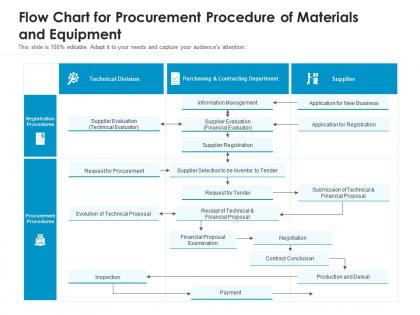
Flow chart for procurement procedure of materials and equipment




Try Before you Buy Download Free Sample Product
 Impress Your
 Audience
 100%
100% Editable
 Save Hours
 of Time


Our Flow Chart For Procurement Procedure Of Materials And Equipment are topically designed to provide an attractive backdrop to any subject. Use them to look like a presentation pro.
People who downloaded this PowerPoint presentation also viewed the following :
Flow chart for procurement procedure of materials and equipment with all 2 slides:
Use our Flow Chart For Procurement Procedure Of Materials And Equipment to effectively help you save your valuable time. They are readymade to fit into any presentation structure.
FAQs for Flow chart for procurement procedure of
Key stages in a procurement process flow chart include needs identification, vendor sourcing, proposal evaluation, contract negotiation, purchase order creation, goods receipt, and invoice processing. These stages streamline organizational purchasing by establishing clear approval workflows, ensuring compliance with budgetary controls, and maintaining vendor relationship management, ultimately delivering cost efficiency and procurement transparency across departments.
A flow chart improves procurement clarity by visualizing each step, decision point, and approval pathway, eliminating confusion about roles, timelines, and dependencies. Through clear visual mapping, organizations streamline vendor evaluations, accelerate approval cycles, and reduce process bottlenecks, with many companies finding that standardized workflows enhance compliance and ultimately deliver faster procurement outcomes.
Microsoft Visio, Lucidchart, SmartDraw, Creately, and Draw.io are highly effective for creating procurement process flowcharts, offering specialized templates and collaborative features. These platforms streamline chart development through drag-and-drop interfaces, real-time collaboration, and integration capabilities, with many organizations finding that visual procurement mapping enhances transparency, reduces cycle times, and improves stakeholder alignment across departments.
Ensuring regulatory compliance within procurement flow charts requires embedding mandatory approval checkpoints, automated compliance verification systems, and documented audit trails at each stage. These controls streamline adherence to industry regulations, government standards, and internal policies, with many organizations finding that integrated compliance frameworks significantly reduce risk exposure while accelerating procurement cycles and enhancing operational transparency.
Supplier evaluation ensures procurement teams select vendors based on quality standards, cost-effectiveness, delivery reliability, financial stability, and compliance requirements. This critical assessment phase enables organizations to minimize supply chain risks, negotiate better contract terms, and establish strategic partnerships that ultimately deliver consistent product quality, reduced operational costs, and enhanced competitive advantage across their procurement operations.
Procurement process flow charts enhance stakeholder communication by providing visual clarity, standardizing terminology, identifying role responsibilities, and creating shared understanding across departments. These visual tools streamline discussions between procurement teams, suppliers, finance, and management, while reducing miscommunication and accelerating decision-making, ultimately enabling organizations to maintain transparent, efficient procurement operations.
Common pitfalls include overcomplicating the workflow, omitting key approval stages, failing to define clear decision points, neglecting supplier evaluation criteria, and ignoring compliance checkpoints. These oversights can create bottlenecks, compliance risks, and inefficient resource allocation, with many organizations finding that streamlined, well-defined procurement charts ultimately enhance transparency and accelerate purchasing cycles.
Risk management integrates into procurement through supplier assessment, contract evaluation, compliance monitoring, and contingency planning at each workflow stage. Organizations embed risk controls by conducting due diligence during vendor selection, establishing performance metrics throughout contract execution, and maintaining backup suppliers, ultimately delivering supply chain resilience and operational continuity.
Procurement process flow charts track metrics including cycle time, cost per purchase order, supplier performance ratings, approval bottlenecks, and compliance adherence rates. These measurements enable organizations to streamline vendor negotiations, reduce processing delays, and enhance budget accuracy, with many companies finding that systematic tracking delivers significant cost savings and operational efficiency across their supply chains.
Automation streamlines procurement workflows by digitizing approvals, automating vendor selection, and eliminating manual data entry across each flowchart stage. Through AI-powered systems, organizations accelerate purchase requisitions, enhance supplier evaluations, and reduce processing times from weeks to days, while minimizing errors and delivering significant cost savings and operational efficiency.
Visual representation of procurement processes delivers enhanced transparency, streamlined communication, faster onboarding, improved compliance tracking, and clearer identification of bottlenecks. These visual tools enable organizations to reduce processing times, minimize errors, and enhance stakeholder understanding, with many companies finding that flowcharts ultimately accelerate decision-making while ensuring consistent procurement standards across departments.
Flow charts help identify procurement bottlenecks by visualizing each process step, approval stage, and decision point, making delays and inefficiencies immediately apparent through mapping workflows, tracking cycle times, and highlighting redundant activities. Through systematic analysis, organizations can pinpoint where requests stall, streamline vendor evaluations, and eliminate unnecessary approvals, ultimately reducing procurement cycles and enhancing operational efficiency across departments.
A procurement flow chart for global supply chains should include supplier qualification and selection, multi-tier approval workflows, international compliance checkpoints, currency and contract management, risk assessment protocols, and cross-border logistics coordination. These elements streamline operations by standardizing processes across regions, ensuring regulatory compliance, and enabling real-time visibility, with many multinational organizations finding enhanced supplier relationships and reduced procurement cycle times.
Organizations can customize procurement flow charts by adapting approval hierarchies, adjusting vendor evaluation criteria, incorporating industry-specific compliance requirements, and modifying budget thresholds to match their operational scale. Manufacturing companies often add quality control checkpoints while financial services integrate risk assessment stages, ultimately streamlining processes that align with company policies, regulatory demands, and strategic procurement objectives.
Technology revolutionizes procurement by automating workflows, enabling real-time tracking, integrating supplier databases, and providing advanced analytics for strategic decision-making. Through AI-powered sourcing platforms and cloud-based systems, organizations streamline vendor management, accelerate approval cycles, and enhance cost transparency, ultimately delivering faster procurement cycles and significant operational efficiency gains.
-
Qualitative and comprehensive slides.
-
Innovative and attractive designs.
-
Great product with effective design. Helped a lot in our corporate presentations. Easy to edit and stunning visuals.
-
Easy to edit slides with easy to understand instructions.
-
Colors used are bright and distinctive.
-
Informative design.
-
Great quality product.
-
Very unique and reliable designs.
-
Easily Understandable slides.