


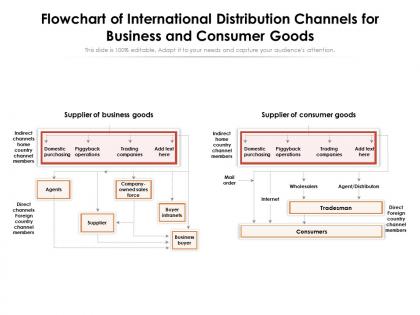
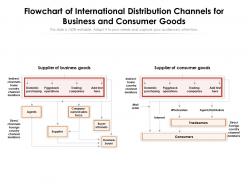
Flowchart of international distribution channels for business and consumer goods




Try Before you Buy Download Free Sample Product
 Impress Your
 Audience
 100%
100% Editable
 Save Hours
 of Time


Our Flowchart Of International Distribution Channels For Business And Consumer Goods are topically designed to provide an attractive backdrop to any subject. Use them to look like a presentation pro.
People who downloaded this PowerPoint presentation also viewed the following :
Flowchart of international distribution channels for business and consumer goods with all 2 slides:
Use our Flowchart Of International Distribution Channels For Business And Consumer Goods to effectively help you save your valuable time. They are readymade to fit into any presentation structure.
FAQs for Flowchart of international distribution channels for business
Key components include market research and localization, strategic partner selection, regulatory compliance frameworks, logistics optimization, and pricing strategies tailored to local markets. These elements work together by ensuring products reach target audiences efficiently while maintaining profitability, with many multinational companies finding that integrated distribution networks ultimately deliver enhanced market penetration and sustainable competitive advantage across diverse regions.
Cultural differences significantly impact international distribution channels through varying consumer behaviors, purchasing preferences, relationship-building approaches, and regulatory expectations across markets. These cultural nuances influence everything from channel partner selection to customer engagement strategies, with many global companies finding that adapting their distribution methods to local cultural contexts ultimately delivers stronger market penetration and sustainable competitive advantage.
Technology revolutionizes global distribution networks by enhancing supply chain visibility, automating inventory management, enabling real-time tracking, and facilitating predictive analytics for demand forecasting. Through AI-powered logistics platforms and IoT sensors, companies streamline cross-border operations, reduce shipping costs, and improve delivery accuracy, with many multinational retailers finding significantly enhanced customer satisfaction and competitive advantage.
Companies effectively manage international logistics challenges by establishing local partnerships, implementing robust tracking systems, diversifying transportation modes, and maintaining strategic inventory buffers across regions. Through advanced supply chain technologies, organizations streamline customs processes, optimize route planning, and enhance visibility, with many multinational retailers and manufacturers finding that regional distribution centers significantly reduce delivery times while improving cost efficiency.
Businesses should consider partner reputation, market knowledge, financial stability, distribution network reach, and cultural compatibility when selecting international distribution partners. These factors enable organizations to streamline market entry, enhance customer experiences, and minimize operational risks, with many companies finding that strategic partnerships in retail, manufacturing, and technology sectors ultimately deliver faster market penetration and sustained competitive advantage.
Regulations and compliance significantly influence international distribution channel selection by determining product standards, licensing requirements, import restrictions, and local partnership mandates. Industries like pharmaceuticals, financial services, and food products often require specialized distributors with regulatory expertise, compliance infrastructure, and established government relationships, ultimately enabling faster market entry while minimizing legal risks and operational delays.
Direct international distribution offers complete control over brand positioning, customer relationships, and profit margins, while enabling faster market response and quality assurance. However, it requires significant capital investment and local market expertise, whereas indirect methods through distributors or agents reduce costs and leverage local knowledge, though with less control over pricing and customer experience, making the choice dependent on market complexity and resource availability.
Companies can adapt their marketing strategies by customizing messaging for local preferences, partnering with regional distributors who understand cultural nuances, and adjusting pricing models to match local market conditions. Through strategic localization, businesses streamline market entry while maintaining brand consistency, with many retail and technology companies finding that flexible distribution partnerships ultimately deliver faster market penetration and sustained competitive advantage.
Key metrics for evaluating international distribution networks include delivery times, cost per shipment, inventory turnover, customer satisfaction scores, and market penetration rates. These performance indicators enable businesses to optimize logistics efficiency, reduce operational costs, and enhance customer experiences across different regions, with many multinational companies finding that regular metric analysis delivers competitive advantage and sustainable growth in global markets.
Common pitfalls include inadequate market research, poor partner selection, insufficient local regulatory compliance, cultural misunderstandings, and weak supply chain coordination. These challenges often result in costly delays, damaged brand reputation, and failed market entry, with many businesses finding that thorough due diligence and strategic local partnerships significantly minimize risks while accelerating successful international expansion.
Businesses leverage e-commerce platforms in international distribution by accessing global markets instantly, reducing physical infrastructure costs, and enabling direct customer relationships across borders. These platforms streamline cross-border logistics, payment processing, and regulatory compliance, with many retailers finding that marketplace integration delivers faster market entry, enhanced customer data insights, and significant operational efficiency gains.
Trade agreements significantly impact international distribution channels by reducing tariffs, streamlining customs procedures, harmonizing regulatory standards, and enabling preferential market access for member countries. These frameworks enhance supply chain efficiency and reduce compliance costs, with many manufacturers and retailers finding that strategic distribution partnerships within trade bloc regions deliver faster market entry, lower operational expenses, and improved competitive positioning across multiple international markets.
Businesses ensure consistent international product quality through standardized manufacturing processes, rigorous supplier certification programs, comprehensive quality management systems, and regular cross-market audits. Through strategic partnerships with certified local suppliers and implementation of global quality standards, companies streamline operations while maintaining brand integrity, ultimately delivering uniform customer experiences and competitive advantage across diverse markets.
Branding creates trust and consistency across international distribution channels, enabling partners to confidently represent products while ensuring unified customer experiences regardless of location. Strong brand identity streamlines partner onboarding, reduces marketing costs, and enhances channel performance, with many global retailers finding that recognized brands deliver faster inventory turnover and higher profit margins.
Businesses should approach international pricing through market research, competitive analysis, local purchasing power assessment, and regulatory compliance considerations. This strategic combination enables companies to balance profitability with market penetration, with many organizations finding that localized pricing models, currency hedging strategies, and value-based positioning ultimately deliver sustainable market entry and long-term competitive advantage.
-
Easily Editable.