

FMEA Method For Evaluating A Process Powerpoint Presentation Slides




Try Before you Buy Download Free Sample Product
 Impress Your
 Audience
 100%
100% Editable
 Save Hours
 of Time


FMEA is a technique that various companies use to detect product failures or defects. It is a qualitative and highly structured process used by analysts looking to reduce the chances of faults by detecting problems and their possible repercussions. Here is a professionally designed template on FMEA Method for Evaluating a Process that is useful for the corporates specifically production companies that want to identify potential risks regarding occupational and health hazards and environmental hazards. This can also be used by the companies that have just initiated a new process and want to identify the potential threats or failure in the process. The deck covered the details related to sections such as FMEA process overview, team structure and responsibilities, possible effects and cause of the failure; Severity, Occurrence, and Detection SOD ranking, risk assessment, action steps to eliminate the failure, RPN Risk priority number calculations, etc. The presentation covers critical steps involved in the process, analysis of the process, fundamental failure modes, potential effects of failure mode, FMEA scoring regarding SOD, etc. Customize this 100 percent editable template now.
People who downloaded this PowerPoint presentation also viewed the following :
Content of this Powerpoint Presentation
Slide 1: This slide introduces FMEA Method for Evaluating a Process. State Your Company Name and begin.
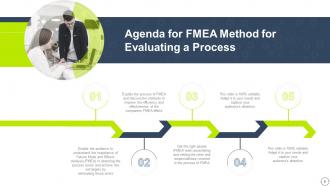
Slide 2: This slide states Agenda of the presentation.
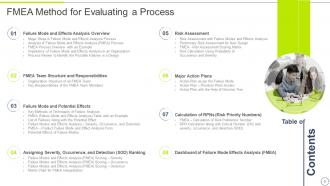
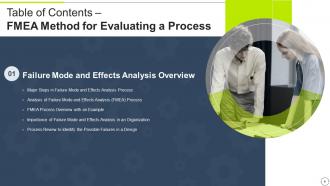
Slide 3: This slide presents Table of Content for the presentation.
Slide 4: This slide depicts title for five topics that are to be covered next in the template.
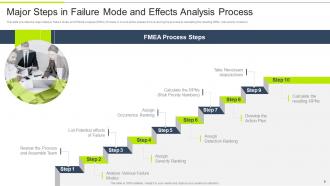
Slide 5: This slide provides the major steps in Failure Mode and Effects Analysis (FMEA) Process.
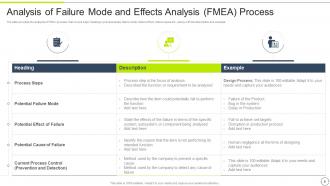
Slide 6: The slide provides the analysis of FMEA process, that covers major headings (process steps, failure mode, failure effect, failure cause etc.).
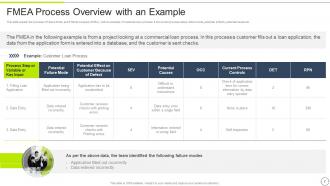
Slide 7: This slide explain the process of Failure Mode and Effects Analysis (FMEA), with an example of customer loan process.
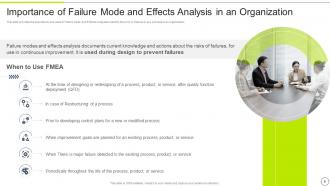
Slide 8: This slide provides the importance and uses of Failure Mode and Effects Analysis to identify the error or failures in any process in an organization.
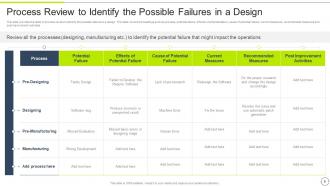
Slide 9: This slide provides the table of process review to identify the possible failures in a design.
Slide 10: This slide depicts title for two topics that are to be covered next in the template.
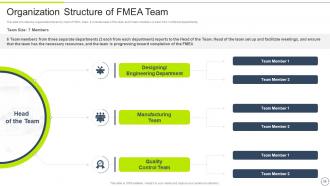
Slide 11: This slide provides the organization/hierarchy chart of FMEA Team.
Slide 12: This slide provides the image, name, designation, and key roles and responsibilities of the team members of FMEA team.
Slide 13: This slide depicts title for six topics that are to be covered next in the template.
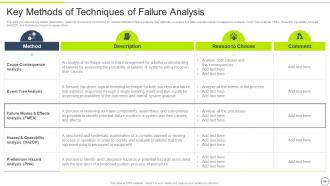
Slide 14: This slide provides the key details (description, reason to choose and comments) for various methods of failure analysis.
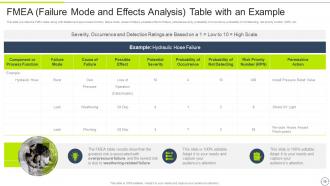
Slide 15: This slide provides the FMEA table along with details such as process function, failure mode, cause of failure, etc.
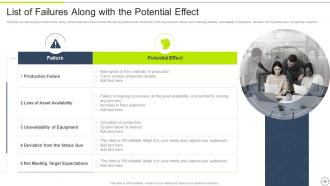
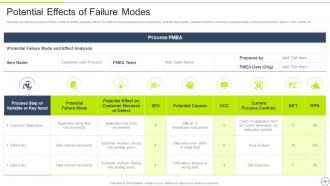
Slide 16: This slide provides the list of failure mode, along with the potential effect of those failures.
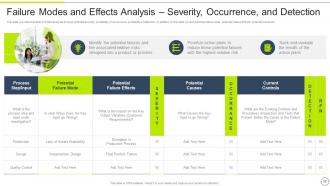
Slide 17: This slide provides the table of effect analysis through potential severity, probability of occurrence, probability of detection.
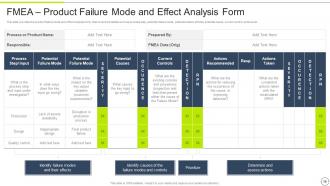
Slide 18: This slide provides the product failure mode and effect analysis form, that covers the details such as process step, potential failure mode, etc.
Slide 19: This slide provides the process of FMEA in order to identify potential effects.
Slide 20: This slide depicts title for four topics that are to be covered next in the template.
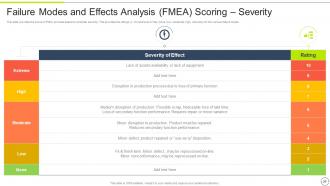
Slide 21: This slide provides the score of FMEA process based on potential severity.
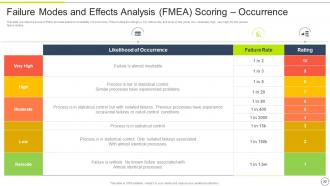
Slide 22: This slide provides the score of FMEA process based on probability of occurrence.
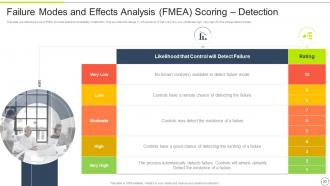
Slide 23: This slide provides the score of FMEA process based on probability of detection.
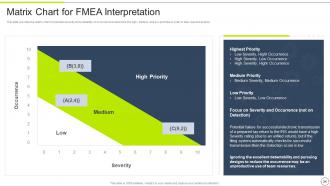
Slide 24: This slide provides the matrix chart of potential severity and probability of occurrence to determine the high, medium and low priorities.
Slide 25: This slide depicts title for four topics that are to be covered next in the template.
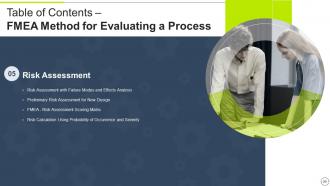
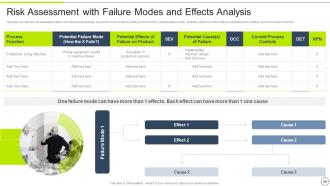
Slide 26: This slide provides the risk assessment table with failure mode analysis.
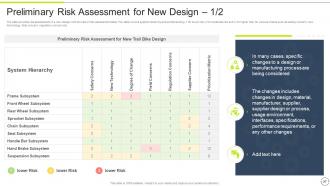
Slide 27: The slide provides risk assessment of a new design with the help of risk assessment table.
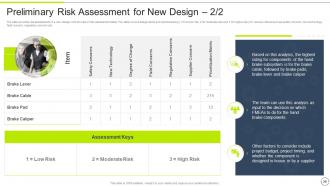
Slide 28: The slide provides risk assessment of a new design with the help of risk assessment table.
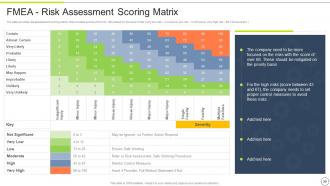
Slide 29: The slide provides risk assessment scoring matrix, that provides scores (from 0 to 100) based on the level of risk.
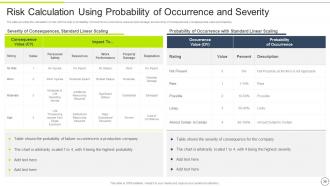
Slide 30: The slide provides the calculation of risk with the help of probability of occurrence and severity of consequences.
Slide 31: This slide depicts title for three topics that are to be covered next in the template.
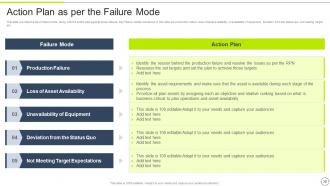
Slide 32: This slide provides the list of failure mode, along with the action plan against those failures.
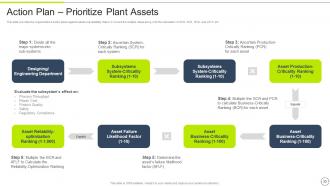
Slide 33: This slide provides the organization’s action plans against asset unavailability failure.
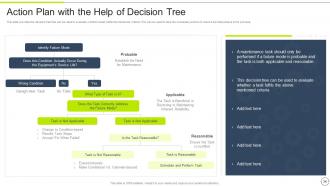
Slide 34: This slide provides the decision tree that can be used to evaluate whether a task fulfils the mentioned criteria.
Slide 35: This slide depicts title for two topics that are to be covered next in the template.
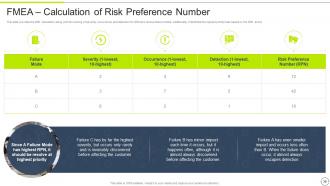
Slide 36: This slide provides the RPN calculation along with the ranking of severity, occurrence, and detection for different various failure modes.
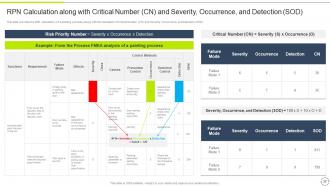
Slide 37: This slide provides the RPN calculation (of a painting process) along with the calculation of Critical Number (CN) and Severity, Occurrence, etc.
Slide 38: This slide depicts title for three topics that are to be covered next in the template.
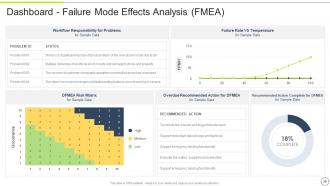
Slide 39: This slide presents Dashboard - Failure Mode Effects Analysis (FMEA).
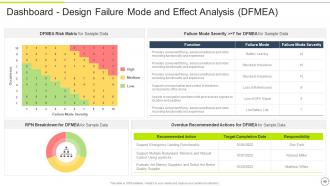
Slide 40: This slide exhibits Dashboard - Design Failure Mode and Effect Analysis (DFMEA).
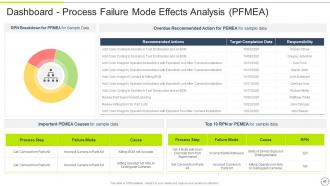
Slide 41: This slide illustrates Dashboard - Process Failure Mode Effects Analysis (PFMEA).
Slide 42: This slide displays Icons for FMEA Method for Evaluating a Process.
Slide 43: This slide is titled as Additional Slides for moving forward.
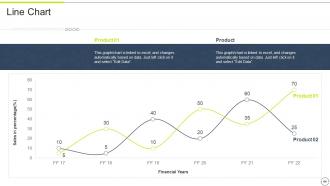
Slide 44: This slide describes Line chart with two products comparison.
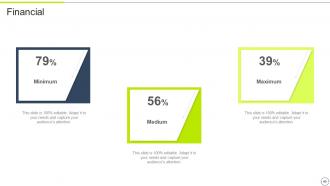
Slide 45: This is a Financial slide. Show your finance related stuff here.
Slide 46: This slide presents Roadmap with additional textboxes.
Slide 47: This is a Timeline slide. Show data related to time intervals here.
Slide 48: This slide contains Puzzle with related icons and text.
Slide 49: This slide shows Post It Notes. Post your important notes here.
Slide 50: This slide depicts Venn diagram with text boxes.
Slide 51: This is a Thank You slide with address, contact numbers and email address.
FMEA Method For Evaluating A Process Powerpoint Presentation Slides with all 56 slides:
Use our FMEA Method For Evaluating A Process Powerpoint Presentation Slides to effectively help you save your valuable time. They are readymade to fit into any presentation structure.









FAQs for FMEA Method For Evaluating A Process
FMEA is basically about catching problems before they bite you in the ass. You go through your process step-by-step asking "what could break here?" then rate how bad it'd be and how likely. Honestly, it's kind of like being a professional worrier - but in a good way! The math gives you priority numbers so you know which fires to put out first. Most teams jump around randomly fixing stuff, but this makes you think ahead instead. I'd start with whatever process scares you most. Way cheaper than dealing with disasters later, trust me.
Don't just do FMEA once and call it done - that's where most teams screw up. Run it during concept phase first when fixes are still cheap. Then hit it again during detailed design, prototyping, and right before you launch. Honestly, I've watched so many projects get burned by treating it like a checkbox exercise. Your FMEA needs to be a living doc that grows with the product. Update it whenever you change designs or find new failure modes in testing. Oh, and build those FMEA reviews right into your project milestones from the start. Makes it way less painful later.
So Design FMEA is all about what could break in your actual product - like how parts might fail or interact badly. Process FMEA is different - it's about screwups during manufacturing. Here's how I think about it: Design FMEA asks "what if this component fails?" Process FMEA asks "what if we mess up making it?" You'll want to do Design FMEA first, way early when you're still sketching out specs. Then tackle Process FMEA later when you're planning production. Honestly, catching design issues early will save you so much more money than fixing manufacturing problems down the line. The timing really makes a huge difference in your budget.
So you'll want a 1-10 scale for each one, but make sure your whole team agrees on what the numbers actually mean first. Severity is basically how badly it screws things up for customers - 1 is "meh, whatever" and 10 is "oh shit, everything's broken." Occurrence tracks how often it happens, detection is whether you'll catch it before customers do. Getting everyone on the same page about the criteria is honestly such a pain. Start with whatever rating system your company already uses (or just grab some industry standards) and tweak from there.
Dude, you absolutely need different people in your FMEA sessions. Manufacturing folks will spot assembly problems that designers totally miss. Field service brings the real-world failure data - that stuff's gold. Quality people catch different issues too. I've watched so many FMEAs tank because one department tried doing it alone. Honestly, some of my best sessions got a bit chaotic with everyone talking over each other, but that's where the good insights come from. Get design, manufacturing, quality, and field service in the room. Different perspectives = catching failure modes you'd never think of solo.
Honestly, just start with Excel or Google Sheets - you've already got them and they work fine for basic FMEA stuff. If you end up doing this constantly, then maybe look at the fancy dedicated tools like ReliaSoft XFMEA or Minitab, but they're expensive as hell. Some bigger companies use those all-in-one quality platforms like MasterControl that have FMEA built in. But here's the thing - the software really doesn't matter that much. Getting your team actually engaged and having a solid process is way more important. I'd honestly rather see a good FMEA done on a napkin than a crappy one in expensive software.
Yeah totally! Just switch from thinking about broken parts to broken processes. Map out your whole service flow - like hotel check-in - then figure out what could go sideways at each step. System crash? Undertrained staff? You still rate the same stuff: how bad it'd be for customers, chances it'll happen, how fast you'd catch it. Honestly beats scrambling after things blow up. My friend used this at her restaurant and caught so many potential disasters before they hit customers. Way better than playing defense all the time.
Don't be too vague with your failure modes - get specific. Make sure someone on your team actually understands the process deeply, otherwise you're just shooting in the dark. I've sat through way too many meetings where people are basically making stuff up. Honestly, perfect scoring isn't worth getting stuck for weeks analyzing everything to death. Better to move forward with decent numbers than never finish at all. Set clear boundaries upfront so you don't scope creep into oblivion. Most importantly, actually do something with your results - FMEAs that collect dust are pointless.
Update your FMEA at major milestones - design reviews, prototype testing, before production. Also revisit it when you make big design changes or find new failure modes during testing. Too many teams just file it away after the first draft, which is honestly pretty useless. Monthly reviews work great for active projects. The whole point is that it should grow as you learn more about your system. Got unexpected issues during validation? User feedback revealing problems you missed? Perfect time to go back and update your risk rankings. Oh, and set actual calendar reminders or you'll forget.
Look, FMEA is basically your get-out-of-jail-free card with regulators. You're showing them upfront that you've mapped out what could go wrong and how you'll handle it. Super critical in medical devices, automotive, that kind of stuff. When auditors show up (and they always do), you can wave your FMEA documentation and be like "see, we thought this through already." Just don't be one of those companies that does it once and forgets about it. Keep the thing updated or it's useless. Honestly saved my team's ass more times than I can count during compliance reviews.
Use standardized templates and fill everything out completely - don't get lazy with the columns. Document the real failure modes, not just generic BS that could apply to anything. I've seen way too many worthless FMEAs because people rushed through them! Your RPN calculations need backup reasoning so someone else can actually understand why you rated things that way. Oh, and this is huge - assign clear owners and deadlines for action items. Otherwise you'll spend hours creating something that just sits on a shelf collecting dust. Specific detection methods and occurrence data are what separate good FMEAs from paperwork exercises.
FMEA works best when you treat it like a living process, not just paperwork. Instead of doing it once and forgetting about it, pull it out every quarter - trust me on this. You're building up this knowledge bank of what goes wrong and why, which actually gets referenced (unlike most documentation that sits there unused). The cool part is how it forces you to rank risks, so you're not wasting time on minor stuff when bigger problems need attention. Oh, and the action tracking piece? That's what separates teams that actually improve from ones that just talk about it. Makes your failure analysis way more strategic.
Go after the highest RPN scores first - those are your biggest headaches. Most companies use 100-125 as the cutoff, though honestly every place does it different which drives me nuts. Don't just chase numbers though. High severity stuff needs attention even if you can detect it well, since catastrophic failures suck regardless. Quick wins that drop occurrence or boost detection are your friend. Tackle those before the monster preventive actions that take forever. Set up your action plan with owners and deadlines, then recalculate RPNs after you're done to see if you actually moved the needle.
So aerospace FMEA is basically FMEA on steroids - way stricter because people die if stuff goes wrong. You're dealing with FAA requirements and insane documentation needs. Automotive cares more about cost vs quality for mass production. Honestly, aerospace will make you want to pull your hair out sometimes with all the review cycles. Your severity scores get brutal, detection methods are crazy rigorous. Different stakeholders keep wanting changes too. Oh and figure out which industry standards you're working with first - that's like half the battle right there.
Don't treat FMEA like some one-and-done thing you check off. Build quarterly reviews right into your schedule where teams actually dig into real field data and new problems they've found. Honestly, I've watched way too many of these just sit there rotting in SharePoint folders. Track your risk numbers over time and actually celebrate when your fixes work! Here's what really matters though - give specific people ownership so someone's butt is on the line for keeping it fresh. Oh, and stick those FMEA reviews directly on your project milestone calendars. Makes it way harder to skip.
-
I was confident and well prepared for my presentation for the first time ever. With SlideTeam’s templates, I could deliver one of my best presentations. Will be coming back for more!
-
I was never satisfied with my own presentation design but SlideTeam has solved that problem for me. Thank you SlideTeam!