

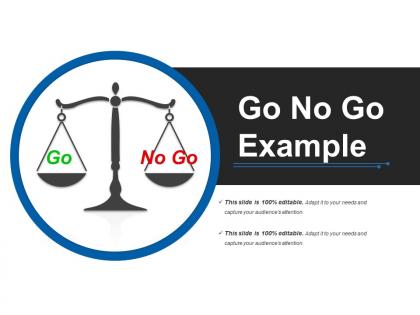
Go no go example




Try Before you Buy Download Free Sample Product
 Impress Your
 Audience
 100%
100% Editable
 Save Hours
 of Time


Showcase the cost and benefits of your organization with the aid of Go No Go Example PPT slide. You can develop a model that projects the future decisions by using the quality process presentation template. With the help of this professionally designed lean decision PowerPoint graphic, you can outline various strategies to mitigate the risks associated with decision-making. You can reschedule the time and minimize the opportunity cost with the assistance of go-no-go decision PPT slideshow. Employ the business plan PowerPoint layout to portray the particular model for project selection. Use go-no-go decision strategy PPT visual and share different parameters of your business with the employees. There are various high-quality icons present in the slide which makes your presentation even more meaningful and impressive. You can observe and record the overall activities of the project by downloading our ready-to-use project go-no-go decisions PowerPoint theme.
People who downloaded this PowerPoint presentation also viewed the following :
Go no go example with all 5 slides:
Chat up your audience with our Go No Go Example. Get them in an interactive mood.


FAQs for Go
You gotta look at the basics first - can you actually pull this off with your team and budget? Risk assessment is huge too (learned that the hard way on a project last year). What's the worst case scenario and can you live with it? Also think about whether this fits your bigger picture goals or if you're just chasing something shiny. Opportunity cost matters - what are you NOT doing if you commit to this? Honestly, I'd make a quick scoring system for these factors. Beats making decisions based on whatever mood you're in that day.
Honestly, risk assessment is what saves you from making dumb decisions based on "feels right" energy. You gotta weigh threats against benefits - budget blowouts, delays, staffing issues, market shifts. I've watched so many projects crash because someone went with their gut instead of actual data. Score your risks by probability and impact, then see if they're worth the potential upside. If high-probability disasters outweigh gains, walk away. My advice? List your top 5 risks first and rate them. Makes the whole go/no-go thing way less stressful and you'll actually have solid reasoning behind your choice.
Dude, you really need different people weighing in on this stuff. Finance spots budget issues you'll totally miss. Operations knows if you actually have the resources. Customers tell you if anyone even wants this thing - which honestly should be obvious but isn't always. I've watched so many projects crash because someone just asked their usual yes-people instead of getting real feedback. Set up some basic way to compare what everyone's saying. Don't just go with your gut on big decisions like this. The whole point is catching those red flags before they bite you.
Honestly, data analytics is a game-changer for Go/No-Go calls. Instead of going with your gut (which let's be real, isn't always reliable), you're looking at actual numbers - past project performance, market data, resource usage patterns, risk factors. The cool thing is you'll catch trends that would fly right past you otherwise. Like why certain project types keep bombing under specific conditions. You can actually model out different "what-if" scenarios too, which is pretty neat. My advice? Pick 3-5 metrics that have historically predicted success at your company and start there.
Don't fall into the perfectionism trap - you'll never get 100% certainty on anything. Set "good enough" criteria upfront and actually stick to them. Sunk costs mess with your head too, so try to ignore what you've already spent. One thing that drives me crazy is when there's like 10 people trying to make the decision but nobody's actually in charge. Politics get messy fast. Give one person final say, define what success looks like before you start, and put a deadline on it. Nothing's worse than those decisions that just drag on forever because everyone keeps overthinking it.
Honestly, it depends so much on what industry you're in. Tech companies? They'll ship something at like 80% confidence because worst case, users complain and you patch it later. But healthcare is a totally different beast - they need 99%+ certainty before anything goes live. Makes sense though, right? A buggy app is annoying. A faulty medical device could literally kill someone. Healthcare deals with years of clinical trials and FDA hoops. Meanwhile tech bros are like "move fast and break things." Always think about your industry's "cost of being wrong" first - that's really what drives these decisions.
Honestly, just stick with the basics - they work better than all the fancy stuff anyway. Go/No-Go matrix is clutch - you score things like feasibility and ROI against what actually matters to you. SWOT analysis covers your strengths, weaknesses, opportunities, threats. Stage-Gate is solid for product decisions. Don't overthink it though. Pick maybe 5-7 criteria that fit your situation instead of copying templates online (I've done that mistake before). Start with a simple matrix and tweak it as you go. These three frameworks handle like 90% of what you'll run into.
Dude, team dynamics totally mess with Go/No-Go calls. When people feel safe speaking up, you actually get the real concerns and crucial info. But dysfunctional teams? Everyone clams up or just follows whoever yells loudest. Groupthink kills good decisions every time. Power stuff is huge too - junior people won't challenge the boss even when they see obvious red flags, which honestly drives me crazy. You lose all that valuable perspective when voices get silenced. Create actual space for pushback, maybe assign someone to argue the opposite side before big moves.
Look, if your Go/No-Go decisions aren't tied to what the company actually cares about, you'll end up approving projects that seem smart but don't really matter. I've seen this happen way too often - teams working on stuff that's technically solid but completely misses the bigger picture. You need criteria that connect back to your org's real priorities from day one. Otherwise it's like driving a nice car in the wrong direction, which sounds dumb but honestly happens all the time. Make every project decision a strategic one, not just "does this work?"
Okay so scenario planning is basically your safety net for big decisions. Build out 3-4 different futures - best case, worst case, the realistic middle ground. Then see how your project holds up in each one. Start with your biggest uncertainties and work from there. What if funding gets cut? What if the market shifts? Honestly, it's way better than just crossing your fingers and hoping for the best. You'll spot problems early and figure out if you can actually pivot when things inevitably get messy. Plus it shows you which assumptions will totally sink you if they're wrong.
Oh man, confirmation bias is the worst - you just cherry-pick stuff that backs up what you already want to do. Then there's sunk cost fallacy where you keep going because you've already put so much in. Anchoring bias makes your first impression stick to everything after that. Status quo bias is weird though, sometimes saying "no" just feels safer than shaking things up. Overconfidence will definitely push you toward bad "yes" decisions, especially when things have been going well lately. Best thing? Get someone to argue against you on purpose.
Honestly? Check in every 2-4 weeks at major milestones, or whenever something big changes. You don't want to overthink every little thing - that's just spinning your wheels. But you also can't just cruise on autopilot either. I'd set up formal checkpoints when you're planning everything out. Budget goes off the rails? Time to reassess. External stuff shifts? Same deal. Oh, and make sure your team knows they can call for an emergency review if needed. Trust me, it's way better to pause and think than to plow ahead blindly.
Track both the obvious stuff (ROI, timelines, hitting your targets) and the messier process stuff too. Did you use good data? Were stakeholders actually aligned, or just nodding along? How fast did you decide given the complexity? Here's the thing though - good decisions can still blow up because of random external crap. So really focus on whether your framework and info were solid at decision time. I'd probably track this across multiple decisions to see if there are patterns in how you're approaching things. The outcome metrics matter, but they don't tell the whole story.
Honestly, the biggest help is getting all your decision stuff in one place instead of chasing down info from like 5 different teams. Super annoying otherwise. You can set up scoring systems that automatically rate projects against whatever criteria you pick. Some tools even flag risks you'd probably miss on your own. But the real winner? Real-time collaboration where everyone can actually weigh in at once - no more endless email threads that go nowhere. I'd start by figuring out where your current process gets stuck, then find tools that fix those specific pain points.
Start with anonymous votes before anyone talks - stops people from just copying whatever the CEO says. Rotate who plays devil's advocate so it's not always poor Sarah shooting down ideas. Have your data criteria nailed down ahead of time instead of going with vibes. Oh, and make the quiet people talk first before the loud ones take over the whole meeting. The tricky part? People need to feel safe disagreeing with their boss without worrying they'll get passed over for promotion next time.
-
Graphics are very appealing to eyes.
-
Easy to edit slides with easy to understand instructions.