


Headwinds tailwinds for financial investment




Try Before you Buy Download Free Sample Product
 Impress Your
 Audience
 100%
100% Editable
 Save Hours
 of Time


Our Headwinds Tailwinds For Financial Investment are explicit and effective. They combine clarity and concise expression.
People who downloaded this PowerPoint presentation also viewed the following :
Content of this Powerpoint Presentation
Description:
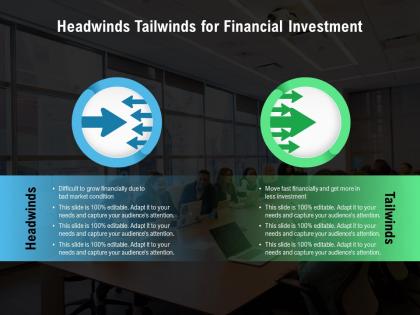
The image is a PowerPoint slide titled "Headwinds Tailwinds for Financial Investment." It is split into two sections, each with an icon and text. On the left, the "Headwinds" section has an icon with arrows pointing left against the direction of an arrow symbol, indicating resistance or challenges. The accompanying text states, "Difficult to grow financially due to bad market conditions," suggesting factors that could impede financial growth. On the right, the "Tailwinds" section has an icon with arrows pointing in the same direction as the central arrow symbol, indicating favorable conditions. The text here reads, "Move fast financially and get more in less investment," implying situations that could propel financial growth.
Use Cases:
This slide can be relevant in multiple industries where strategic investment decisions are crucial:
1. Banking:
Use: Educating clients on market dynamics affecting investments.
Presenter: Investment Banker
Audience: Clients, Investors
2. Asset Management:
Use: Presenting market analysis to fund managers.
Presenter: Financial Analyst
Audience: Portfolio Managers, Investment Committees
3. Corporate Finance:
Use: Advising on company investments and financial strategies.
Presenter: CFO
Audience: Board Members, Shareholders
4. Real Estate:
Use: Analyzing market trends for property investment.
Presenter: Real Estate Analyst
Audience: Real Estate Investors, Developers
5. Insurance:
Use: Discussing investment portfolios for insurance funds.
Presenter: Insurance Fund Manager
Audience: Policyholders, Insurance Agents
6. Venture Capital:
Use: Assessing the investment climate for startup funding.
Presenter: Venture Capitalist
Audience: Startups, Entrepreneurs
7. Education:
Use: Teaching economics or finance students about investment principles.
Presenter: Professor
Audience: Students, Academic Peers
Headwinds tailwinds for financial investment with all 2 slides:
Give your audience a fulfilling experience. They will find our Headwinds Tailwinds For Financial Investment elevating.

FAQs for Headwinds tailwinds
Honestly, it's a mess out there right now. Interest rates are still the main thing screwing with everything - your borrowing costs, whether bonds actually look decent compared to stocks, all of it. The Fed's got everyone guessing what they'll do next, inflation's better but not gone, and then you've got random geopolitical drama adding more chaos. Oh, and don't get me started on the whole AI bubble thing in tech - half hype, half legitimate but who knows which companies actually deserve their valuations. Just stick with solid companies that make actual money and don't overthink the timing.
So interest rates basically control everything in investing. Low rates? Money floods into stocks because bonds suck. When rates go up, suddenly those "boring" safe investments look good again - people bail on risky growth stocks. It's wild how fast money moves around. Higher rates also crush company valuations since future earnings get discounted harder. Growth companies get hit worst. Honestly, I just watch Fed meetings religiously now because even rumors about rate changes send portfolios into chaos before anything actually happens. The whole system's pretty reactive.
So your risk tolerance is basically how much you can handle watching your money go up and down without freaking out. High risk tolerance? Load up on stocks for better long-term gains. More conservative? Bonds and stable stuff won't make you lose sleep. Age plays a huge role though - like, someone who's 25 has decades to recover from crashes, but if you're retiring soon, totally different story. Honestly, I'd figure out what level of account swings won't make you want to sell everything in a panic, then just build around that.
So basically you spread your money across different stuff - stocks, bonds, real estate, international markets. That way if one thing crashes, you're not completely screwed. Different investments usually don't all tank at the same time (like when tech stocks died but bonds stayed okay). Honestly, I think the hardest part is actually sticking to it when everything feels chaotic. You want things that don't typically move together. Check what you have now - are you way too heavy in one company or sector? That's usually where people mess up without realizing it.
Look, active investing *could* get you higher returns if you're good at picking stocks and timing stuff. But honestly? It eats up so much time and those fees add up quick. Index funds are the opposite - cheap, easy, you just buy everything and chill. Downside is you'll only match the market, never crush it. Here's the thing though - even most pros can't consistently beat index funds anyway, which is kinda wild when you think about it. I'd say start with passive investing to build your foundation, then maybe mess around with some active stuff later once you've got your bearings.
Dude, global stuff is like a weather system for your local investments. Fed raises rates? That boring real estate deal suddenly looks way better than risky tech stocks. Chinese GDP tanks or European rates shift, and boom - capital flows change direction, which hits what's available near you. Currency swings mess with everything too, honestly. I always peek at what the big economies are doing before jumping into local deals - especially if there's any export or foreign money involved. Sounds nerdy but it's saved me from some questionable moves.
Behavioral finance basically explains why people make dumb money decisions - panic selling, FOMO buying into bubbles, all that stuff. Traditional finance theory pretends everyone's super logical, which is obviously BS. Loss aversion is a big one - people hate losing money way more than they like making it. Then there's overconfidence and herd mentality driving market swings. I actually think understanding these psychological quirks gives you an edge. You can spot opportunities when everyone else is freaking out and avoid making those same emotional mistakes yourself.
When big geopolitical stuff happens, markets freak out. Investors get scared and dump risky assets - think emerging market stocks - then pile into safe stuff like US bonds or gold. Wars, trade fights, sanctions, elections... basically anything that creates uncertainty. The speed is crazy now with all the computer trading making everything more intense. Nobody knows what's next, so prices bounce around like pinballs while markets try to figure out different scenarios. Oh, and definitely check where your investments are geographically spread out during messy times - you don't want everything in one region.
Tech changed everything about investing, no joke. Apps like Robinhood made it so easy that kids are building portfolios in high school now. Algorithms handle millions of trades instantly while robo-advisors basically run your investments on autopilot. AI spots market trends before humans even notice them. Your phone gives you real-time updates wherever you are - though honestly, checking too often makes you crazy. Blockchain's adding transparency too. The trick is figuring out which tools actually help vs just being shiny distractions. Most people get overwhelmed by all the options.
Honestly, you've gotta look at two main things - the company's actual financial health and their ESG stuff. Debt levels, steady cash flow, how they handle market shifts. Can they survive when things get messy? ESG matters more now since regulations keep changing and people actually care about this stuff (which is kinda refreshing tbh). The UN SDGs are pretty useful as a framework if you want something concrete to follow. I'd review quarterly and just ask yourself: are these companies fixing future problems or making them worse? That question alone will totally change how you pick investments.
So ESG is getting way more precise now - regulations are forcing companies to actually show their data instead of just talking a good game. AI's making it easier to spot real impact vs. BS greenwashing too. Supply chain stuff and community impact (the social part) is blowing up right now. Climate tech's still huge obviously, but there's more focus on adapting to changes we can't prevent rather than just stopping emissions. Honestly, the biggest thing I'm noticing? Fund managers aren't doing separate "ESG funds" anymore - they're just baking it into everything. You should probably start thinking about your current investments through this lens. It's becoming standard, not some niche thing.
Liquidity is just how fast you can turn your investments into cash without taking a hit. Stocks and ETFs? Super liquid - you can sell them basically instantly. Real estate or private equity will give you better returns usually, but your money's stuck for years. Honestly though, that can save you from yourself if you're the type to freak out and sell everything during a crash lol. I'd keep some cash around for emergencies and random opportunities that pop up. The rest depends on when you'll actually need the money.
Dude, inflation is basically eating away at your money every year. That $100 today? Could easily be $130 in ten years. Keeping cash under your mattress is honestly just watching it lose value - kinda depressing when you think about it. You'll want stuff that beats inflation: stocks, real estate, maybe some TIPS bonds. REITs and commodities can help too since they tend to do okay when prices are rising. The annoying thing is inflation messes with interest rates and market prices, so you really need to spread things around. Check what you've got now and see if you need more inflation protection.
Data analytics is honestly a game-changer for investing - you can spot market patterns and test strategies before risking actual money. Python's great but even Excel works for analyzing historical performance and asset correlations. The free financial data available now is insane compared to just a few years ago. Start with basics like Sharpe ratios, beta coefficients, and moving averages. What's really cool is how it removes emotional bias from your decisions. You'll stick to evidence-based approaches instead of panic buying/selling. Backtesting alone has saved me from some terrible investment ideas.
Honestly, bear markets suck but they're great for building wealth if you don't freak out. Keep buying small amounts regularly - nobody can time the bottom anyway, so don't even try. Dividend stocks and boring stuff like utilities actually become your best friends here. Tax-loss harvesting is clutch if you've got losses sitting around. Don't sell everything in a panic (I know it's tempting), but maybe dial back the risk a bit. This is when you find amazing companies trading cheap. My dad always said the best opportunities come when everyone else is running scared.
No Reviews