


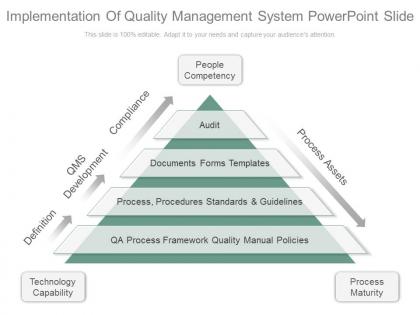
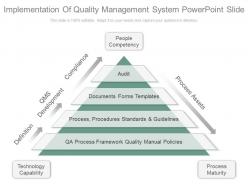
Implementation of quality management system powerpoint slide




Try Before you Buy Download Free Sample Product
 Impress Your
 Audience
 100%
100% Editable
 Save Hours
 of Time


Take every opportunity to make your next presentation a winner. Our Implementation Of Quality Management System Powerpoint Slide are waiting to work for you.
People who downloaded this PowerPoint presentation also viewed the following :
Implementation of quality management system powerpoint slide with all 7 slides:
Enlarge the canvas with our Implementation Of Quality Management System Powerpoint Slide. Paint the big picture for your audience.




FAQs for Implementation of quality management
Key components of an effective Quality Management System include documented processes, leadership commitment, customer focus, continuous improvement mechanisms, and risk management protocols. These elements work together by establishing clear quality standards, ensuring consistent delivery across operations, and enabling organizations to monitor performance metrics, ultimately delivering enhanced customer satisfaction and competitive advantage in increasingly regulated business environments.
A QMS contributes to business efficiency by standardizing processes, reducing waste, minimizing errors, and streamlining operations across all departments. Through consistent quality protocols, organizations achieve faster production cycles, lower operational costs, and enhanced customer satisfaction, with many companies finding that systematic quality management ultimately delivers improved profit margins and stronger competitive positioning.
Quality Management Systems commonly integrate Lean manufacturing, Six Sigma, ISO 9001 standards, Total Quality Management (TQM), and Kaizen methodologies. These approaches work synergistically by eliminating waste, reducing defects, and standardizing processes, with many organizations finding that combining Lean's efficiency focus with Six Sigma's statistical rigor delivers significant cost reductions and enhanced customer satisfaction.
Organizations effectively measure QMS implementation success through key performance indicators like defect rates, customer satisfaction scores, audit findings, process cycle times, and compliance metrics. These measurements enable businesses to track operational efficiency improvements, identify areas requiring attention, and demonstrate ROI to stakeholders, with many finding that regular assessment drives continuous improvement and competitive advantage.
Employee training and engagement serve as fundamental pillars of successful quality management systems, ensuring consistent implementation of quality standards, procedures, and continuous improvement practices across all organizational levels. Through comprehensive training programs and active engagement initiatives, organizations cultivate quality-conscious cultures where employees understand their roles in quality delivery, identify improvement opportunities, and take ownership of outcomes, ultimately enhancing customer satisfaction and operational excellence.
A QMS facilitates compliance by establishing standardized processes, documentation protocols, regular audits, and continuous monitoring systems that align with regulatory requirements. Through automated tracking and reporting capabilities, organizations in healthcare, manufacturing, and financial services streamline compliance verification, reduce audit preparation time, and maintain consistent adherence to industry standards, ultimately delivering operational transparency and competitive advantage.
ISO 9001 emphasizes continuous improvement and customer satisfaction through process-based management, while other standards like Six Sigma focus on defect reduction, TQM on organizational culture transformation, and Lean on waste elimination. These approaches complement each other strategically, with many organizations finding that combining ISO 9001's systematic framework with sector-specific methodologies delivers enhanced operational efficiency and competitive advantage.
Digital tools enhance QMS effectiveness by automating document control, streamlining audit processes, enabling real-time data collection, and facilitating compliance tracking across multiple locations. Through cloud-based platforms and mobile applications, organizations in manufacturing, healthcare, and financial services deliver faster corrective actions, improved transparency, and enhanced regulatory compliance, ultimately reducing operational costs while strengthening quality outcomes.
Organizations face challenges including employee resistance to change, inadequate training, resource constraints, complex documentation requirements, and lack of leadership commitment when implementing quality management systems. These obstacles can be overcome through comprehensive change management programs, phased implementation approaches, and robust training initiatives, with many companies finding that strong executive sponsorship, clear communication strategies, and dedicated project teams ultimately deliver smoother transitions and sustainable quality improvements.
Continuous improvement integrates into QMS culture through regular performance reviews, employee feedback systems, standardized problem-solving methodologies, and cross-functional improvement teams. Organizations like manufacturing plants and healthcare facilities enhance operational efficiency by embedding improvement metrics into daily workflows, training staff on quality tools, and celebrating incremental wins, ultimately delivering sustained competitive advantage.
Key QMS effectiveness metrics include customer satisfaction scores, defect rates, process cycle times, audit findings, corrective action closure rates, and compliance percentages. These indicators enable organizations to track operational efficiency, product quality, and regulatory adherence across manufacturing, healthcare, and service sectors, ultimately delivering improved customer experiences and competitive advantage.
Customer feedback and satisfaction surveys inform QMS adjustments by identifying process gaps, service deficiencies, and improvement opportunities through direct user insights. These data sources enable organizations to prioritize corrective actions, refine quality standards, and enhance operational procedures, with many companies finding that systematic feedback integration ultimately delivers improved customer retention and competitive advantage.
Documentation serves as the foundation of a robust QMS by establishing standardized procedures, ensuring regulatory compliance, facilitating knowledge transfer, and providing audit trails for continuous improvement. Through comprehensive documentation systems, organizations streamline training processes, maintain consistent quality standards across departments, and enable rapid identification of improvement opportunities, ultimately delivering enhanced operational efficiency and reduced compliance risks.
Organizations leverage audits to enhance their QMS by identifying process gaps, ensuring regulatory compliance, and uncovering improvement opportunities through systematic evaluation. These assessments enable companies to streamline operations, reduce costs, and strengthen quality controls, with many manufacturing and healthcare organizations finding that regular internal and external audits ultimately deliver enhanced customer satisfaction and competitive advantage.
Common misconceptions about Quality Management Systems include that they're only for large corporations, create excessive paperwork, stifle innovation, guarantee immediate results, and are one-size-fits-all solutions. These misconceptions often prevent organizations from leveraging QMS benefits like streamlined operations, enhanced customer satisfaction, and competitive advantage, with many companies finding that modern systems actually reduce bureaucracy while driving strategic growth.
-
Visually stunning presentation, love the content.
-
Awesomely designed templates, Easy to understand.