


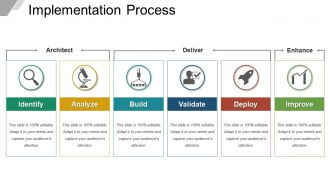
Implementation process






Try Before you Buy Download Free Sample Product
 Impress Your
 Audience
 100%
100% Editable
 Save Hours
 of Time


Display grasp of every aspect with our Implementation Process. They help exhibit great dexterity.
People who downloaded this PowerPoint presentation also viewed the following :
Implementation process with all 5 slides:
Highlight your hard work by adding vibrant full color Implementation Process to your presentations. We work hard to compliment your hard work.

FAQs for Implementation process
So there's four main phases: planning, prep, execution, and evaluation. Planning is honestly where most projects either succeed or completely fall apart - you need solid goals and everyone actually on board. Then prep is all the nitty gritty stuff like timelines and figuring out what could go wrong. During execution, just stay on top of communication and track your milestones. Oh, and don't forget evaluation afterward - that's how you learn what worked. One thing though: always pad your timeline because I swear everything takes way longer than you think it will.
Start by actually talking to your stakeholders - don't just assume what they want. Weekly check-ins work great, but honestly I'd rather annoy people with too many updates than leave them in the dark. Your executives want the big picture stuff while end users need nitty-gritty details like training schedules. Keep asking for feedback and actually use it, otherwise people tune out fast. Oh, and pick someone to own communications - doesn't have to be fancy, just consistent. Trust me, showing up regularly beats perfect emails every time.
Track the obvious stuff first - adoption rates, how long tasks take, error counts. Compare those to whatever you had before. But honestly, user feedback matters just as much because I've seen systems that looked perfect on paper but everyone hated using them. Business metrics are crucial too (cost savings, productivity, whatever your boss actually cares about). Don't go crazy tracking everything though. Pick 3-5 things that actually matter for your goals and check them weekly the first month. Way easier than drowning in data.
Dude, your tech stack choice is gonna make or break your timeline. Go with stuff your team already knows and you'll cruise through development. Pick something trendy? Good luck with all that extra debugging time - been there, done that. Also think about finding devs later if you need to hire. Nobody wants to hunt for someone who knows some obscure framework. Scaling matters too, but honestly that's usually not the biggest issue early on. Stick with boring, reliable tech unless there's a solid reason not to.
Oh dude, collaboration can totally make or break your whole project. I've watched so many things crash and burn just because people didn't talk to each other - like, basic stuff too. You'll catch problems way earlier when everyone's actually communicating instead of working in their own little bubbles. Set up regular check-ins from the start and actually stick to them. Make sure people know what they're responsible for, and honestly? The biggest thing is creating space where people feel okay saying "hey, this isn't working" or throwing out random ideas. Trust me, those conversations save you so much headache later.
Ugh, the usual suspects: scope creep, not enough resources, and people who hate change. Set your boundaries early and actually stick to them - seriously, "one tiny addition" always becomes like fifteen more things. Build in extra time from the start because something will go wrong (it always does). Get your key stakeholders involved in the planning process so they buy in instead of fighting you later. Oh, and do regular check-ins. Catching problems when they're small beats dealing with a complete disaster later. Trust me on that one.
Honestly, good research is what saves your ass later. You'll spot problems before they explode in your face. Dig into what users actually need, figure out the tech limitations, understand how people currently do things. Too many projects crash because someone thought they knew better and skipped this part - classic mistake. Finding the right people to talk to early makes everything smoother. You can see where folks might push back and gather real data to back up your decisions. Just start by writing down everything you don't know yet. That's basically your research plan.
Don't wait until the end to get user feedback - I've watched so many projects crash because of this mistake. Build check-ins right into your timeline from day one. Weekly demos work really well. Make it stupid easy for people to give input too - maybe a Slack channel or basic form, nothing fancy. Here's the thing though: you have to actually show users what you did with their suggestions. People get annoyed and stop helping if they think you're just ignoring them. Oh, and schedule those touchpoints now before you forget!
Dude, training will literally make or break everything. I've watched so many projects crash because they threw together some half-assed training sessions at the last minute. You could build the most amazing system ever, but if people don't get how to use it? They'll just find ways around it or constantly bug IT. Start figuring out your training plan way early - like, months before launch, not days. Focus on stuff they'll actually do day-to-day, and let them mess around with real examples. Give them time to practice with sample data so they don't feel totally lost on day one.
Dude, scope is like putting up fences around your project. No fence? You'll end up rebuilding everything because "oh, wouldn't it be cool if..." Trust me, I've watched simple features turn into six-month nightmares. Write down what you're doing AND what you're NOT doing before you start. That way when your PM comes asking for random stuff mid-project, you can actually push back. Plus it makes estimates way less painful. Honestly, the ability to say no is worth its weight in gold.
Don't wait to think about what could go wrong - bake it into your timeline from the start. Make a list of realistic problems for each phase: tech breaking, people quitting, budget cuts, whatever. Then actually plan for those scenarios with backup options and extra time built in. Honestly, I've watched so many projects implode because teams just crossed their fingers and hoped for the best. Make risk planning a regular agenda item in your meetings, not some one-time thing you check off. Way easier to brainstorm solutions now than when you're already in crisis mode.
Break everything down into smaller chunks with real deadlines - seriously makes a huge difference. Weekly check-ins help you spot problems before they explode. Always pad your timeline by like 20% because something will definitely go wrong (learned this the hard way). Get some kind of visual tracking system going, and when you hit blockers, deal with them immediately instead of crossing your fingers. Oh, and figure out your critical path stuff early - you need to know what could totally screw your timeline if it gets delayed.
Dude, culture will totally make or break your project. Communication styles are completely different everywhere - some places need tons of relationship-building upfront (I learned this the hard way), while others just want you to get straight to business. Decision-making varies wildly too. Religious holidays will mess with your timeline, and don't even get me started on hierarchy expectations. Honestly, team dynamics shift based on local practices way more than you'd think. Get local team members involved from day one. Oh, and definitely pad your schedule for cultural stuff - you'll thank me later when you're not scrambling.
Honestly, it comes down to what you're actually building. Products are concrete stuff - features, specs, things people can touch or click on. Way more straightforward if you ask me. Services though? That's all about the experience - workflows, how people interact with your team, the whole journey. Testing's totally different too. You'll check if product features work properly, but with services you're basically testing entire customer experiences and making sure your staff knows what they're doing. People are weird and unpredictable so services get messy fast. Just figure out if your users want a "thing" or an "experience" first. That'll tell you everything about how to approach it.
Honestly, just pick 2-3 things to track consistently - don't go crazy trying to monitor everything at once. Set up monthly check-ins (or quarterly if you're swamped) to actually look at the data and talk to users. Most teams launch and then... crickets. Big mistake! You want both the hard numbers - error rates, usage stats, whatever - and the messy human feedback about what's driving people nuts. Then here's the thing: actually do something with what you learn. Small tweaks based on real insights beat major overhauls every time. Oh, and put those review dates in your calendar now or you'll keep pushing them off.
-
Content of slide is easy to understand and edit.
-
Awesome use of colors and designs in product templates.