


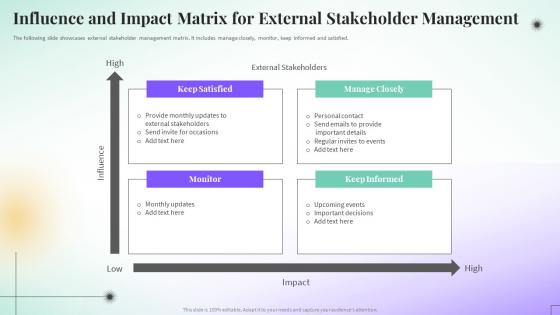
Influence And Impact Matrix For External Stakeholder Management




Try Before you Buy Download Free Sample Product
 Impress Your
 Audience
 100%
100% Editable
 Save Hours
 of Time


The following slide showcases external stakeholder management matrix. It includes manage closely, monitor, keep informed and satisfied.
People who downloaded this PowerPoint presentation also viewed the following :
Influence And Impact Matrix For External Stakeholder Management with all 6 slides:
Use our Influence And Impact Matrix For External Stakeholder Management to effectively help you save your valuable time. They are readymade to fit into any presentation structure.





FAQs for Influence And Impact Matrix For
The Influence Impact Matrix is a strategic assessment tool that plots stakeholders, initiatives, or factors based on their level of influence and potential impact on organizational objectives. Strategic planners use this matrix to prioritize resource allocation, identify key stakeholders for engagement, and focus efforts on high-influence, high-impact areas, ultimately enabling more effective decision-making and competitive advantage.
Organizations effectively identify stakeholders by conducting comprehensive mapping exercises that include internal teams, external partners, regulatory bodies, customers, and community groups. Through systematic stakeholder analysis, companies can categorize these groups by their decision-making authority and project impact levels, with many finding that early identification streamlines project planning and enhances strategic alignment.
Stakeholder assessment criteria include decision-making authority, resource control, project dependency, organizational reach, and potential resistance or support levels. These factors help organizations prioritize engagement strategies by identifying high-influence advocates, managing potential blockers, and allocating communication resources effectively, with many project managers finding that systematic stakeholder mapping significantly improves project outcomes and reduces implementation risks.
An influence impact matrix visualizes relationships by plotting stakeholders, initiatives, or factors along two axes, with influence levels on one axis and impact levels on the other, creating four distinct quadrants for strategic analysis. This visualization enables organizations to prioritize resources effectively, identify key decision-makers, and develop targeted engagement strategies, with many businesses finding that this approach streamlines stakeholder management and enhances project outcomes.
Common pitfalls include overestimating influence levels, misaligning stakeholder interests, relying on outdated information, focusing solely on high-influence targets, and neglecting relationship dynamics between different stakeholder groups. These challenges can lead to ineffective resource allocation and missed strategic opportunities, with many organizations finding that regular matrix updates, cross-functional input, and balanced stakeholder engagement ultimately deliver more accurate assessments and successful outcomes.
The Influence Impact Matrix aids resource allocation by systematically categorizing stakeholders based on their ability to affect project outcomes and their level of interest, enabling strategic prioritization of engagement efforts. Organizations use this framework to allocate communication resources, time, and attention more effectively, with many finding that focusing on high-influence, high-impact stakeholders first streamlines project success while optimizing limited resources.
The Influence Impact Matrix enhances stakeholder engagement by systematically categorizing stakeholders based on their influence levels and potential project impact, enabling targeted communication strategies, resource allocation, and relationship management approaches. This strategic framework helps organizations prioritize high-influence stakeholders, streamline engagement efforts, and develop customized outreach plans, ultimately delivering more effective stakeholder relationships and improved project outcomes across various industries.
The Influence Impact Matrix differs from traditional stakeholder analysis by focusing specifically on two key dimensions—stakeholder influence levels and project impact potential—rather than broader relationship categories. While traditional tools often emphasize communication frequency or general importance, this matrix enables project managers to strategically prioritize engagement efforts, allocate resources more effectively, and develop targeted influence strategies that maximize project success outcomes.
Regular stakeholder mapping reviews, quarterly influence assessments, feedback integration mechanisms, environmental scanning, and dynamic weighting adjustments ensure the Influence Impact Matrix remains current and actionable. These maintenance techniques enable organizations to adapt their stakeholder strategies by incorporating changing business landscapes, evolving relationships, and shifting priorities, ultimately delivering sustained engagement effectiveness and strategic alignment.
The Influence Impact Matrix adapts seamlessly across industries like healthcare, technology, manufacturing, and financial services, with customizable criteria reflecting sector-specific priorities and stakeholder dynamics. Healthcare organizations use it for patient safety initiatives and regulatory compliance, while technology companies leverage it for product development and market penetration strategies, ultimately enabling strategic resource allocation and competitive advantage.
The Influence Impact Matrix helps manage organizational change by identifying key stakeholders based on their influence levels and potential impact from changes, enabling targeted communication strategies and resource allocation. Through this strategic mapping, change managers can prioritize high-influence advocates, address concerns of impacted groups, and develop tailored engagement approaches, ultimately streamlining change adoption and minimizing resistance across departments.
Communication serves as the foundation for Influence Impact Matrix effectiveness, enabling stakeholder mapping accuracy, relationship building, and strategic message tailoring across different influence levels. Through clear dialogue and active listening, organizations can better assess stakeholder positions, build coalitions with high-influence supporters, and address concerns from potential resistors, ultimately delivering more successful change initiatives and stronger stakeholder buy-in.
Teams can collaborate more effectively using the Influence Impact Matrix by collectively identifying stakeholders, assessing their influence levels, and mapping potential project impacts together during planning sessions. This collaborative approach ensures comprehensive stakeholder analysis, aligns team perspectives on risk management, and enables strategic resource allocation, with many project teams finding that shared matrix development improves communication and decision-making throughout project execution.
Case studies demonstrating successful Influence Impact Matrix applications include pharmaceutical companies prioritizing stakeholder engagement during drug approvals, technology firms managing investor relations during IPOs, and healthcare organizations coordinating multi-departmental initiatives. These organizations streamline stakeholder management by categorizing influence levels, mapping impact potential, and allocating resources strategically, ultimately delivering more targeted communication strategies and improved project outcomes.
Feedback loops can be integrated by establishing regular stakeholder assessment cycles, tracking engagement outcomes, monitoring influence changes over time, and adjusting positioning strategies based on response data. Through systematic collection of stakeholder feedback, organizations can identify shifting power dynamics, measure strategy effectiveness, and recalibrate their approach, ultimately delivering more targeted engagement and stronger stakeholder relationships.
-
Informative and engaging! I really like the design and quality of the slides.
-
The designs by SlideTeam are honestly the best I have seen so far. Will be definitely coming back for more.