


Innovation Idea Funnel Process Framework Implementation Growth Successful Development




Try Before you Buy Download Free Sample Product
 Impress Your
 Audience
 100%
100% Editable
 Save Hours
 of Time


Our Innovation Idea Funnel Process Framework Implementation Growth Successful Development are topically designed to provide an attractive backdrop to any subject. Use them to look like a presentation pro.
People who downloaded this PowerPoint presentation also viewed the following :
Innovation Idea Funnel Process Framework Implementation Growth Successful Development with all 10 slides:
Use our Innovation Idea Funnel Process Framework Implementation Growth Successful Development to effectively help you save your valuable time. They are readymade to fit into any presentation structure.


FAQs for Innovation Idea Funnel Process Framework Implementation
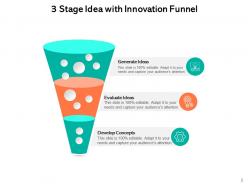
So basically you've got four stages to worry about: ideation (brainstorming a million ideas), screening (tossing the garbage ones), development (actually building stuff), and commercialization (getting it out there). It's like a funnel - starts super wide then gets narrow fast. Honestly, most companies are way too nice about killing bad ideas early on. You want to be brutal in those first two stages or you'll waste months on something that was never gonna work. Just set up clear checkpoints so everyone knows what's needed to move to the next stage. Saves you tons of headaches later.
So basically you need solid checkpoints where ideas either pass or fail based on real criteria - feasibility, market fit, that stuff. Most companies totally botch this by being way too strict or completely chaotic. Regular cross-team reviews help a ton. Kill the weak ideas fast so you're not wasting time on garbage. Here's the thing though - don't make it so rigid that good concepts can't come back after some tweaks. I'd start by looking at your current setup and figuring out where promising ideas are getting stuck for dumb reasons. You want structure but not bureaucracy, you know?
Dude, feedback is everything in innovation - like seriously, it's your sanity check at each step. Get it early when you're testing concepts, then again during prototypes before you waste months building something nobody wants. I swear, so many teams I know just... skip this part? Then wonder why their launch flops. Set up actual feedback systems instead of crossing your fingers and hoping. Ask pointed questions that connect to whatever you're measuring for success. Oh and build these channels into your workflow from day one - trust me, trying to bolt it on later is a nightmare.
Think of data analytics as your roadmap through each stage. When you're brainstorming, dig into customer feedback and market trends - way better than shooting in the dark. A/B testing during development saves you from those "why didn't we think of this sooner" moments. Testing phase is where conversion rates and engagement metrics tell the real story. Honestly, predictive modeling for launches isn't as scary as it sounds - it just helps you gauge how people might react. Pick 2-3 metrics per stage that actually move the needle for your business. Don't overcomplicate it.
Honestly, just use weighted scorecards - rate stuff like market potential, how doable it is, resources needed, and whether it fits your company's direction. Don't get stuck perfecting the system forever though (I've watched teams waste weeks on this). Start basic and tweak it later. Quick experiments or customer chats for your top picks are clutch before you commit. The main thing? Stick with whatever framework you pick so you're actually comparing similar things when deciding what gets the green light.
Look, you've gotta shake things up from day one. Don't just pull the same R&D crew every time - mix in people from different departments, experience levels, all that. Get your frontline staff involved too since they actually see what's broken. I swear, half the companies I know just cycle through their usual 5 senior people and wonder why nothing changes. Set up some cross-functional workshops. Make sure the quiet ones get to speak, not just whoever talks loudest. Oh, and definitely loop in customers and outside partners - they'll spot problems you're totally blind to.
Track your funnel stuff first - submission rates, how fast you evaluate things, what percentage moves between stages. Conversion rates are huge (idea to prototype to launch). Also time-to-market and ROI on innovation spend. Employee participation matters too since dead processes help nobody. Quality scores for ideas and stakeholder satisfaction are worth tracking, though honestly those can be tricky to measure well. Start simple with maybe 3-4 core metrics. You can always pile on more data later once you've got the foundation working.
Tech moves way faster because failing is cheap - they can test stuff in months while healthcare takes years. The FDA will absolutely destroy your timeline if you're not careful. Here's the thing though - tech companies cast a wide net since experiments don't cost much, but healthcare has to be super picky from day one. Those R&D costs are brutal. When you're setting up your process, just think about how much regulation you're dealing with and what happens when things go wrong. That'll tell you how tight your gates need to be.
Honestly, the hardest part is getting leadership to actually care and then dealing with the flood of ideas afterward. Start with a small pilot first - trust me on this one. You'll need clear timelines for each stage or stuff just sits there forever. Also, killing people's pet projects is brutal but necessary. Executive buy-in is make-or-break, so don't even think about launching without it. Oh, and have someone dedicated to managing the whole mess because excitement fades fast when ideas get stuck in limbo. Resources and criteria for what moves forward are obviously crucial too.
Dude, you've gotta break down those department walls if you want innovation to actually work. Get marketing, engineering, and design people in the same room from day one. Each group catches different problems early - like engineering will spot if something's impossible to build while marketing knows if anyone would buy it. The best ideas come from that weird creative friction when different minds clash (in a good way). Instead of ideas getting watered down as they bounce between teams, everyone's iterating together in real time. Honestly, it's night and day compared to the old way. Just start small with your next project.
Honestly, AI and machine learning are total game-changers - companies can actually predict which ideas won't flop before dumping money into them. Collaborative tools like Slack make cross-team innovation so much less painful than those endless email threads (thank god). Cloud computing speeds up prototyping like crazy. Plus data analytics gives you real customer insights instead of just winging it. My advice? Pick maybe 2-3 tools that actually fit what you're already doing. Don't go nuts trying to adopt everything - I've seen that backfire so many times.
Honestly, culture is everything when it comes to innovation. Your team won't even pitch crazy ideas if they're scared of looking stupid or getting blamed later. I've watched amazing innovation processes completely tank because everyone was terrified of "failing" - which is ridiculous since that's literally how you learn what works. Safe environments produce way more ideas, and better ones too. Short version: celebrate smart failures just as much as wins. The volume and quality of what flows through your pipeline will jump pretty fast. Trust me on this one.
Honestly, the worst thing you can do is let too many mediocre ideas keep going without real checkpoints. I've watched teams baby projects that should've been axed ages ago - it's painful to see. Cut the losers fast, trust me. Also check your whole pipeline, not just the shiny new stuff at the top. Like, having tons of early ideas but nothing actually launching? That's a red flag your process is busted. Set up those regular reviews and be brutal about what stays. Resources aren't infinite, so don't pretend they are.
Think of storytelling as your secret weapon for moving ideas through the pipeline. People connect with stories way more than boring spreadsheets - it's just how our brains work. When you frame your innovation as a narrative with a clear problem, your solution as the hero, and show the outcome, suddenly everyone gets it. Stakeholders can actually picture what you're talking about. Plus your story gets stronger as you move forward, adding more proof and details. Trust me, those funding meetings become way less painful when you're not just throwing data at people. Stories stick.
Honestly, the key is never letting stuff just sit there without a plan. Set up regular check-ins and give each project a clear owner - otherwise things just drift forever. Quick wins are your friend here, so celebrate those publicly to keep energy up. Kill the duds fast too (I know it sucks but dead projects are resource drains). Committee hell is real and it murders good ideas left and right! Create some kind of simple tracker so you can actually see where things are getting stuck. Decision points need deadlines or people will debate forever.
-
Topic best represented with attractive design.
-
Informative presentations that are easily editable.
-
Easy to edit slides with easy to understand instructions.
-
Topic best represented with attractive design.
-
Thanks for all your great templates they have saved me lots of time and accelerate my presentations. Great product, keep them up!