


IT Company Report Sample Powerpoint Presentation Slides





Try Before you Buy Download Free Sample Product
 Impress Your
 Audience
 100%
100% Editable
 Save Hours
 of Time


A company profile is a professional introduction of a company to provide operational and financial information. Check out our professionally designed template on IT Company Report Sample that wants to give its business details to its stakeholders employees, investors, clients, partners, shareholders, etc. It covers the operation information such as a brief overview of the company and its products and services, history, geographic presence, mission and vision statement, latest technologies, research and development activities, distribution network, etc. In addition to this, it covers the competitor details such as the name of top competitors by their operations, competitive landscape, financial comparison with competitors, etc. The template has also covered the financial overview of the company that includes the company's financials from its income statement revenue, EBIT, and Net income, balance sheet total assets, total liabilities, goodwill, and cash flow statement cash flows from operating, investing, and financing activities. In the end, it covers strategic details long-term growth goals and strategies, acquisition details, SWOT analysis, and risk management strategies of the company. The module also covers the primary corporate social responsibilities of the company. Download the Information Technology Company Profile PowerPoint Presentation Templates now.
People who downloaded this PowerPoint presentation also viewed the following :
Content of this Powerpoint Presentation
Slide 1: This slide introduces IT Company Report Sample. State Your Company Name and begin.
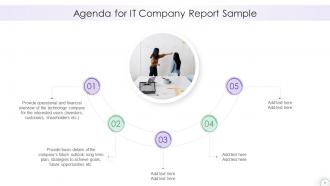
Slide 2: This slide states Agenda of the presentation.
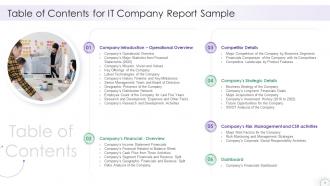
Slide 3: This slide presents Table of Content for the presentation.
Slide 4: This slide highlights title for topics that are to be covered next in the template.
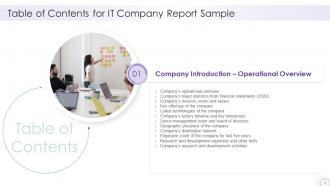
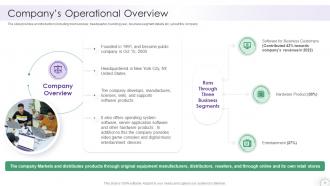
Slide 5: The slide displays an introduction including brief overview, headquarter, founding year, business segment details etc.
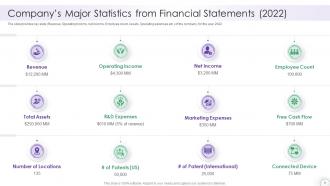
Slide 6: This slide represents Company’s Major Statistics from Financial Statements.
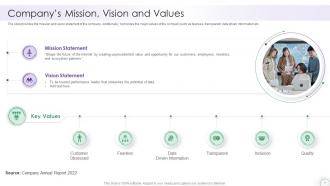
Slide 7: The slide provides the mission and vision statement of the company.
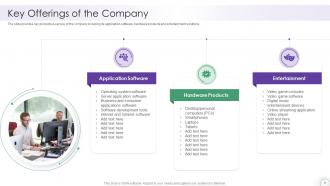
Slide 8: The slide presents key products & service of the company including its application software, hardware products and entertainment solutions
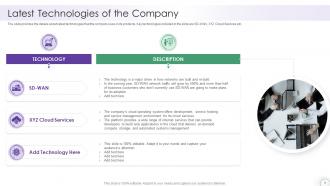
Slide 9: The slide displays the details about latest technologies that the company uses in its products.
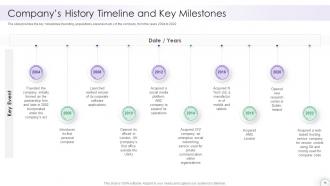
Slide 10: The slide represents the key milestones (founding, acquisitions, expansion etc.) of the company, from the years 2000 to 2020
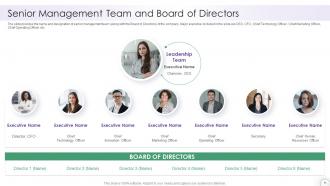
Slide 11: The slide provides the name and designation of senior management team (along with the Board of Directors) of the company.
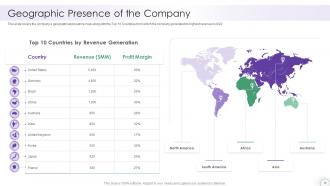
Slide 12: This slide covers the company’s geographical presence map along with the Top 10 Countries from which the company generated its highest revenue.
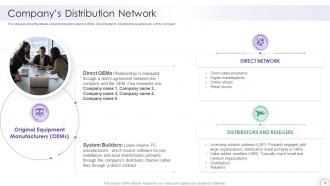
Slide 13: The slide represents the details about distribution network (OEMs, Direct Network, Distributors & sellers etc.) of the company
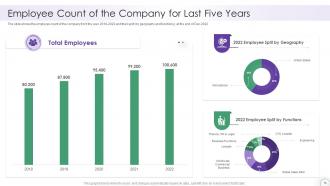
Slide 14: The slide shows the employee count of the company from the year 2017-2021 and their split (by geography and functions).
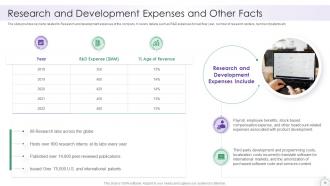
Slide 15: This slide presents Research and Development Expenses and Other Facts.
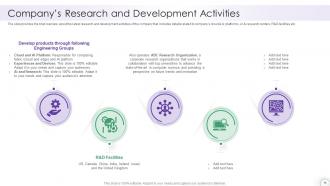
Slide 16: The slide provides the brief overview about the latest research and development activities of the company that includes details related to company’s cloud & AI platforms, AI & research centers, R&D facilities etc.
Slide 17: This slide highlights title for topics that are to be covered next in the template.
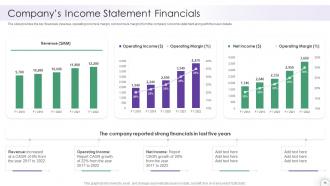
Slide 18: The slide represents the key financials (revenue, operating income & margin, net income & margin) from the company’s income statement.
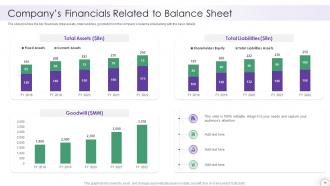
Slide 19: The slide provides the key financials (total assets, total liabilities, goodwill) from the company’s balance sheet along with the basic details
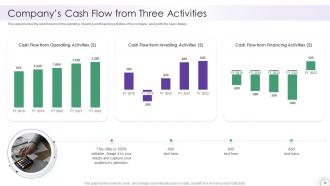
Slide 20: The slide presents the cash flows from the operating, investing and financing activities of the company.
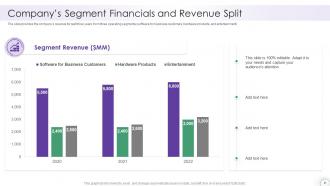
Slide 21: The slide provides the company’s revenue for last three years from three operating segments.
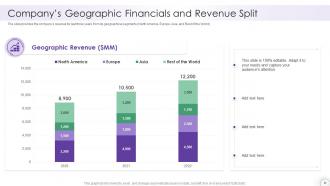
Slide 22: The slide displays the company’s revenue for last three years from its geographical segments.
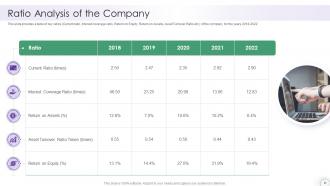
Slide 23: This slide represents a table of key ratios (Current ratio, interest coverage ratio, Return on Equity, Return on Assets, Asset Turnover Ratio etc.) of the company.
Slide 24: This slide highlights title for topics that are to be covered next in the template.
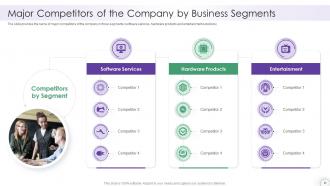
Slide 25: The slide presents the name of major competitors of the company in three segments (software services, hardware products and entertainment solutions).
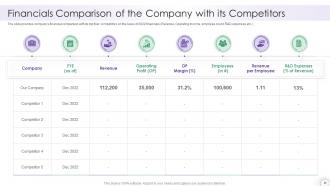
Slide 26: This slide shows Financials Comparison of the Company with Its Competitors.
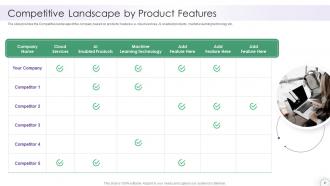
Slide 27: The slide displays the Competitive landscape of the company based on products’ features i.e. cloud services, AI enabled products, machine learning technology etc.
Slide 28: This slide highlights title for topics that are to be covered next in the template.
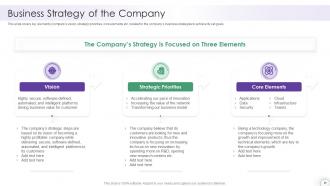
Slide 29: This slide covers key elements (company’s vision, strategic priorities, core elements etc.) related to the company’s business strategies to achieve its set goals.
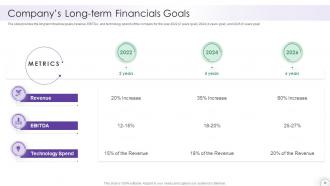
Slide 30: The slide presents the long term financial goals (revenue, EBITDA, and technology spend) of the company.
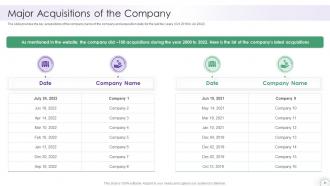
Slide 31: The slide provides the key acquisitions of the company (name of the company and acquisition date) for the last two years.
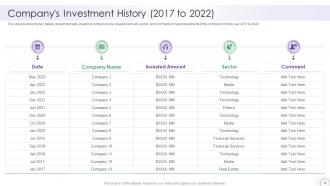
Slide 32: The slide displays the key details (investment date, investing company name, invested amount, sector, and comment) of major investments of the company.
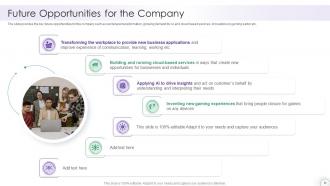
Slide 33: The slide represents the key future opportunities for the company such as workplace transformation, growing demand for AI and cloud based services.
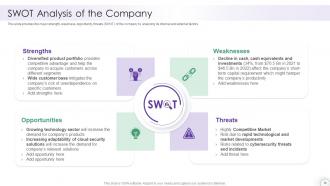
Slide 34: This slide provides the major strength, weakness, opportunity, threats (SWOT) of the company by analyzing its internal and external factors.
Slide 35: This slide highlights title for topics that are to be covered next in the template.
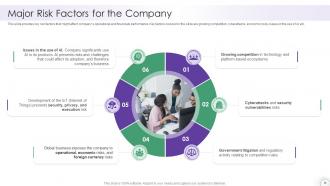
Slide 36: This slide provides key risk factors that might affect company’s operational and financials performance.
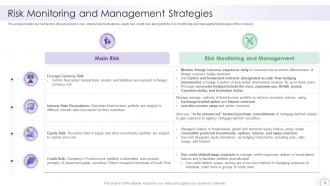
Slide 37: This slide displays key risk factors (foreign currency risk, interest rate fluctuations, equity risk, credit risk) along with the risk management strategies.
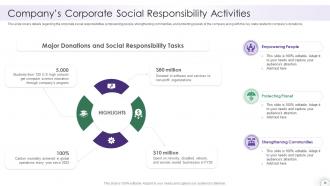
Slide 38: This slide represents Company’s Corporate Social Responsibility Activities.
Slide 39: This slide highlights title for topics that are to be covered next in the template.
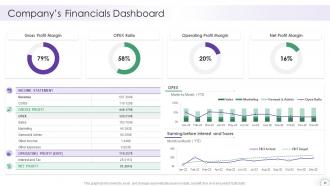
Slide 40: This slide presents Company’s Financials Dashboard with- Gross Profit Margin, Operating Profit Margin, Net Profit Margin, etc.
Slide 41: This slide displays Icons for IT Company Report Sample.
Slide 42: This slide is titled as Additional Slides for moving forward.
Slide 43: This is Our Mission slide with related imagery and text.
Slide 44: This is Our Team slide with names and designation.
Slide 45: This is About Us slide to show company specifications etc.
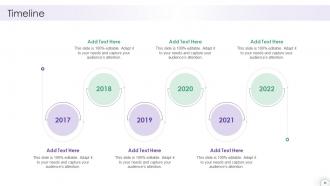
Slide 46: This is a Timeline slide. Show data related to time intervals here.
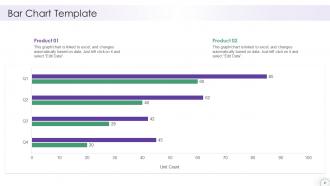
Slide 47: This slide presents Bar chart with two products comparison.
Slide 48: This slide depicts Venn diagram with text boxes.
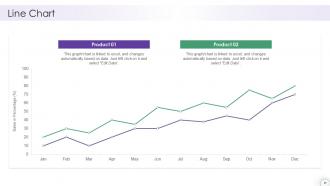
Slide 49: This slide describes Line chart with two products comparison.
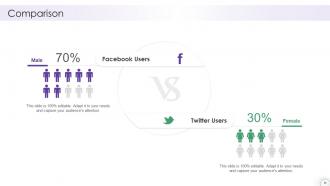
Slide 50: This is a Comparison slide to state comparison between commodities, entities etc.
Slide 51: This slide contains Puzzle with related icons and text.
Slide 52: This is a Thank You slide with address, contact numbers and email address.
IT Company Report Sample Powerpoint Presentation Slides with all 57 slides:
Use our IT Company Report Sample Powerpoint Presentation Slides to effectively help you save your valuable time. They are readymade to fit into any presentation structure.






FAQs for IT Company Report Sample
Track your revenue per employee and customer acquisition cost first - those are non-negotiables. Monthly recurring revenue too if you're subscription-based. Billable utilization rates will show you if people are actually productive, and honestly, developer retention might be your make-or-break metric. Nobody talks about how expensive it is to replace good engineers. Customer satisfaction scores and project delivery times round out the essentials. Don't go crazy with 20 different dashboards though. Pick maybe 5-7 that your leadership team actually uses to make decisions, not just pretty charts nobody looks at.
Don't just dump tech stuff in its own section - work it into your main story instead. Pick maybe 2-3 technologies that actually make sense for what you're trying to do. AI for automation, edge computing, whatever fits. Show real timelines and ROI numbers. Most companies just throw around empty buzzwords (seriously, how many times have you seen "blockchain synergy"?). Focus on how these technologies will solve actual problems your clients have. If you've got pilot results, great - use them. If not, at least outline realistic proof-of-concept plans your team can actually pull off. Keep it concrete and skip the fluff.
Look, customer satisfaction is like your North Star for IT reports - tells you if all that technical work actually matters to clients. Check your retention rates, renewals, support ticket scores. Happy customers stick around and refer others, which honestly makes your quarterly reviews way smoother. When satisfaction drops, there's usually something deeper going on - maybe product issues, slow support, or projects running off the rails. I always track it next to technical metrics because you need both to see the real story. Technical perfection means nothing if customers aren't buying it.
So basically, startups are obsessed with growth stuff - user acquisition costs, monthly recurring revenue, how fast they're burning cash. They're trying to prove they won't die tomorrow, you know? Established companies couldn't care less about that drama. Profitability, steady revenue, market share - boring but reliable metrics. Startup reports honestly get pretty crazy with their projections (part of the hustle I guess), while big firms play it safe with conservative numbers. Just depends what stage they're at. Different priorities completely.
Honestly, competitor analysis is like getting a behind-the-scenes look at what everyone else is doing wrong (and right). You'll catch pricing mistakes before you make them yourself. Plus it shows you exactly where your services are lacking compared to theirs. The cool part? You can spot tech trends early, way before they blow up everywhere. I've seen companies find partnership opportunities they never would've considered otherwise. Short version: it tells you where competitors are screwing up so you can swoop in and do better.
Ditch the spreadsheet dumps - nobody wants to stare at rows of numbers. Use visual dashboards instead. Traffic light systems work great (red/yellow/green) because people just want to know if we're winning or not. Break it down into chunks: revenue growth, margins, cost per acquisition. Always throw in year-over-year comparisons - that's where the real story is. And honestly? The brief explanations matter more than you think. Don't just show the numbers, explain what's actually driving them. Connect everything back to your business goals so stakeholders can see why they should care. Makes your life easier when budget season rolls around.
One key message per slide - seriously, don't try to cram everything in there. Bar charts and line graphs work best for IT stuff since people can actually read them fast. I'd avoid those crazy colorful pie charts (they just make everyone's eyes hurt). Pick a color scheme and stick with it throughout the whole thing. Label your axes clearly - sounds obvious but you'd be surprised. Oh, and always cite where your data came from. The biggest thing though? Tell them exactly what you want them to do about it. Data without action items is pretty useless.
Ugh, regulatory changes are such a nightmare - they mess up your whole reporting setup. New rules mean you're suddenly collecting different data, updating security stuff, changing how you document everything. Remember when GDPR hit? Total chaos. Your timelines get way longer because there's more steps to verify everything. The trick is getting ahead of it instead of panicking at the last minute. I always set up industry alerts so I'm not blindsided. Also, build in extra time for your reporting schedule - trust me on this one. It sucks until everyone figures out the new process, but you'll adapt.
Dude, reporting is a game-changer for IT project management. Track stuff like sprint velocity and delivery timelines in real-time - you'll catch bottlenecks before they mess everything up. The data shows patterns too, like when Sarah's drowning in work again or why database tasks always take forever. Most teams honestly have no clue what's happening without dashboards. Historical data makes future estimates way more accurate. Start with weekly automated reports covering your main KPIs. Trust me, your PMs will love having actual visibility instead of just guessing all the time.
So you'll need the usual ESG stuff - environmental is energy use, carbon footprint, e-waste, data center efficiency. Social covers diversity, safety, community stuff, data privacy. Governance is board makeup, exec pay, cybersecurity, ethics. Data privacy is honestly massive for IT companies right now. Everyone's watching how you handle user data - it's probably your biggest risk area. Oh, and supply chain sustainability if you deal with hardware at all. I'd start by checking what competitors are putting out there, then figure out what you can actually track and show improvement on. Some metrics are way easier to measure than others.
Just add the engagement stuff right into your quarterly reports alongside the usual tech metrics. Survey scores, retention rates, training completions - that kind of thing. Honestly, upper management loves seeing you think beyond just fixing servers and closing tickets. I'd track team satisfaction and internal moves too. Oh, and definitely voluntary turnover by team since that tells you where the real problems are. The key is connecting those numbers to actual business results though. Build a simple dashboard showing engagement trends next to productivity - way more compelling than just raw performance data. Makes you look like you actually get the people side of things.
Focus on three things: data validation, checking your sources, and doing regular audits. I'd set up automated flags for weird outliers - seriously saves you from looking dumb in meetings later. Always double-check you're pulling from the right systems (sounds obvious but you'd be surprised). Cross-reference your big numbers with other sources if you can. Monthly spot-checks are clutch too. Document everything so your teammates can follow your process. Oh, and catch errors early because fixing them after reports go out is the worst.
So here's the deal - international standards make you standardize financial reporting across every country you're in. Total pain at first, honestly. Your accounting team will probably hate you for a while lol. But it does pay off because investors trust you more when everything looks consistent. Plus acquisitions become way less messy since everyone's using the same financial language. You'll need IFRS or GAAP depending on your markets. My advice? Pick one main standard right away and build everything around that. Don't try to retrofit later - learned that the hard way.
Skip the tech speak that'll make investors' eyes glaze over. Nobody wants to read a coding manual. And please, don't pretend everything went smoothly - we all know tech projects are messy. Talk about the actual problems you hit and how you fixed them. Those cheesy stock photos of people pretending to look excited about laptops? Hard pass. Focus on real numbers and what actually happened instead of throwing around buzzwords. Your engineering team already knows what you built - write this for people who control the money.
Dude, stories are a game changer for boring IT presentations. People zone out when you're rattling off server stats, but tell them how your upgrade literally saved someone's Black Friday? Now they're listening. Complex tech stuff becomes way more relatable when you wrap it in real scenarios. I mean, we all know death by PowerPoint is real. Start with a customer problem, walk through your solution, then tie it back to how you fixed their mess. Creates an actual emotional hook instead of just throwing data at people's faces.
-
Thrilled to see several customizable templates catering various verticals and industries.
-
It’s really cool, and you can find pretty much everything you could need for your work or school.