


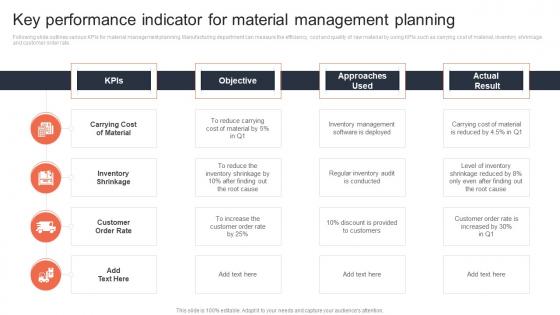
Key Performance Indicator For Material Management Planning




Try Before you Buy Download Free Sample Product
 Impress Your
 Audience
 100%
100% Editable
 Save Hours
 of Time


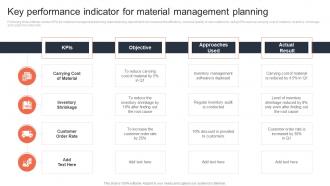
Following slide outlines various KPIs for material management planning. Manufacturing department can measure the efficiency, cost and quality of raw material by using KPIs such as carrying cost of material, inventory shrinkage and customer order rate.
People who downloaded this PowerPoint presentation also viewed the following :
Key Performance Indicator For Material Management Planning with all 6 slides:
Use our Key Performance Indicator For Material Management Planning to effectively help you save your valuable time. They are readymade to fit into any presentation structure.





FAQs for Key Performance Indicator For
For material management, focus on inventory turnover ratio, stockout frequency, and carrying cost percentage. Order accuracy rate and supplier lead times are game-changers too - seriously, they'll prevent so many fires later. Inventory accuracy should hit 95%+ if possible, plus track your days of inventory on hand. Here's the thing though: don't go crazy measuring everything right away. Pick maybe 3-4 that tackle your worst problems first. Get those running smoothly, then add more. Way easier than drowning in data you can't act on anyway.
So tracking KPIs basically gives you a heads-up when inventory's going sideways. You'll catch stuff like counting errors in certain areas or items that keep disappearing - way before it becomes a disaster. Honestly, it's pretty satisfying when the data just points right at the problem. Pick maybe 2-3 accuracy metrics and check them weekly. Things like cycle count accuracy or stock variance rates work well. The whole point is spotting patterns early so you can actually fix what's broken instead of just scrambling to catch up later.
Lead time is honestly the thing that makes or breaks your whole material management setup. Without accurate lead times, you can't set realistic targets for inventory turnover or figure out how much safety stock you actually need. Your supplier performance metrics? They depend on it too. I learned this the hard way - unpredictable lead times will mess up your entire planning process. Long or variable lead times mean you're stuck holding more buffer inventory, which kills your working capital numbers. Measure your actual lead times first, then use those to set all your other KPI targets.
Check if there's a trade group for your industry first - they usually put out reports with all the KPI stuff you need. McKinsey and Deloitte do annual supply chain studies too, though honestly those can be pretty dense. Your ERP system might actually have benchmarking built in, which is convenient since your data's already there. Just make sure you're comparing against similar companies - same size, complexity, all that. I'd probably start with maybe 3-5 basics like inventory turnover and stockout rates. You can always add more metrics later once you get the hang of it.
Look at your past data first - that's your real starting point, not some random numbers that look impressive. Pick maybe 3-5 metrics tops (inventory turnover, stockouts, carrying costs). Honestly, I've watched teams drown in dashboards and it's painful to see. Get your team involved when setting targets. They know what's actually doable day-to-day. Make sure everything connects to bigger company goals too. Your KPIs should push people but not break them, you know? Check in quarterly since this stuff changes fast. Start with beating your own records, then aim higher.
So technology pretty much handles all that spreadsheet nonsense you're probably doing now. Most ERP systems show your KPIs in real-time - inventory turnover, stockouts, carrying costs all get calculated automatically. Dashboards look way better than they used to, honestly. You can set alerts when numbers hit certain levels instead of constantly monitoring everything yourself. The predictive stuff is cool too - helps catch trends early. I'd start with whatever system you already have and just build custom reports. Most let you do it without bugging IT, which is nice.
Honestly, just focus on three main things: **on-time delivery**, **quality defects**, and **cost performance**. Those will give you like 90% of what you need to know. **Lead time variability** is super important too - even if they're technically on time, inconsistent timing screws up your whole planning process. You can also track **fill rates** and how responsive they are when you reach out, but don't go crazy with too many metrics right away. Pick maybe 3-4 that actually matter for your specific situation and review them monthly. Works way better than drowning in data nobody looks at.
Honestly, KPIs are a game-changer for demand forecasting - way better than just winging it. Track stuff like inventory turnover, seasonal patterns, and supplier lead times to catch trends you'd totally miss otherwise. I've watched teams slash their forecasting errors by 30% just from monitoring the right metrics consistently. Focus on demand variability, how often you're out of stock, and consumption patterns across different timeframes. Oh, and start small - pick your top 3-5 materials first. Trust me, trying to track everything at once will bury you in data you can't actually use.
Ugh, data silos are the absolute worst - your ERP and warehouse system will constantly show different numbers and you'll want to scream. Plus everyone thinks "on-time delivery" means something different, which gets messy fast. First thing: get everyone on the same page about what your KPIs actually mean. Seriously, have that awkward meeting now or suffer later. Then work on connecting your systems better, even if it's just syncing data regularly. Automate whatever you can so people aren't fat-fingering numbers into spreadsheets. Oh, and standardize how you define stuff across teams - sounds boring but it'll save your sanity.
Honestly, KPIs are like having a money radar for your business. Track stuff like inventory turnover and carrying costs - you'll spot the cash drains fast. Low turnover? You're sitting on too much stock (ouch, expensive). Supplier delivery metrics show which vendors are screwing you over with delays. Purchase price variance helps with negotiations, and monitoring stockouts prevents those crazy rush orders that kill your budget. The trick is setting up dashboards that actually make sense - I've seen too many that are just confusing. When patterns jump out at you, that's when you can move quickly.
Look, manufacturing and retail track totally different KPIs because their supply chains are like apples and oranges. Manufacturing obsesses over inventory turnover, waste rates, supplier lead times - all that production efficiency stuff. Retail? They're all about stock-outs, product velocity, seasonal forecasting. Honestly, retail KPIs shift way more often too, which can be exhausting. Manufacturing cares if they're transforming materials efficiently. Retail just wants the right products available when customers show up. Figure out if your materials are production inputs or direct sales items first - that'll tell you which direction to go with your KPIs.
Cycle time's a game changer - it shows how long your whole process takes from order to delivery. Track it and you'll spot bottlenecks fast. Could be slow suppliers, warehouse issues, or those annoying approval delays. Honestly, I've seen companies waste months before realizing their problem was sitting right there in the data. Faster cycle time means better cash flow and happier customers. Start by measuring everything end-to-end, then break it down by stage. That's where you'll find the real time wasters and know exactly what to fix first.
Look, if your team doesn't care about the KPIs, those numbers are basically useless. Engaged employees actually watch things like inventory accuracy and waste reduction - plus they want to make those metrics better. The ones who've checked out? They'll just sleepwalk through their shifts and your data will show it. Here's what I've noticed though - when staff help you pick the KPIs in the first place, they're way more invested in hitting targets. They start catching problems early and throwing out ideas for improvements. It's like having extra managers everywhere, but without the ego trip.
Oh man, when those material KPIs go off track, everything starts falling apart. Production gets delayed, then you're scrambling with expensive rush orders or stuck with way too much inventory sitting around. Your suppliers get annoyed, customers are pissed about late deliveries - honestly, it's just a mess all around. Finance will be breathing down your neck about budget overruns too. Set up some kind of early warning system so you can catch problems before they snowball. Trust me, your boss will notice if this keeps happening and nobody wants that conversation.
Check those KPIs monthly if you can manage it - quarterly at the absolute minimum. Supply chains are nuts right now, so what looked solid 3 months ago could be trash today. Monthly lets you catch trends early, then do your deep dives quarterly where you actually change targets or ditch the metrics that aren't helping. I learned this the hard way when I waited too long and missed some major supplier issues. Annual reviews? Forget it - way too late. You'll miss demand shifts, cost changes, all that stuff. Just throw it on your calendar now or you'll definitely forget.
-
Informative presentations that are easily editable.
-
They helped us design the pamphlets for our church’s food drive! The people loved the design, and I’m happy to say it was successful. Thank you, SlideTeam!