


Material Requirement Planning Dashboard With Inventory Management




Try Before you Buy Download Free Sample Product
 Impress Your
 Audience
 100%
100% Editable
 Save Hours
 of Time


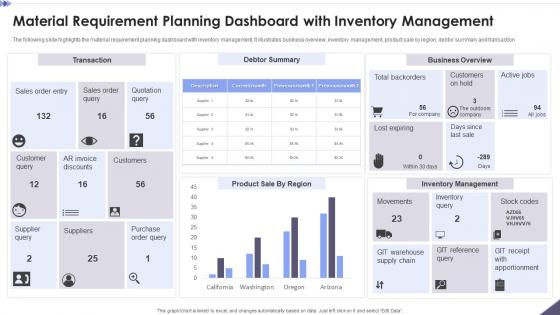
The following slide highlights the material requirement planning dashboard with inventory management, It illustrates business overview, inventory management, product sale by region, debtor summary and transaction.
People who downloaded this PowerPoint presentation also viewed the following :
Material Requirement Planning Dashboard With Inventory Management with all 7 slides:
Use our Material Requirement Planning Dashboard With Inventory Management to effectively help you save your valuable time. They are readymade to fit into any presentation structure.





FAQs for Material Requirement Planning Dashboard
So MRP basically makes sure you've got the right stuff when you need it for production. Think of it like a smart calculator that works backwards from your schedule. It takes your master production plan and figures out exactly what components you'll need, when to order them, considering lead times and what's already in stock. Honestly, it's a lifesaver - no more panic ordering or sitting on piles of unused parts. First thing though? Get your bill of materials nailed down. That's where everything starts, and if it's wrong, you're screwed from day one.
So MRP is like meal prepping - you plan everything out and buy materials ahead of time based on your production schedule. JIT is more like ordering food when you're actually hungry, only getting stuff right when you need it. With MRP you won't run out of materials but your cash gets tied up in inventory. JIT keeps costs down but honestly, you're screwed if suppliers are late. I'd go with MRP if your demand is pretty predictable and you trust your suppliers to be reliable.
Look, MRP needs three main things to actually work. Your master production schedule comes first - what you're making and when. Then you need solid bill of materials data showing every component that goes into your products. Inventory records are the third piece, and honestly? Most places totally bomb this part because their inventory tracking is a mess. Oh, and don't forget lead times for both purchasing and manufacturing. If your data sucks in these areas, the whole system just spits out useless info. Start with an inventory audit - that's usually where everything falls apart first.
So MRP basically tells you exactly what to buy and when, based on your production schedule. No more guessing or panic-ordering extra stuff. It checks your current stock, looks at lead times, then spits out precise buying recommendations. Super helpful for avoiding that nightmare where you're drowning in inventory that's just eating cash and warehouse space. The system's pretty smart too - it'll catch when you already have enough stock to cover upcoming orders, so you can skip buying more. Honestly wish more people would just trust what it says instead of going with their gut. Run it regularly and actually listen to it.
Look, forecasting is what makes your whole MRP system actually work. It drives your master production schedule, which then calculates what materials you need and when. Bad forecasts? You'll end up with way too much stuff sitting around or constant stockouts - both suck for business. Honestly, I've seen companies spend tons on fancy MRP software but totally phone it in on demand planning. That's backwards. Get your forecasting solid first because everything else flows from there. Without it, you're basically guessing and hoping for the best.
Honestly, just track a few key things and you'll know pretty quick if your MRP is working. Inventory turnover is huge - plus how often you're running out of stock or missing production deadlines. Your forecast accuracy matters too because if you're always way off, something's broken. The biggest one though? Compare your actual costs to what you planned. That's where the rubber meets the road since MRP should save money, not waste it. Oh, and don't forget lead times and supplier performance - those mess with your planning if they're inconsistent. Monthly reports work fine for most places.
Honestly? Data's gonna be your biggest headache. If your inventory numbers, BOMs, or lead times are even slightly off, everything crumbles fast. People will fight you on changing how they work too - I've seen that kill projects before they start. Then there's the tech side... older systems usually hate talking to new MRP software, which gets expensive quick. Oh, and the training takes forever. My take? Fix your data accuracy first, then focus on getting the department heads actually excited about it. Don't rush the rollout or you'll regret it.
MRP works best when it talks to your other systems automatically. Production scheduling syncs up so when MRP figures out what materials you need, it kicks off work orders without you having to do anything. Supply chain stuff is where it really shines though - direct communication with suppliers for reordering and delivery schedules. The companies killing it also hook up quality management and financials. Everything from POs to inventory values just flows through. Oh, and make sure data goes both directions between systems - I've seen too many one-way setups that create headaches later. Map out what needs real-time updates versus batch processing first.
So lead times are basically how MRP figures out when to order stuff. The system counts backwards from when you need something delivered, then subtracts however long each part takes to get. Like if your supplier needs 3 weeks for materials, MRP automatically schedules that order 3 weeks early. Pretty straightforward, right? But here's where companies mess up - they don't keep their lead time data current. You end up with way too much inventory or you're constantly doing rush orders because the timing's off. I'd say update that data every quarter, maybe more if you've got flaky suppliers.
So the main ones are SAP, Oracle, Microsoft Dynamics, and NetSuite. SAP's super powerful but honestly a nightmare to set up - I've seen companies take forever with it. Most have the basics covered: demand forecasting, inventory stuff, production scheduling, procurement management. They'll hook into whatever ERP you're already running and give you real-time supply chain visibility. NetSuite's way easier to use than SAP if you want something less headache-inducing. Really comes down to your size and budget though. I'd grab demos from like 2-3 options and see what clicks with how you guys work.
So MRP basically handles this through constant re-planning - you can set it to run weekly, daily, or real-time if your system's fancy enough. Demand changes? Update your master schedule and watch it recalculate everything down the line. The trick is nailing your lead times and safety stock so you can roll with the punches. Modern systems are pretty good at auto-adjusting when demand spikes hit. Just don't go crazy tweaking every tiny change - honestly, that'll drive you nuts. Set some thresholds for what actually needs a replan vs. normal noise.
So MRP completely changes your supplier game - instead of just winging it, you'll actually know what you need and when. Your procurement gets way smarter since you can plan around real demand and lead times. Suppliers eat this stuff up because predictability is gold to them. Better contracts, fewer emergency orders, stronger relationships since you're not scrambling all the time. Here's the thing though - you've gotta share that MRP data with your main suppliers. Otherwise everyone's still flying blind. Makes such a difference when you're all looking at the same numbers.
Look, MRP is actually perfect for small businesses because you don't have years of messy processes to fix. Cloud systems are crazy cheap now - seriously, some cost less than what you spend on lunch. Start with your main products only, don't get fancy yet. The real win? You'll stop tying up cash in extra inventory or scrambling when a big order hits. Just focus on seeing what you need and when. I'd pick something simple and grow into it rather than going all-out from day one. Way less headache that way.
Look, the biggest MRP myth? People think it's some magical optimizer that'll solve everything. Wrong. It just crunches numbers - tells you what materials you need and when, based on your schedule and BOMs. Bad data in means bad results out, period. Also, tons of companies assume it handles safety stock calculations or complex capacity issues. It really doesn't do either well. Honestly, I've seen so many places get burned by this. Treat MRP like a decent planning tool, not your savior. Just make sure your data's clean first or you'll hate the results.
So AI and ML are making MRP demand forecasting way more accurate - they analyze weather patterns, social media buzz, economic data instead of just looking at last year's numbers. Real-time inventory optimization is getting crazy good too. When supply chain stuff hits the fan, these systems auto-adjust production schedules. Your team ends up dealing with way fewer stockouts and overstock headaches. Honestly the tech has come so far lately it's kind of nuts. Planners can actually do strategic work instead of putting out fires all day. I'd start with whatever AI modules your current ERP vendor offers.
-
Like always a great experience with you guys. Always there on the drop of hat to help.
-
Best way of representation of the topic.