

Material Requirements Planning And Forecasting Dashboard Strategic Guide For Material





Try Before you Buy Download Free Sample Product
 Impress Your
Audience
 100%
Editable
 Save Hours
of Time


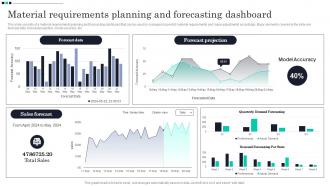
This slide consists of a material requirements planning and forecasting dashboard that can be used by managers to predict material requirements and make adjustments accordingly. Major elements covered in the slide are forecast data, forecast projection, model accuracy, etc.
People who downloaded this PowerPoint presentation also viewed the following :
Material Requirements Planning And Forecasting Dashboard Strategic Guide For Material with all 10 slides:
Use our Material Requirements Planning And Forecasting Dashboard Strategic Guide For Material to effectively help you save your valuable time. They are readymade to fit into any presentation structure.








FAQs for Material Requirements Planning And Forecasting Dashboard Strategic
You need three main things: master production schedule, bill of materials, and inventory records. Think of the BOM like a recipe - it shows exactly what goes into each product. Your master schedule says what to build and when. Inventory records track what's actually sitting in your warehouse vs what the computer thinks is there (spoiler: they're usually different). Don't forget lead times from suppliers and some kind of demand forecasting. Honestly, if your data's messy, you'll get trash results no matter what. I'd start with cleaning up those BOMs first - they're always the biggest disaster.
Honestly, good forecasting is what makes your MRP dashboard actually useful instead of just pretty charts. Better demand data means the system calculates smarter material requirements and realistic schedules. You'll have way fewer stockouts and less dead inventory cluttering your warehouse. Your procurement people will thank you too - no more panicked order changes every week. I learned this the hard way when our forecasts were garbage and everything downstream was chaos. Short story: fix your forecasting first, then watch your whole MRP system suddenly make sense.
Look, historical data is what makes your forecasts actually work. You need those past consumption patterns to spot things like seasonal spikes - maybe you always burn through 30% more steel in Q4, stuff like that. Without decent historical data you're just shooting in the dark, which means you'll either run out of inventory or end up with piles of components nobody needs. Trust me, the algorithm gets way better once it has more data to work with. You'll want at least 12-18 months of clean data to get forecasts that don't suck.
Honestly, just hook your MRP dashboard straight into your ERP system and IoT sensors - maybe supplier APIs too if they're not terrible. Skip the manual uploads, that's just busywork nobody wants. Start with the basics: current stock, work-in-progress, and how your actual production compares to what you planned. Those three will save your butt when things go sideways. Real-time data means you'll catch problems early instead of scrambling later. Don't go crazy though - pick one or two sources first, prove it works, then add more.
Honestly, the two big things that'll bite you are crappy data and people pushing back. If your inventory numbers are all over the place, forget it - garbage in, garbage out. Staff who've been doing things the same way forever will fight you hard on changes. Can't really blame them though. Integration with your current systems is usually a nightmare, and yeah, it's gonna cost you upfront. Oh, and the setup takes way longer than anyone thinks. Best bet? Clean your data first - like, really clean it. Then get your key people involved early so they don't feel like you're forcing stuff on them.
Honestly? Go with linear regression if your demand has any kind of trend or seasonality. Moving averages are dead simple to calculate, but they're always playing catch-up since they just look at what already happened. I mean, they're fine for super stable products that don't change much. But regression actually picks up on patterns and gives you way better safety stock numbers. I've worked with planners who avoid it because the math seems scary, but it's really not that bad once you get used to it. Your reorder points will thank you later.
Track your forecast accuracy and inventory turnover first - those are your bread and butter metrics. Stock-outs and safety stock levels matter too because nobody wants to deal with pissed off customers. Don't forget supplier stuff like on-time delivery and lead time variance. Honestly, the whole game is balancing service levels with what you're spending on inventory. So throw in carrying costs and obsolete inventory percentages. Start simple with these basics. Your team can handle fancier metrics later once they're not drowning in the dashboard.
Dude, MRP dashboards are seriously clutch for cutting inventory costs. You get real-time data showing what you actually need vs. all the stuff just sitting there collecting dust. Slow movers become super obvious - no more mystery stockpiles eating your cash. Better purchase timing too, so you're not panic-ordering huge quantities way too early. I swear, nothing's worse than realizing you've got a warehouse full of parts nobody wants for months. The forecasting helps you stay stocked without going overboard. Honestly? Just start tracking your inventory turns first - you'll spot the problem areas fast.
Honestly, AI and machine learning are crushing it right now for demand forecasting - they catch patterns in your data that you'd miss completely. Cloud platforms are huge too since your whole supply chain can actually talk to each other in real-time. IoT sensors got way cheaper lately, so you can automate inventory tracking instead of those painful manual counts. Predictive analytics are getting scary good at catching disruptions early. Oh, and definitely bug your current MRP vendor about AI features - they're all scrambling to add them.
Okay so here's the thing - when different departments actually talk to each other, your forecasts get SO much better. Sales knows about upcoming promos, marketing has campaign dates, operations understands what you can actually produce. Finance keeps everyone grounded with budget reality checks. It's wild how much stuff gets missed when teams just do their own thing in separate bubbles. Procurement usually has the best intel on supplier delays too, which... yeah, that matters more than people think. Set up monthly meetings where everyone shares what's coming up. Trust me, your predictions will actually make sense instead of getting blindsided by obvious stuff.
Demand forecasting is literally make-or-break for procurement costs. Get it right and you'll negotiate solid contracts because you actually know your volumes. Mess it up? Hello emergency orders at crazy prices, plus dead inventory sitting around forever. Safety stock gets all wonky too when your forecasts are off. Honestly, I've seen companies burn so much cash on this stuff. Your supplier relationships improve big time when you can give them reliable numbers - they'll even offer better payment terms. Start there with the forecasting accuracy, then build your procurement strategy around those predictions. Way more strategic that way.
Build buffer stock into your MRP - that's your safety net for demand spikes. Dynamic safety stock levels work way better than fixed ones since they adjust based on how accurate your forecasts actually are. Rolling forecasts with shorter time periods help you spot trends quicker too. ABC analysis is honestly a total game changer for figuring out which items need the biggest buffers. Exception reporting is key - you want alerts when actual demand goes way off from what you predicted. Oh, and review your buffer levels monthly. Sounds boring but you gotta adjust based on real performance data, not just gut feelings.
Dude, visualization tools are a game changer for MRP data. You know how you're drowning in those massive spreadsheets? Charts and graphs turn that mess into something you can actually understand quickly. Heat maps show you shortages right away, trend lines reveal seasonal stuff - it's way better than squinting at rows of numbers. I swear it's like the difference between reading a manual and just seeing the picture. You'll catch problems and spot opportunities so much faster. Oh, and start with whatever visualizations answer the questions you're asking every single day first.
Honestly, cloud MRP is so much better than those old on-premise systems. Way cheaper to start with, and you can access everything from anywhere - which is huge. Your team can actually work together in real time even if they're scattered all over. Updates just happen automatically too, so no more waiting around for IT to install patches. Scaling up or down is super easy when your business changes. The integration thing is pretty smooth compared to what I've seen with legacy systems. Oh, and you won't be stuck babysitting servers anymore - that alone makes it worth it. Definitely push for a demo if you're considering it.
Look, training is honestly what separates successful MRP dashboards from total flops. Your team needs to actually understand what they're looking at - like what each metric means and how to read the data properly. Otherwise they'll either completely ignore it or make terrible decisions based on stuff they don't get. I can't tell you how many companies I've seen drop serious cash on these systems only to have them sit there unused because nobody bothered teaching people how to use them right. Plus good training helps catch data problems early and shows people which numbers actually matter for their specific job. Worth the investment upfront, trust me.
-
Extremely professional slides with attractive designs. I especially appreciate how easily they can be modified and come in different colors, shapes, and sizes!
-
The best collection of PPT templates!! Totally worth the money.