


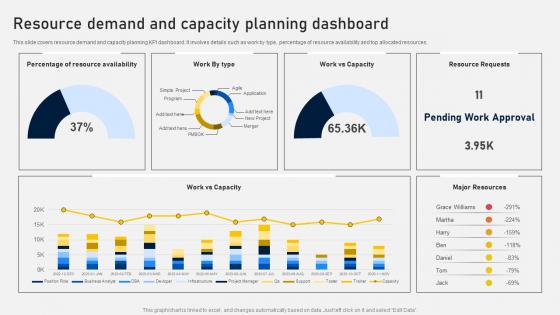
Resource Demand And Capacity Planning Dashboard




Try Before you Buy Download Free Sample Product
 Impress Your
 Audience
 100%
100% Editable
 Save Hours
 of Time


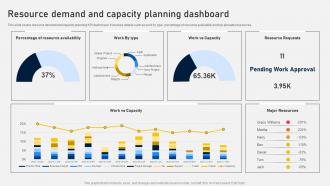
This slide covers resource demand and capacity planning KPI dashboard. It involves details such as work by type, percentage of resource availability and top allocated resources.
People who downloaded this PowerPoint presentation also viewed the following :
Resource Demand And Capacity Planning Dashboard with all 7 slides:
Use our Resource Demand And Capacity Planning Dashboard to effectively help you save your valuable time. They are readymade to fit into any presentation structure.





FAQs for Resource Demand And
Honestly, start by listing everything you've got - people, money, equipment, time. Then figure out what's most critical and assign accordingly. I always add extra buffer time because something will definitely break or go wrong, trust me on this one. Don't spread your team too thin across projects either. Match people's actual skills to what they're doing, not just whoever's available. Check in regularly so you can catch problems before they spiral. Oh, and create a resource breakdown structure first thing - sounds boring but you'll thank yourself later when you're not scrambling to figure out why deadlines are slipping.
Honestly, just throw everything into a spreadsheet first - forget the fancy project management software for now. Figure out what's actually urgent vs. what's just important, then give your best people and budget to those top priorities. Always pad your timelines because I swear something unexpected always happens. Check in weekly to see who's swamped and who has bandwidth. Don't be afraid to move people around when things shift. The biggest mistake? Making some rigid plan and sticking to it no matter what. Reality changes fast, so you've got to stay flexible and ready to pivot.
Monday.com or Asana work well for team stuff - you can see who's swamped and who has bandwidth. Smartsheet's decent too. But honestly? I've watched so many teams buy these crazy expensive enterprise tools and then barely use half the features. Kinda defeats the purpose. If you mean server monitoring, New Relic and Datadog are solid. CloudWatch does the job too for basic needs. The real trick is finding something people will actually keep updated. Best dashboard in the world won't help if your team ignores it. Start simple, see what sticks.
Honestly, external stuff constantly throws your resource planning out the window. Market demand shifts? You're moving budget and people around like crazy. Economic downturns hit and suddenly you're cutting costs and "optimizing" staff - hate that word but whatever. Supply chain issues mess with how you buy things too (we've all lived through that nightmare recently). Interest rates go up and your financing gets expensive, so those big capital projects get shuffled around. The trick is building in flexibility upfront. That way you're adapting fast instead of panicking when everything goes sideways.
Dude, good team communication is what saves projects from total chaos. You'll catch resource problems before they blow up, and nobody ends up doing duplicate work (which is the worst). Regular check-ins are clutch - people can actually speak up about issues early. Plus when everyone's talking, you can play to people's strengths instead of just randomly assigning tasks. I swear, half the project disasters I've seen could've been avoided if teams just... talked to each other more? Sounds obvious but apparently it's not.
Honestly, analytics just shows you where your money's actually going vs where you think it's going. You'll catch bottlenecks and see which teams are burning through resources (marketing departments are notorious for this lol). The cool part is predicting future needs - like when you'll need more servers or staff based on past patterns. But here's the thing: don't build some crazy dashboard right away. Pick 3-4 metrics that actually matter and start there. I made that mistake once and ended up drowning in charts nobody looked at. Keep it simple first, then expand.
Honestly, you're gonna deal with three main headaches: not having enough resources, putting them in the wrong places, and having zero clue what's actually available. Stakeholders will always ask for the moon too - that never changes. Get yourself a real-time tracking system first so you can see what you've got and where it's going. Prioritize based on actual data, not whoever complains the most (learned that one the hard way). Regular check-ins help catch issues early. Set up some dashboards with alerts - way better than scrambling when everything's already on fire.
Look, good resource management is basically cutting waste and shrinking your environmental footprint - that's what sustainable business boils down to. You optimize materials, energy, and time, then boom - you're using less stuff AND spending less money. Honestly, it's one of those rare business moves that actually makes sense from every angle. Your sustainability goals get met while your profits go up because inefficiencies disappear. Customers care about this stuff now too, way more than they used to. I'd start with auditing where you're currently wasting the most resources first.
Honestly, start with what's bugging you most right now - pick 2-3 metrics that match those pain points. Check your resource utilization rates (are people swamped or sitting around?). Project delivery times and staying on budget are obvious ones since good resource management should help both. Employee satisfaction scores matter too - nobody wants burnt out teams. The financial stuff like cost per project and ROI on resources will show you the bigger picture. I'd also watch for the softer signs... fewer bottlenecks, less chaos when deadlines hit. You'll know it's working when those last-minute resource scrambles become rare.
Honestly, just bake resource planning right into your risk process from day one. Map out your critical stuff first - team, budget, equipment, whatever you're working with. Then figure out what could go wrong with each one. Shortages are the obvious killer, but don't forget about overallocation or having the wrong skills when you need them. I've seen projects tank because nobody thought about this early enough. Build those resource limits into your risk scenarios and have backup plans ready. Track your utilization metrics like you would any other risk indicator. Resource availability isn't just something that creates problems - it's also how you solve them.
Honestly, the AI forecasting stuff is where I'd start - those tools are getting scary good at predicting what you'll actually need. Circular economy approaches are huge right now too, basically just designing out waste from the get-go. Companies are also sharing resources way more, like pooling equipment between departments or even with other businesses. Oh and the IoT tracking thing is pretty wild - sensors everywhere telling you exactly where everything is in real time. I know it sounds like a lot but the AI forecasting usually pays for itself fastest, so maybe try that first?
Skill development is honestly a game-changer for resource management. When your people get better at what they do, you don't need as many bodies to hit the same goals. Skilled workers are faster, screw up less, and can jump between different tasks - no more being pigeonholed into one thing. They also won't need you breathing down their necks constantly. I watched one team shave 30% off their project timelines just by training up their staff. The trick? Figure out which skills will pack the biggest punch efficiency-wise, then throw your training budget at those areas first. ROI is usually pretty solid too.
Honestly, start by asking each person what they actually need to work well from home - that'll save you so much guesswork. Set up regular check-ins but don't go overboard with the scheduling. Slack or Teams helps keep everyone connected without constant emails. The recognition thing is tricky since you can't just swing by their desk, so be way more deliberate about calling out good work. Clear expectations around availability matter more than you'd think. And please don't micromanage their hours - trust me on this one. Just stay connected without being that hovering manager nobody wants.
Dude, forget those crazy long-term plans - they're basically useless now. Do shorter cycles instead, like quarterly reviews so you can actually pivot when stuff changes. Cross-train your people and budget for learning because honestly, the pace of change is just insane right now. AI alone has flipped everything upside down in like 12 months. Build good relationships with vendors and stay connected to what's happening in the industry. Oh, and treat your resource strategy like it's alive - update it every few months, not once a year. Your team's adaptability matters way more than having the "perfect" plan that'll be outdated in six months anyway.
So I'd start with utilization rates - basically how much of your stuff is actually working vs just sitting there. Cost per unit and turnaround times are obvious ones. Resource efficiency matters too, like what you're getting out of what you put in. Quality metrics depend on your industry though. Oh, and capacity planning is clutch - you gotta see those bottlenecks coming before they smack you in the face. Honestly, don't go crazy tracking everything. Pick maybe 3-5 things that actually matter to your bottom line. Start simple, then add more as you figure out what the data's telling you.
-
“Easy to use. I always wanted to have a quick search for products and SlideTeam has helped me have it.”
-
I looked at their huge selection of themes and designs. They appeared to be ideal for my profession. I'm sure I'll grab a few of them.