


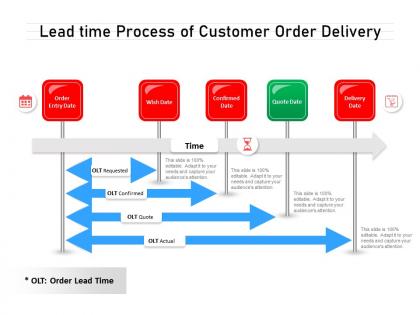
Lead time process of customer order delivery




Try Before you Buy Download Free Sample Product
 Impress Your
 Audience
 100%
100% Editable
 Save Hours
 of Time


Calculate the order of lead time by employing the Lead Time Process Of Customer Order Delivery slideshow. Discuss the entire process of order delivery time by using this attention-grabbing PPT template. Showcase the lifecycle of customer orders with the help of a ready-to-use PPT slideshow. You can also tell the effect of lead time on cost with the help of a visually appealing manufacturing lead time PPT infographic. Provide information on order time in warehouse operations by taking the advantage of our readymade PowerPoint visual. Describe how lead time affects the amount of stock that a company needs to hold at any point in time. As this slide is fully adaptable to your needs, the insertion of new facts is extremely easy. Take the assistance of the order-to lead time process PPT visual to discuss the ways by which the company can reduce the number of days in purchase order lead time. Also, discuss how long lead time affects the business. Thus, download this meaningful and eye-catching PPT presentation and demonstrate the process of preparation and transportation of material.
People who downloaded this PowerPoint presentation also viewed the following :
Lead time process of customer order delivery with all 2 slides:
Give your audience a fulfilling experience. They will find our Lead Time Process Of Customer Order Delivery elevating.

FAQs for Lead time process of
Honestly, it usually comes down to a few big things - your suppliers being flaky, how you're shipping stuff, and whether you've got enough inventory on hand. Distance matters too (obviously shipping from China takes forever). Demand spikes will screw you over every time. Manufacturing hiccups, quality problems, even random weather can throw everything off. I swear seasonal rushes are the worst though. Best thing you can do? Map out your whole process step by step. Figure out what you can actually control vs what you just have to work around. Some stuff you'll never be able to fix, but at least you can plan for it.
Honestly, good lead time management is a game-changer for keeping customers happy. You've gotta be upfront about realistic delivery times so people can actually plan around them. Nobody wants to deal with angry calls asking "where's my stuff?" every day - been there, not fun. The trick is being honest about what you can actually deliver instead of promising crazy fast times just to get the sale. Look at your past performance first. Figure out what timelines you can hit consistently. Customers will trust you way more when you underpromise and overdeliver than the other way around.
Dude, technology is seriously a lifesaver for cutting lead times. First thing - map out your whole process digitally and you'll instantly see where things are getting stuck. Real-time tracking means no more nasty surprises when stuff goes sideways. Automation handles all those tedious handoffs between teams, plus AI can predict delays before they hit. The scheduling optimization is pretty wild too - it'll shuffle resources around automatically. Honestly, just having that visibility changes everything because you're not guessing anymore. Digital workflows keep everyone synced up without the constant back-and-forth emails. Game changer for sure.
So I'd focus on three main things: average lead time, how much that time varies, and your on-time delivery rate. The average gives you your baseline. Variability shows if you're consistent - customers hate unpredictable timing, trust me. On-time percentage is obvious but crucial since it's what customers actually care about. Oh, and definitely break it down by product type or supplier too because different stuff behaves totally differently. Start tracking these weekly, then you can dig deeper once you spot some trends. Way easier than trying to measure everything at once.
Map out what you're doing now and find the bottlenecks first. There's usually 2-3 big ones that are way cheaper to fix than you'd think. Better supplier communication or cutting out unnecessary handoffs between teams can literally save you days. Don't do what I did and try fixing everything simultaneously - that's expensive and chaotic. Pick one thing, see if it actually works, then move on. You want those quick wins where small changes give you massive time savings. Trust me, they're out there if you look for them.
Look at your past lead times first - what patterns do you see? Some suppliers are just flaky, that's reality. I'd build in buffer time based on who you're dealing with. ABC analysis helps you figure out which stuff actually matters to watch closely. Set up alerts when things start going weird compared to your normal baseline. Keep safety stock for the critical components - learned that one the hard way. Having backup suppliers for key items is clutch when someone inevitably screws you over. Oh, and start with your top 20% of SKUs this week.
Oh man, this is so real. Different cultures have totally different ideas about what "urgent" means - like Germans think Americans are crazy impatient, while we're over here tapping our fingers waiting. Some cultures care way more about getting everyone on board and doing things perfectly than rushing stuff out. I had a project with our Tokyo office once and kept thinking they were behind schedule, but turns out their timeline was completely normal for them (whoops). Religious holidays mess things up too, obviously. My advice? Just ask upfront what their realistic timeframes look like and pad your deadlines accordingly. Trust me on this one.
Honestly, the biggest game-changer is just getting your teams to actually talk to each other. Sales, ops, procurement - whoever's in the mix. Those silos are what kill you every time. We started doing weekly check-ins between departments and suddenly bottlenecks weren't these surprise disasters anymore. People could see problems coming and jump on them early. The visibility alone is huge - everyone gets how their stuff affects the bigger picture. I mean, it sounds almost too simple but we cut our lead times by like 3 weeks just from better communication. Worth trying before you go crazy with fancy solutions.
Yeah, you can totally slash lead times with smarter inventory positioning and better demand forecasting. Stock your high-volume stuff closer to customers - seems obvious but so many companies miss this. ABC analysis is clutch for figuring out which items need priority placement. I swear, once you see the patterns it makes total sense. Safety stock calculations will save you from those panic rush orders that take forever. Oh, and map out where your top items are sitting geographically. You'll probably find some easy wins by moving things upstream in your distribution network.
Dude, supplier delays will kill you every time. Development always takes way longer than you think, and stakeholders constantly want "just one more tiny feature" - which is never actually tiny. New components are the worst because nobody knows how they'll behave at scale. Your teams will fight each other too - marketing's ready to launch while engineering needs three more months. Procurement's still getting quotes. Regulatory stuff? Always slower than promised. Honestly, I'd build in like 20% extra time and lock down requirements super early. Otherwise you'll spend every Monday explaining why things are behind schedule. Trust me on this one.
Break your projects into 1-2 week chunks instead of those massive months-long deliveries. Daily standups are honestly clutch - just 15 minutes but they surface problems before they blow up. You'll catch issues way earlier with constant feedback loops. After each sprint, do retrospectives so your team can actually improve their process and cut out the time-wasters. Oh, and map out your current workflow first. Find the biggest bottlenecks and hit those with agile practices. I swear those short sprints make such a difference compared to the old waterfall approach.
Honestly, getting tight with your suppliers can slash lead times by like 20-30%. When they actually trust you, they'll bump your orders up the priority list and give you the real scoop on delays before everything goes sideways. Rush orders? Way easier when you're not just another random customer. I've watched companies shoot themselves in the foot by treating suppliers like they're totally replaceable - spoiler alert, they're not. Just start having regular convos with your main suppliers. Listen to what's actually slowing them down. It's kind of obvious but most people skip this step and then wonder why their timelines suck.
Honestly, just track everything through dashboards - order times, supplier delays, all that stuff. You'll start seeing weird patterns like how some suppliers are always late on Fridays (I swear this happens everywhere). Look at your three biggest slowdowns first and build simple tracking around those. The cool part is using your historical data to actually predict when delays might hit. Like, if it's been raining for two days and your main supplier is across town, maybe expect issues. Start small though - don't try to monitor every single metric right away or you'll go crazy.
Lead time basically controls your whole customer experience and how smoothly your business runs. Knowing your exact lead times lets you set realistic delivery expectations and manage inventory without constantly scrambling. Trust me, it seems super boring until customers start flooding your inbox asking where their stuff is - then it becomes your biggest headache. You can optimize your supply chain and reduce storage costs when you've got reliable delivery promises down. Honestly, just start by mapping out each step in your fulfillment process and actually timing how long each part takes.
Map out your whole process first and spot where things get stuck - that's where you'll get the biggest bang for your buck. Then run it like mini experiments: measure where you're at now, change one thing, test it for a couple weeks, measure again. Way better than trying to fix everything at once (learned that the hard way). Focus on cutting out waste and making handoffs between teams smoother. Oh, and automate the boring repetitive stuff if you can. Track progress weekly - those small wins actually add up to some pretty solid improvements over time.
No Reviews