


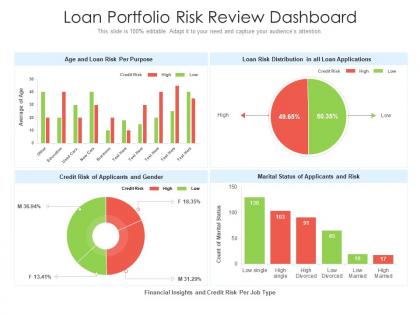
Loan portfolio risk review dashboard




Try Before you Buy Download Free Sample Product
 Impress Your
 Audience
 100%
100% Editable
 Save Hours
 of Time


Our Loan Portfolio Risk Review Dashboard are topically designed to provide an attractive backdrop to any subject. Use them to look like a presentation pro.
People who downloaded this PowerPoint presentation also viewed the following :
Loan portfolio risk review dashboard with all 2 slides:
Use our Loan Portfolio Risk Review Dashboard to effectively help you save your valuable time. They are readymade to fit into any presentation structure.
FAQs for Loan portfolio
Look, credit risk is your biggest headache - borrowers will default. Then you've got concentration risk if you're too heavy in one sector or area. Interest rates shifting can mess you up too, plus liquidity issues. Honestly, when the economy tanks, your whole portfolio can go sideways fast. Operational stuff matters - like if your underwriting is garbage or you're not monitoring properly. Diversify across different borrower types and industries, that's basic. Run some stress tests first to find your weak spots, then tweak your strategy. Oh, and loan terms - mix those up too.
Look, economic indicators are basically your early warning system for loan trouble. Unemployment goes up? Default rates follow. GDP tanks or rates spike? Same story - your portfolio takes a hit. Inflation's the tricky one though - makes borrowers seem fine on paper while they're actually getting squeezed hard. I'd definitely track stuff like consumer confidence and housing starts alongside your usual metrics. Honestly, these leading indicators will spot problems way before they show up in your book. If you're not already building this into your monthly dashboards, you should start.
So there are basically three main ways to tackle this. Start with probability of default models - logistic regression works great, or you could go the machine learning route. Then you'll need loss given default analysis for recovery rates, plus exposure at default calculations. Honestly, Monte Carlo simulations are a game changer for stress testing different scenarios. The whole point is combining these into an expected loss framework so you can put actual dollar amounts on risk. I'd build baseline models from your historical data first, then add forward-looking stuff on top. It sounds like a lot but once you get the hang of it, it's pretty straightforward.
Think of diversification like not putting all your eggs in one basket - you're spreading risk across different borrower types, industries, locations, and loan amounts. If you put too much money in one sector and it crashes (hello, 2008 housing mess), you're screwed. But when your loans are spread out, some might go bad while others keep performing fine. That's honestly the whole point - smoothing out those inevitable losses. Borrowers won't all face the same problems if they're in different situations. I'd start by looking at where you're currently concentrated and figure out your biggest exposures first.
Think of collateral as your backup plan when loans go bad. Banks can grab and sell whatever you put up - houses, cars, equipment - to cover what you still owe. It cuts their losses big time. Real estate's popular but honestly, you gotta be careful about overvaluing stuff. Markets crash (2008 was brutal for that). Your whole loan portfolio gets safer when there's solid collateral behind it. Just don't get lazy - banks need to check what those assets are actually worth regularly. Different market conditions can tank values fast.
Basically you're running "what if everything goes wrong" scenarios on your loan portfolio. Economic crash, unemployment through the roof, interest rates going nuts - that kind of stuff. See how your default rates and portfolio values would tank. Run different levels of bad news, different timeframes too. Honestly it's pretty eye-opening when you realize how concentrated your risk might be in certain areas or industries. The whole point is figuring out where you're vulnerable so you can set better reserves and maybe spread things around more. Think of it as stress-testing before life does it for you.
Set up automated alerts for the big stuff - payment delays, credit utilization jumps, debt-to-income shifts. Check your borrowers' credit scores monthly, though weekly's honestly better if your credit bureau can handle it. Track outside signals too: industry troubles, big life changes, regulatory hits in their sector. Oh and build some early warning dashboards that catch problems before they wreck your numbers - that's been a game changer for us. Start with your riskiest exposures first, then roll it out to everyone else. Way easier than trying to do everything at once.
When the economy tanks, consumer loans and credit cards get hammered first - unemployment does that. Interest rates mess with mortgages and commercial real estate big time. Auto loans? They track unemployment since people still need to get to work, but fancy stuff gets cut immediately. Housing's bizarre though - prices can stay high even when defaults spike. Honestly, I think secured loans just handle downturns way better than unsecured debt. Don't wait for default numbers since they're always months behind. Watch job growth and yield curve stuff instead - that'll give you a heads up.
Start with Basel III - that's your foundation for capital requirements. Risk-weighted assets and proper ratios are crucial here. CECL (or IFRS 9 internationally) comes next for loan provisions, and trust me, the paperwork is brutal. You'll also need stress testing under CCAR or whatever your local version is, plus any concentration limits. Honestly, I'd map out which regs actually apply to your institution first - size and charter type matter a lot. Build everything around those core requirements rather than trying to tackle everything at once.
Honestly, ML models are game-changers for loan risk stuff. They'll spot patterns in borrower data that old-school scoring totally misses - like analyzing hundreds of variables at once, even social media behavior (which is kinda wild if you think about it). The cool part? They actually learn from new defaults and get smarter over time. You can stack different algorithms together too, which cuts down on those annoying false positives. I'd say start with gradient boosting on whatever data you've got. Works pretty well for credit risk without much tweaking.
Most places use SAS, R, and Python for the serious number crunching. Banks love their fancy platforms too - Moody's Analytics, FICO Model Builder, stuff like that. Excel's still everywhere (yeah I know it's ancient but whatever). Tableau and Power BI handle the pretty charts that make executives happy. Honestly though? Start with R or Python if you're new to this. They're way more flexible and you won't blow your budget on licensing fees. Plus once you get the hang of one, picking up other tools isn't too bad.
So basically you're putting all your eggs in one basket, which is a recipe for disaster. When too much of your portfolio sits in one sector or area, any shock there can wreck everything fast. Remember 2008? Banks got destroyed because they went way too heavy on real estate - probably seemed like a safe bet at the time. Losses should spread out naturally if you're doing it right. Map out where you've got the biggest concentrations first, then set some hard limits. Mix it up across different industries and regions. Short bursts of pain beat total wipeouts.
So basically, when interest rates jump around, it can really screw with your loan portfolio. Fixed-rate loans start looking pretty terrible compared to whatever's available in the market - major opportunity cost there. Variable-rate borrowers get hit with higher payments, which obviously makes them way more likely to default. Though rising rates do help your margins on new variable loans, so there's that. The longer your loan terms, the worse these swings hurt you. Duration risk is no joke. I'd probably run stress tests every quarter or so to see how different rate scenarios would mess things up.
Start with stress-testing what you've got against these new risk scenarios. Concentration risk is your biggest concern - if you're heavy in sectors that just became riskier, slowly trim those down. Build up the stable stuff instead. Don't go crazy and make huge moves overnight though, that's how you tank your yield (learned that one the hard way). For new loans, tighten up your underwriting criteria to match the new risk landscape. Oh and document everything clearly so you can explain your moves to stakeholders later. They'll definitely ask.
Look, 2008 taught us that diversification literally means survival. You can't just spread loans around different people - geography, sectors, products all matter. Housing seemed "safe" until everything crashed at once because it was all connected. Stress testing became massive after that crisis, and honestly? Those fancy risk models are garbage if your data sucks. Black swan events basically exist to make models look stupid. My takeaway: build tons of protection layers and whatever you think is worst-case scenario... yeah, it'll probably get worse than that.
-
Innovative and attractive designs.
-
It saves your time and decrease your efforts in half.
-
Enough space for editing and adding your own content.