


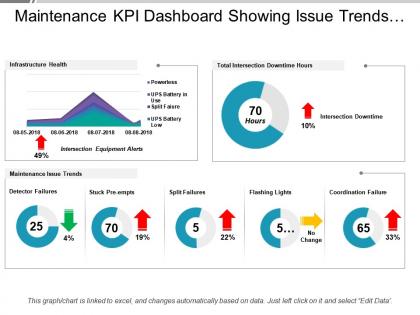
Maintenance kpi dashboard showing issue trends and infrastructure health




Try Before you Buy Download Free Sample Product
 Impress Your
 Audience
 100%
100% Editable
 Save Hours
 of Time


Ensure the innocent get their due with our Maintenance Kpi Dashboard Showing Issue Trends And Infrastructure Health. Bring the actual criminals to book.
People who downloaded this PowerPoint presentation also viewed the following :
Maintenance kpi dashboard showing issue trends and infrastructure health with all 6 slides:
Demonstrate you have a backbone with our Maintenance Kpi Dashboard Showing Issue Trends And Infrastructure Health. Express differences in an amicable fashion.



FAQs for Maintenance kpi dashboard showing issue trends
So you'll definitely want to track MTBF and MTTR - that's mean time between failures and mean time to repair. MTTR is honestly where most people find they can make huge improvements. Equipment availability percentage is the big one though, combines both metrics and that's what the bosses actually look at. Oh, and planned vs unplanned downtime ratio is super helpful too since it shows if you're staying ahead of problems or just constantly putting out fires. Those four will give you a really solid view of how things are actually performing reliability-wise.
Honestly, tracking your maintenance KPIs is a game changer for spotting equipment issues early. You'll want to focus on stuff like OEE, MTBF, and planned vs unplanned downtime - those tell the real story. I worked with a team that cut their surprise breakdowns by 30% just from staying on top of the data weekly. Pretty crazy what a difference it makes when you're actually watching the trends instead of just reacting to problems. Don't go overboard though - pick maybe 3 or 4 metrics that match what you're trying to achieve and review them religiously with your crew.
So you're tracking stuff like vibration patterns and temperature changes to spot when equipment's about to crap out. Think of it as your machines giving you a heads up - "hey, I'm feeling rough" - before they actually break down. Way better than waiting for everything to explode or doing maintenance you don't even need yet. You can plan repairs during downtime instead of scrambling when something dies at 2am (been there, it sucks). Just make sure you've got decent sensors set up and actually do something with the data you're collecting.
Join some industry associations or maintenance groups - they publish tons of benchmarking data. Manufacturing plants have completely different OEE targets than hospitals, so find sector-specific reports. SMRP and local maintenance chapters share anonymized data at conferences (honestly, conferences are where you'll learn the most). Partner with industry consultants too - they've got access to way broader datasets. Just make sure you're comparing similar asset types and company sizes, not random stuff. Oh, and don't try benchmarking everything at once. Pick 3-4 core KPIs first.
Honestly, most teams I know swear by a CMMS like Fiix or UpKeep - they automatically pull your data and give you those nice dashboards for tracking downtime and work orders. Don't get sucked into perfecting every metric though, you'll go crazy. If you're running a smaller operation, Excel with pivot tables works totally fine as long as you actually keep up with entering data (which is harder than it sounds). The real trick isn't finding the perfect tool - it's just picking one and sticking with it instead of constantly switching platforms. Start basic, then add complexity once everyone's comfortable.
KPIs are totally different depending on your industry - it's wild how much they vary. Healthcare obsesses over uptime for life-critical stuff and regulatory scores because, well, people die if equipment fails. Manufacturing cares way more about OEE and planned vs unplanned downtime since they're chasing efficiency. Response times matter huge in hospitals too. Manufacturing tracks cost per unit produced religiously. Don't just steal KPIs from other industries though - match them to what'll actually move the needle for your specific operation. What works in a factory won't work in a hospital.
So maintenance KPIs are literally what build your OEE scores. Availability comes from tracking downtime and failures, performance shows up in speed metrics, and quality reflects how well your equipment makes good parts. Pretty straightforward connection, honestly. Better maintenance KPIs like mean time between failures? You'll see that boost your OEE numbers directly. I'd focus on figuring out which maintenance metrics hit your biggest OEE problem areas first - saves you from chasing the wrong stuff.
Look, KPI trends are basically your crystal ball for figuring out what's actually working vs. what's just bleeding money. If equipment downtime keeps climbing month after month, that's screaming "switch to preventive maintenance NOW." Cost per repair going up? Ditch that ancient conveyor belt already instead of throwing good money after bad (seriously, we all have that one machine we're way too attached to). When mean time between failures starts improving, you know your preventive strategy's actually working. I'd track this stuff monthly - it's perfect ammunition for budget meetings and helps you catch problems before they turn into expensive nightmares.
Data's always a nightmare - scattered everywhere, missing pieces, total mess. Your team will hate you if the metrics feel like gotcha moments instead of actual help. Honestly, most places try tracking like 20 different things and wonder why nothing improves. Focus on maybe 3-5 KPIs max that your crew can actually control. You want some forward-looking stuff (PM compliance) mixed with the after-the-fact numbers (downtime). Getting leadership buy-in is huge too. Start small with metrics that make sense to everyone, then add more once you've got momentum going.
Monthly reviews are your sweet spot for catching issues before they blow up. Do a bigger analysis every quarter though - that's when you figure out if you're even measuring the right stuff. I've seen teams get way too fixated on wrench time when their real problem was reliability. Weekly might make sense if you're running critical equipment, but honestly most places can stick with monthly. Just put it on your calendar and actually show up, even when you're swamped. Those "we'll skip this month" decisions always bite you later.
Training your maintenance crew is honestly a no-brainer for KPIs. Your repair times drop, equipment stays up longer, and you get way fewer repeat breakdowns. Good techs spot issues early during routine checks - saves you from those expensive emergency calls later. Plus they work safer, which keeps incident rates low. I'd start with your biggest skill gaps first since that's where you'll see the fastest improvements. We did this at my last job and the ROI was pretty obvious within like 6 months. The upfront cost stings a bit but it really does pay for itself when your assets last longer.
Honestly, tracking maintenance KPIs is a game changer for catching stuff before it goes sideways. I'm talking equipment uptime, time between failures, how often you actually finish your scheduled maintenance - that kind of thing. Way better than scrambling when everything breaks at once (been there, not fun). Like finding a wonky bearing early versus buying a whole new motor later? No contest. Pick maybe 3 or 4 metrics that actually matter for your setup. Track 'em for three months minimum and you'll start seeing patterns. It's wild how much money you save just by being ahead of the curve.
Look, when you connect your maintenance KPIs to your asset management system, you'll actually see what's happening with your equipment in real-time instead of flying blind. Honestly, it's a game changer. You can spot problems before they turn into costly disasters and schedule maintenance based on what your assets are actually telling you. Budget meetings become way easier when you've got solid data backing up your requests. I'd start with maybe 3 or 4 key metrics that actually matter to your business - don't go crazy tracking everything at first.
Think of maintenance KPIs as your early warning system - they catch problems before they become disasters. Track stuff like equipment failure rates, overdue inspections, and safety incidents. When audit time rolls around, you'll look like a hero with all that data proving you stayed on top of mandatory schedules. Trust me, explaining why critical equipment wasn't serviced when something breaks is not a conversation you want to have. My advice? Figure out which KPIs match your biggest compliance headaches first. Then set up alerts so you know when things start going sideways.
Honestly, the tech for tracking maintenance KPIs is getting pretty wild. Start with IoT sensors on your biggest problem equipment - they'll give you real-time data and prove ROI fast. AI can predict failures before they hit, which is huge. Digital twins sound fancy but they're basically virtual copies of your assets for better analysis. AR tools let techs see maintenance info overlaid right on the equipment (feels like the future, right?). Cloud dashboards tie it all together so you can check everything from your phone. Pick whatever's causing your worst downtime and sensor that first.
-
Easily Editable.
-
Much better than the original! Thanks for the quick turnaround.