


Predictive Maintenance Dashboard With Active Incidents




Try Before you Buy Download Free Sample Product
 Impress Your
 Audience
 100%
100% Editable
 Save Hours
 of Time


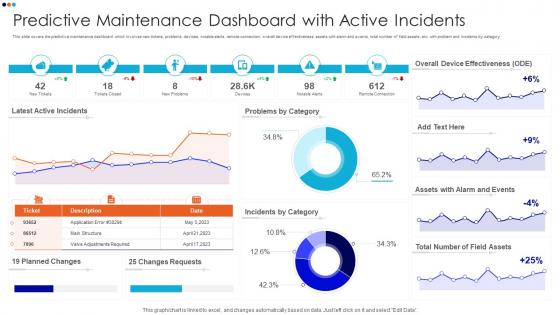
This slide covers the predictive maintenance dashboard which involves new tickets, problems, devices, notable alerts, remote connection, overall device effectiveness, assets with alarm and events, total number of field assets, etc. with problem and incidents by category.
People who downloaded this PowerPoint presentation also viewed the following :
Predictive Maintenance Dashboard With Active Incidents with all 7 slides:
Use our Predictive Maintenance Dashboard With Active Incidents to effectively help you save your valuable time. They are readymade to fit into any presentation structure.






FAQs for Predictive Maintenance Dashboard
Honestly, the biggest difference is way less emergency repairs and lower costs overall. You're catching stuff right when it needs fixing - not too early, not after it's totally busted. Equipment runs longer too since you stop problems before they trash everything else. Planning becomes actually manageable when you can see failures coming weeks out. Schedule repairs during slow periods instead of panicking when machines die during your busiest day (been there, it sucks). I'd start with just your most critical equipment first to show it works, then roll it out from there.
So basically, predictive maintenance watches your equipment and tells you "hey, this thing's gonna break in 2 weeks" before it actually does. You stick sensors on stuff - vibration monitors on motors, thermal cameras checking electrical panels, that kind of thing. Way better than just fixing broken stuff or blindly replacing parts every 6 months like we used to. The data shows you exactly when maintenance is needed. Honestly feels like magic sometimes. I'd start with whatever equipment would totally screw you if it died, then expand from there once you've got the hang of it.
So you'll need IoT sensors first - those grab vibration, temp, and performance data from your machines. Analytics platforms crunch all that info and find patterns (seriously, the data volume is crazy at first). Machine learning spots when stuff might break down. Oh, and get a CMMS system to handle work orders and track everything. Start with sensors on your most critical equipment though. That's where you'll actually see results fast instead of just throwing money around.
Honestly, data analytics is a game-changer for predictive maintenance. Machine learning models can spot patterns in your equipment data that you'd never catch - stuff like subtle sensor readings or weird correlations in failure logs. The algorithms actually get better over time too, which is pretty neat. Instead of playing the guessing game with breakdowns, you're working with real trends. Just make sure you've got clean sensor data first - that's where everything starts. Without good data going in, your predictions will be garbage. Once you have that foundation though, you can build some seriously reliable models.
So basically, IoT sensors are like having tiny health monitors stuck all over your equipment. They're constantly tracking temperature, vibration, pressure - you name it. All that data gets fed into predictive algorithms that spot patterns and tell you when stuff's about to break down. Way better than just crossing your fingers and doing maintenance on a schedule, honestly. Without these sensors you're pretty much guessing. I'd start small though - throw some basic vibration or temp sensors on your most critical machines first. No point going crazy right off the bat.
So basically these ML algorithms can crunch through tons of sensor data and catch failure patterns we'd never spot. They get scary accurate because they're learning from all the historical breakdowns and how equipment behaves under different conditions. Instead of just changing parts every X months, the system will literally tell you "that pump's gonna die in 3 weeks" based on tiny vibration changes or whatever. Honestly the best part is you can plan repairs during normal downtime rather than dealing with those 2am emergency calls that always cost a fortune.
Honestly, data quality will be your biggest headache - sensors give you garbage data half the time. Getting buy-in is brutal too since leadership doesn't want to spend money preventing problems that haven't happened yet. Legacy system integration is a nightmare (been there). Finding someone who gets both the equipment AND the data science? Good luck with that. Oh, and people hate change even when it makes sense. My advice: pick one critical piece of equipment first, show them the money you save, then expand from there.
So basically you're looking at savings vs what you spent on the whole setup. Big things to track: way less surprise breakdowns, cheaper repairs since you catch stuff early, equipment lasting longer. Oh and fewer 3am emergency calls - that alone is worth it honestly. One company I heard about saved like $200K just avoiding a single production shutdown. Do the math yearly - total savings minus your costs for software, sensors, training, whatever. Then divide by those costs. I'd check monthly though so you can keep showing your boss it's actually working.
Honestly, manufacturing and energy companies are crushing it with predictive maintenance right now. Factories can dodge those million-dollar surprise shutdowns, and power plants catch turbine problems before everything goes to hell. Airlines are obsessed with it too (makes sense - grounded planes = angry passengers). Oil and gas use it for pipelines and offshore rigs where fixing stuff costs a fortune. Data centers are hopping on the trend to stop servers from dying randomly. My cousin works at a plant and says it's been a game-changer. If your industry has pricey equipment that can't go down, you should probably look into it.
So basically you want to ditch those rigid maintenance schedules and let the data tell you when stuff actually needs fixing. Track things like vibration, temperature, pressure - that kind of monitoring will show you patterns before things break. Machine learning can crunch all that and be like "yo, that pump's gonna die in 3 weeks" instead of just servicing everything every 6 months like clockwork. Honestly, it's way more efficient. Start with your most critical equipment first, then expand from there. The goal is hitting that sweet spot where you're doing maintenance right before failure risk spikes.
Honestly, you're gonna want data analysts and machine learning people first - that's your foundation. But here's the thing everyone screws up: don't ignore the old-school mechanics who actually know your equipment. I've watched teams build amazing algorithms that completely miss obvious stuff because they don't understand the machines. You'll also need someone good with IoT sensors and getting all that data connected. Vibration analysis, thermography - those skills matter too. Oh, and definitely check what talent you already have before hiring. Sometimes people have hidden skills you don't know about.
Dude, environmental stuff totally changes your whole predictive maintenance game. Temperature swings mess with vibration readings. Humidity and salt air from coastal areas? That's corrosion city. Dusty places will clog filters way faster than the manual says - I've seen pumps that needed weekly checks instead of monthly. You can't just follow generic schedules anymore. Vibrations act weird in extreme heat or cold, so your baselines get thrown off. Honestly, mapping out your specific environmental headaches first is huge. Then adjust monitoring frequency and sensor alerts based on what's actually killing your equipment.
Dude, there's some solid proof this stuff actually works. GE cut their locomotive downtime by 10% with vibration sensors. Rolls-Royce tracks jet engines in real-time to catch problems early. Shell saved 20% on maintenance costs at refineries - which honestly makes sense since those places are expensive to shut down. Delta uses it too for avoiding flight delays. My advice? Don't go crazy trying to do everything at once. Pick one important piece of equipment, test it out, see if you get results. Then expand from there if it works.
Honestly, get your executives talking about it first - once they're throwing real money at predictive maintenance, everyone else pays attention. Train people so the tech doesn't freak them out. Celebrate every small win like crazy because that momentum builds fast. When someone finds an issue through monitoring, don't blame them for it - you want honest reporting, not people covering stuff up. Share those success stories everywhere, especially the ones about avoiding those brutal middle-of-the-night emergency calls (we've all been there). Making data sharing normal instead of secretive changes everything.
So IBM Maximo, SAP PM, and Fiix work great for big companies. Smaller shops usually do fine with UpKeep or Limble though. I've watched way too many places overthink this stuff and buy these massive systems nobody ends up using properly. If you're already using Microsoft stuff, their Azure IoT with Power BI is pretty decent. The real trick is finding something your techs will actually use - doesn't matter how smart the AI is if people won't log their data. Oh, and definitely try a pilot run on your most important equipment first before going all-in.
-
SlideTeam has helped me take my presentation to the next level. Everyone at the office is impressed! I’ll be using their designs for a long-long time.
-
Amazing variety of PowerPoint slides. Really helpful in designing professional presentations.