


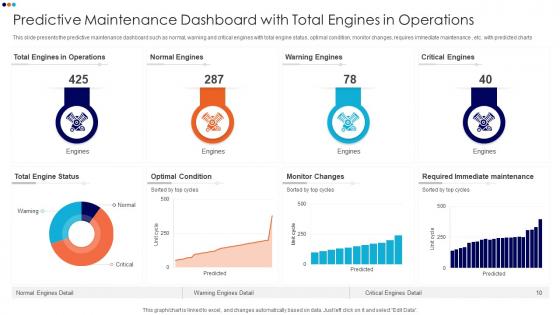
Predictive Maintenance Dashboard With Total Engines In Operations




Try Before you Buy Download Free Sample Product
 Impress Your
 Audience
 100%
100% Editable
 Save Hours
 of Time


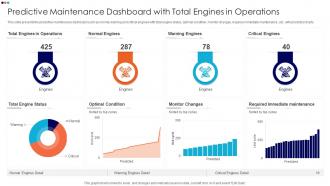
This slide presents the predictive maintenance dashboard such as normal, warning and critical engines with total engine status, optimal condition, monitor changes, requires immediate maintenance , etc. with predicted charts.
People who downloaded this PowerPoint presentation also viewed the following :
Predictive Maintenance Dashboard With Total Engines In Operations with all 7 slides:
Use our Predictive Maintenance Dashboard With Total Engines In Operations to effectively help you save your valuable time. They are readymade to fit into any presentation structure.





FAQs for Predictive Maintenance Dashboard With Total
Ok so you need four things basically. Get sensors on your critical equipment first - that's your data foundation. Analytics tools come next because raw data is pretty much useless on its own, honestly. Then build clear workflows so your team actually knows what to do when something pops up as a red flag. Oh and don't forget training - I've seen companies blow tons of money on fancy systems that just sit there because nobody learned how to use them properly. Start with maybe 2-3 of your most important machines and grow it out slowly.
So basically, preventive maintenance is just doing stuff on a schedule - like changing oil every 3,000 miles whether your car needs it or not. Predictive is way cooler though. You've got sensors watching everything in real-time, so when vibration gets weird or temps start climbing, boom - you get an alert before anything breaks. Way less guesswork involved. My buddy at the plant says it's saved them tons on emergency repairs. I'd start with whatever equipment you can't afford to have go down and see what monitoring gear's out there.
Honestly, just start with some basic IoT sensors on your most critical equipment - vibration and temperature monitoring is usually the sweet spot. The sensors feed data to machine learning algorithms that learn your equipment's patterns and flag potential failures. SCADA systems handle the data collection, then you can use Python or other analytics tools to dig deeper. Prices have dropped so much lately it's actually affordable now. Don't overthink it though - pick like 2-3 machines and see how it goes. You can always add more sensors later once you figure out what works.
Look, IoT sensors are what make predictive maintenance actually happen. They're constantly grabbing data - vibration, temp, pressure, all that stuff - from your equipment in real time. Before this tech, we were stuck doing manual checks and crossing our fingers nothing would randomly fail (which it always did at the worst times). All that sensor data flows into analytics platforms where machine learning spots failure patterns before they wreck your day. Honestly, the ROI comes pretty fast if you start with just your most critical equipment first. Then you can add more sensors later.
So basically, ML algorithms dig through tons of historical equipment data and catch patterns we'd totally miss. They'll analyze stuff like vibration and temperature readings to predict failures months ahead - way better than those old "change it every 6 months" schedules. The cool part? They actually get smarter as they learn from real outcomes. You can stream live sensor data and watch them refine their predictions. Honestly, neural networks are overkill for most situations though. Start with your most critical equipment, get clean sensor data flowing, then maybe try random forests first - they're easier to work with.
Honestly, manufacturing and oil & gas companies see the best results with predictive maintenance. Aviation too - obviously you don't want a jet engine failing mid-flight. Utilities and power plants are huge winners since their equipment costs millions to replace. Railways jump on this hard because when trains break down, passengers lose their minds and revenue tanks fast. The sweet spot? Focus on assets where failure is either expensive or dangerous. Oh, and you'll need decent sensor data to make it work - can't predict much without good information coming in.
Honestly, predictive maintenance is a game changer - most companies see 10-40% cuts in maintenance costs right off the bat. But here's where it gets good: you catch problems early. Like, you'll replace a $500 bearing instead of watching your $50k motor die completely. Equipment runs way longer too when you're fixing things based on actual wear, not some random schedule. One client avoided a single production shutdown and saved millions - just from that one incident. Oh, and calculate what downtime costs you per hour first. That number will make the investment feel like a no-brainer.
So basically, data analytics takes all that sensor stuff - vibrations, temps, pressure readings - and figures out when your equipment's gonna fail. Pretty wild how it catches patterns we'd totally miss. You can actually predict breakdowns weeks ahead instead of scrambling when something dies unexpectedly. Honestly, the whole thing works way better than I expected when I first heard about it. Focus on your most critical machines first though - don't try to do everything at once. Then you'll actually have time to fix things during scheduled downtime rather than panic mode.
Honestly, data quality will probably be your biggest headache. Sensors can be temperamental and give you junk readings. Plus you might not have enough historical data to build anything decent. Legacy equipment integration is a nightmare too - most of that stuff wasn't built to talk to modern systems. Finding people who know both maintenance AND data science? Good luck with that. Leadership always balks at the upfront costs until they see results. My advice: pick one critical piece of equipment first, prove it works, then expand. Way easier to get budget approved once you've got some wins under your belt.
Honestly, predictive maintenance is a game changer for keeping your equipment running longer. You catch problems while they're still small and cheap to fix - way better than waiting for everything to blow up on you. It's like going to the doctor for checkups instead of ignoring chest pains, you know? Monitor stuff like vibrations and temperature changes, then swap out worn parts during planned downtime. No more surprise breakdowns at 2am (trust me, been there). I'd start with your most expensive or critical machines first. Makes the biggest impact that way.
Okay so definitely track your equipment uptime first - that's the big one. Mean time between failures too, since you're trying to catch stuff before it breaks. Cost per asset matters because nobody wants to blow their budget on maintenance, right? Oh and prediction accuracy is huge - like what's even the point if your system's wrong constantly? That ratio of planned vs unplanned maintenance will show you the real picture. Honestly these four metrics will tell you pretty much everything about whether your program's actually worth it.
GE's wind farms are a perfect example - they cut unplanned downtime by 70% just by using sensors to catch turbine issues early. Delta saved $100M per year monitoring their engines, which honestly blows my mind. Heavy machinery companies like Caterpillar do something similar, predicting part failures weeks ahead with IoT sensors. The basic idea is always the same though. Real-time data plus machine learning spots problems before they actually break. Instead of scrambling to fix stuff after it fails, maintenance teams can plan ahead and swap parts on their own schedule.
Honestly, predictive maintenance isn't meant to replace everything you're already doing - it just makes you way smarter about timing. You'll still need your regular preventive stuff for critical equipment and reactive fixes when things break unexpectedly. But now you've got actual data telling you when to switch between approaches instead of just guessing or following some rigid calendar. Start with your most important assets first, then expand from there. I'd focus on getting those data streams flowing smoothly before anything else - that's what'll guide your decisions on which maintenance route to take when.
Use actual data from your equipment right off the bat - way more interesting than boring generic stuff. Your team needs to get the "why" behind each tool, not just where to click. Too many programs crash because people think they're learning random software instead of fixing real problems. Pair your experienced guys with the new people for mentoring. Create simple decision trees they can check when alerts go off. Oh, and definitely start with just one critical asset first - I can't stress this enough. Give them some early wins so they actually trust the tech instead of fighting it.
Honestly, predictive maintenance is a game changer for safety. You can spot equipment failures before they actually happen by tracking things like vibrations and temperature changes. Way better than having a bearing suddenly seize up while someone's working right next to it, you know? When you catch issues early, there's time to properly shut down and fix things when it's safest. You can even schedule repairs when fewer people are around the equipment. I'd start with your most critical safety stuff first - just get some basic monitoring going on those machines. It's probably the smartest investment you'll make.
-
The best collection of PPT templates!! Totally worth the money.
-
Superb! The innovative and inspiring template designs provide an edge to the presentation.