

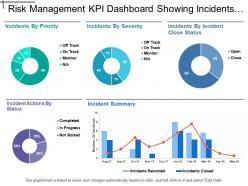
Risk Management Kpi Dashboard Showing Incidents By Priority And Severity






Try Before you Buy Download Free Sample Product
 Impress Your
Audience
 100%
Editable
 Save Hours
of Time


Advise folks to analyze events gone by with our Risk Management Kpi Dashboard Showing Incidents By Priority And Severity. Encourage them to introspect.
People who downloaded this PowerPoint presentation also viewed the following :
Risk Management Kpi Dashboard Showing Incidents By Priority And Severity with all 6 slides:
Conscientious minds are behind our Risk Management Kpi Dashboard Showing Incidents By Priority And Severity. They will live up to their promise to benefit you.


FAQs for Risk Management Kpi Dashboard Showing Incidents By
Okay so you'll want to cover four main things: identifying risks, assessing them, figuring out how to handle them, and keeping track. First, actually think through what could realistically go wrong for YOUR situation - those generic templates are pretty useless tbh. Prioritize based on how likely stuff is and how badly it'd mess you up. High-priority ones need actual action plans with someone specific owning each one. Oh and monitoring is huge because everything changes constantly. You can't just make the plan and forget about it. Set those calendar reminders right now or you'll never look at it again - trust me on this one.
Honestly, get your whole team in a room and brainstorm what could go wrong. They see stuff you don't since they're doing the actual work. Look back at old projects too - same mistakes happen over and over (people have terrible memories lol). Risk checklists help cover the obvious bases: budget, timeline, technical issues, staffing problems. Talk to people outside your team who've done similar work. Here's the thing though - don't just do this once at the start. New problems come up constantly, so check in regularly. Otherwise you'll get blindsided by something totally predictable.
Think of risk assessment as your project's insurance policy. You're basically making a list of everything that could blow up in your face, then figuring out how likely each disaster actually is. Honestly, most people skip this part because it feels tedious, but trust me - you'll thank yourself later when you're not scrambling at 2am. Build your backup plans right into the timeline and budget from the start. What I do is write down my worst-case scenarios first, then work backwards to create escape routes. Short version: expect the worst, plan for it, hope for the best.
AI and machine learning can spot patterns way before you'd even notice something's off - honestly, it's wild how much they pick up on. Real-time dashboards let you watch multiple risk indicators at once, and automated alerts make sure nothing gets missed. Simulation software is pretty cool too since you can test worst-case scenarios without any real damage. Though I'd say start with just one area where you're currently kind of winging it and add monitoring there first. The data insights alone will probably blow your mind once you see everything laid out clearly.
Set up risk reviews monthly or quarterly - depends how fast your industry moves. Track your key indicators consistently, but skip the checkbox mentality during meetings (those compliance calls are brutal). Focus on what's actually changed instead of rehashing the same tired risk register. Different departments will catch stuff you miss from your angle. Honestly, most people forget this part, but document what you learn and update your treatments based on findings. Otherwise you're just wasting everyone's time going through motions.
Cultural stuff totally changes how teams see risk. Hierarchical places? People won't speak up about obvious problems. Meanwhile, individualistic cultures think they can handle everything alone - which, spoiler alert, usually backfires. Germans are way more cautious than Silicon Valley types, and that shows up in timelines and how seriously they take compliance. Oh, and age matters too - younger folks are cool with digital risks that would freak out older employees. Honestly, you've got to actually ask around during risk assessments instead of assuming everyone thinks like you.
Honestly, diversify your income streams first - don't put all your eggs in one customer basket. Cash reserves are clutch, saved me so many times when things went sideways. Get those credit lines set up now while you're doing well, not when you're desperate (banks smell fear lol). Track your numbers weekly instead of monthly - way more helpful than you'd think. Oh and get decent insurance for the big stuff that could wreck you. These aren't sexy moves but they actually work. Most businesses skip this boring foundation stuff and regret it later.
So compliance basically gives you your starting point for risk management - you've gotta meet those requirements no matter what. SOX for financial stuff, GDPR for data privacy, Basel III if you're dealing with banks. They set the minimum standards for how you identify, monitor, and report risks. The fines are brutal if you mess this up, honestly. But don't just stop there and call it a day. Yeah, use those rules as your foundation, then add whatever else makes sense for your actual business risks. Good risk management isn't just about ticking boxes - it's about protecting what matters to your company specifically.
Dude, skipping risk management is like asking for trouble. Your project will get hit with delays and budget disasters you never saw coming. Small problems turn into massive headaches because you don't have backup plans ready. Honestly, there's nothing worse than watching stakeholders panic when everything goes sideways - trust me on this one. Your team ends up constantly putting out fires instead of actually managing anything. Just write down your 5 biggest risks and figure out what you'll do if they happen. Even something basic saves you from total chaos later.
So basically you want a risk matrix - probability vs impact thing. Start with the scary stuff that could wreck your operations, finances, or reputation. Even if it seems unlikely, because honestly nobody expects their server to crash until it does. After those nightmares, move to medium-impact stuff that happens more often. The trick is being real about how bad AND how probable each risk actually is. Oh, and make a simple scoring system so everyone on your team rates things the same way instead of just winging it.
So there's three main ways to tackle this stuff. Qualitative is probably what you'll see most - just risk matrices with high/medium/low ratings because they're dead simple. Quantitative gets all fancy with monte carlo sims and probability math (honestly overkill half the time). Then there's semi-quantitative that mixes both by putting numbers on the qualitative scales. Oh, and depending on your field you might run into FMEA or bow-tie analysis too. My advice? Just match whatever approach fits your data and how complex things actually are. No point doing advanced calculations if a basic matrix works fine.
So basically, qualitative risk assessment is like saying "this feels pretty risky" while quantitative puts actual numbers on it - like "$50K loss with 30% probability." Most places I've seen just use both honestly. Qualitative's way faster and gets everyone on the same page with those color-coded charts. Numbers are better when you're trying to justify budget stuff to executives though. My advice? Start broad with the qualitative approach to spot your big risks, then crunch the actual math on whatever keeps you up at night.
Oh totally - talking about risks regularly makes such a huge difference. People actually notice potential problems instead of letting them hide in someone's brain or some dusty spreadsheet. I'd start simple: just ask "what could bite us this week?" during your normal team meetings. Maybe set up a shared risk tracker everyone can peek at. And definitely do those brutal honest conversations after stuff goes wrong (those are gold). I worked with this one team where only the PM knew about risks... yeah, that imploded spectacularly. Just don't make it feel like you're being Debbie Downer 24/7.
Risk matrices are your best bet - they plot probability against impact so the big threats jump out immediately. Heat maps do something similar but with colors that make everything super obvious. If you need more detail, try risk registers in Excel or those GRC platforms (though honestly, simple dashboards sometimes work better than the expensive stuff). These give you ownership tracking, timelines, mitigation plans - the whole nine yards. Start with whatever matches how your team already works. You can always get fancier tools later once you figure out what you're actually missing.
First thing - write down every nightmare scenario that could tank your business. Supply chain issues, hackers, fires, your best employee quitting, all of it. Then make actual plans for each one with who does what and how you'll communicate. Yeah, it's tedious but way better than panicking later. Build up some cash reserves too because revenue can disappear overnight (learned that one the hard way). Oh, and run through these scenarios every few months with your team. You'll catch problems you never thought of.
-
Awesome use of colors and designs in product templates.
-
Wonderful templates design to use in business meetings.