


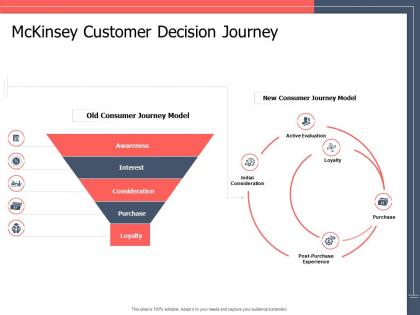
Mckinsey customer decision journey ppt powerpoint presentation styles background designs




Try Before you Buy Download Free Sample Product
 Impress Your
 Audience
 100%
100% Editable
 Save Hours
 of Time


Our MCkinsey Customer Decision Journey Ppt Powerpoint Presentation Styles Background Designs are topically designed to provide an attractive backdrop to any subject. Use them to look like a presentation pro.
People who downloaded this PowerPoint presentation also viewed the following :
Mckinsey customer decision journey ppt powerpoint presentation styles background designs with all 2 slides:
Use our MCkinsey Customer Decision Journey Ppt Powerpoint Presentation Styles Background Designs to effectively help you save your valuable time. They are readymade to fit into any presentation structure.
FAQs for Mckinsey customer decision journey ppt powerpoint presentation
The customer decision journey includes awareness, consideration, evaluation, purchase, and post-purchase advocacy stages, each significantly influencing buying behavior through different touchpoints and motivations. These stages enable businesses to strategically align marketing efforts, personalize customer experiences, and optimize conversion rates, with many organizations finding that mapping these journeys ultimately delivers higher customer satisfaction, increased loyalty, and competitive advantage in increasingly complex markets.
Businesses can effectively map customer decision journeys through data analytics, customer interviews, touchpoint analysis, behavioral tracking, and cross-departmental collaboration to identify key moments and pain points. By understanding these pathways across awareness, consideration, and purchase phases, companies streamline marketing efforts, personalize messaging, and optimize resource allocation, ultimately delivering higher conversion rates and enhanced customer experiences.
Social proof significantly influences customer decision-making by providing validation through reviews, testimonials, ratings, user-generated content, and peer recommendations. These trust signals streamline the evaluation process by reducing perceived risk and uncertainty, with many businesses finding that strategic social proof placement accelerates conversions, enhances credibility, and ultimately delivers higher customer confidence throughout their purchase journey.
Customer feedback can be integrated through surveys at key touchpoints, social listening tools, post-purchase reviews, focus groups, and analytics platforms tracking user behavior. These insights enable businesses to refine product features, streamline purchasing processes, and address pain points, with many companies finding that continuous feedback loops ultimately enhance customer satisfaction and drive higher conversion rates.
**INPUT**: What metrics should be used to assess the effectiveness of each stage in the customer decision journey? **OUTPUT**: Key metrics include awareness reach and brand recall, consideration engagement rates and content interactions, purchase conversion rates and cart abandonment, and post-purchase satisfaction scores and retention rates. These measurements enable organizations to identify bottlenecks, optimize touchpoints, and enhance customer experiences throughout their journey, with many companies finding that stage-specific tracking ultimately delivers improved conversion rates and stronger customer relationships. [Word count: 60]
Digital channels fundamentally transform traditional customer decision journeys by enabling omnichannel experiences, real-time personalization, instant access to information, social proof integration, and seamless purchase completion across multiple touchpoints. Through data analytics and AI-driven insights, businesses can anticipate customer needs, deliver targeted recommendations, and create frictionless experiences that accelerate decision-making while increasing conversion rates.
Understanding customer personas significantly enhances decision journey analysis by enabling personalized touchpoint mapping, targeted messaging strategies, behavioral pattern recognition, and demographic-specific pain point identification. Through persona-driven insights, organizations can tailor marketing campaigns, optimize conversion funnels, and deliver customized experiences across retail, healthcare, and financial services sectors, ultimately improving customer satisfaction and increasing sales conversion rates.
**INPUT**: What psychological factors drive a customer's transition from awareness to consideration? **OUTPUT**: Psychological factors include cognitive curiosity, social proof validation, emotional resonance with brand messaging, perceived relevance to personal needs, and trust-building through credible sources. These drivers work by reducing uncertainty, creating mental availability, and establishing initial preference patterns, with many organizations finding that strategic content positioning and peer testimonials significantly accelerate this critical transition phase. [Word count: 58 words]
The post-purchase experience represents the final crucial stage where customer satisfaction, loyalty, and advocacy are determined through support quality, product performance, and follow-up engagement. This phase directly influences repeat purchases, referrals, and brand perception, with companies like Amazon and Apple excelling through seamless returns, proactive customer service, and loyalty programs that transform satisfied customers into brand advocates.
Companies can track customer decision journeys using analytics platforms like Google Analytics, CRM systems, marketing automation tools, heat mapping software, and customer data platforms. These technologies streamline tracking by consolidating touchpoint data, analyzing behavioral patterns, and providing real-time insights, with many retail and financial services organizations finding that integrated approaches ultimately deliver enhanced personalization and improved conversion rates.
Segmentation enables businesses to customize decision journeys by grouping customers based on demographics, behaviors, preferences, and purchase patterns, then designing targeted touchpoints for each segment. For instance, millennials might prefer social media interactions and mobile-first experiences, while enterprise clients require detailed consultations and technical documentation, ultimately delivering more relevant experiences and higher conversion rates.
COVID-19 significantly accelerated digital transformation in customer decision journeys, with consumers increasingly relying on online research, virtual consultations, and contactless purchasing processes. This shift has pushed businesses across retail, healthcare, and financial services to enhance their digital touchpoints, streamline omnichannel experiences, and prioritize safety-focused solutions, ultimately delivering faster, more flexible customer interactions.
Storytelling plays a crucial role in customer decision-making by creating emotional connections, simplifying complex information, and building trust throughout the journey. Through compelling narratives, businesses enhance brand recall, address customer pain points, and demonstrate value propositions more effectively than traditional marketing approaches, ultimately driving higher conversion rates and customer loyalty.
Brands can reduce friction by streamlining checkout processes, providing transparent pricing, offering multiple payment options, implementing live chat support, and optimizing mobile experiences. Through strategic touchpoint mapping, companies in retail, banking, and healthcare deliver faster service resolution, clearer product information, and seamless cross-channel transitions, ultimately enhancing customer satisfaction while increasing conversion rates.
Businesses can leverage predictive analytics, machine learning algorithms, customer behavior tracking, purchase pattern analysis, and sentiment monitoring to forecast shifts in decision journeys. Through advanced data modeling, companies in retail, banking, and healthcare identify emerging preferences, anticipate buying triggers, and adapt touchpoints proactively, ultimately delivering personalized experiences and maintaining competitive advantage.
No Reviews