


Monetizing Data And Identifying Value Of Your Data Powerpoint Presentation Slides




Try Before you Buy Download Free Sample Product
 Impress Your
 Audience
 100%
100% Editable
 Save Hours
 of Time


Firms can generate revenue from two methods such as indirect and direct methods of monetization. Grab our competently designed Monetizing Data and Identifying Value of your Data template that is useful in demonstrating various ways a firm can generate revenue. The template also includes information regarding how the firm can determine data value to obtain quantifiable economic benefits to the firm. The template comprises of analysis of the current state by analyzing present concerns that lead to ineffectiveness of data handlings, such as outdated data management system, bad sales performance, and high customer churn rate. The template covers information regarding the importance of data in organizational profitability, the role of dark data, and various players through which valuable data is captured. It provides details about data use maturity to determine data deliberator, adopter, and innovator. Users can identify essential attributes from customer data. Users can embrace advanced technologies to improve operational processes and reduce customer churn through predictive analytics and machine learning. It allows users to determine different revenue streams associated with data monetization methods. Customize this 100 percent editable template now.
People who downloaded this PowerPoint presentation also viewed the following :
Content of this Powerpoint Presentation
Slide 1: This slide displays title i.e. 'Monetizing Data and Identifying Value of Data' and your Company Name.
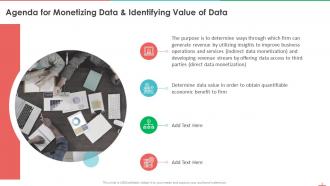
Slide 2: This slide presents agenda.
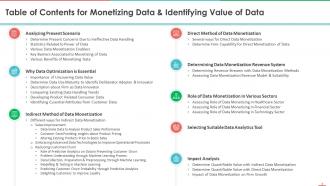
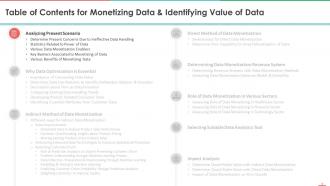
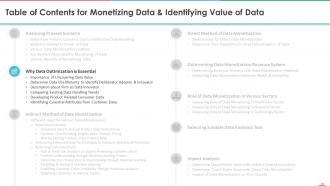
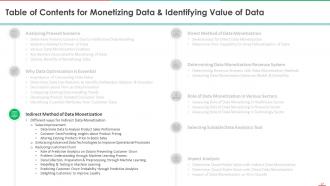
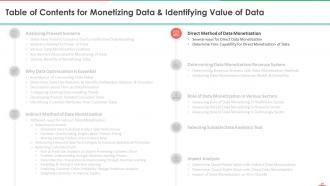
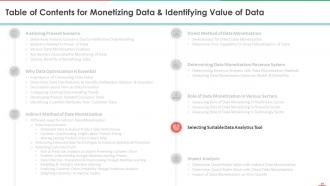
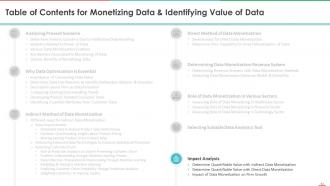
Slide 3: This slide exhibits table of contents.
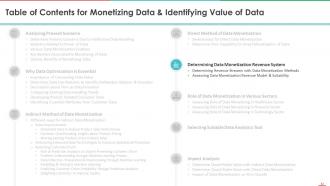
Slide 4: This slide depicts title for five topics that are to be covered next in the template.
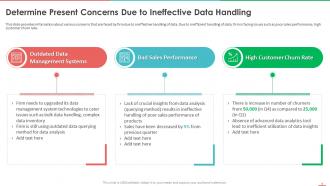
Slide 5: This slide provides information about various concerns that are faced by firm due to ineffective handling of data.
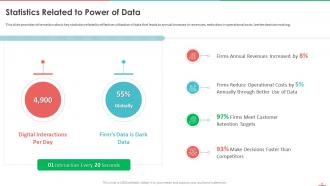
Slide 6: This slide provides information about key statistics related to effective utilization of data that leads to annual increase in revenues, etc.
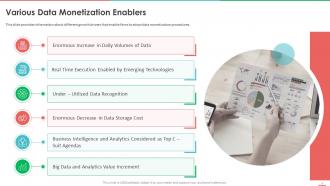
Slide 7: This slide provides information about different growth drivers that enable firms to adopt data monetization procedures.
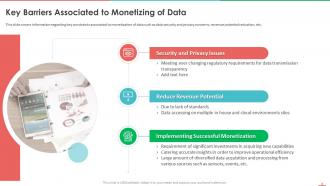
Slide 8: This slide covers information regarding key constraints associated to monetization of data such as data security and privacy concerns, etc.
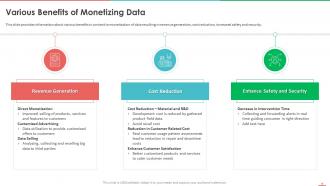
Slide 9: This slide provides information about various benefits in context to monetization of data resulting in revenue generation, cost reduction, etc.
Slide 10: This slide depicts title for six topics that are to be covered next in the template.
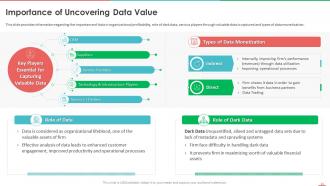
Slide 11: This slide provides information regarding the importance of data in organizational profitability, role of dark data, etc.
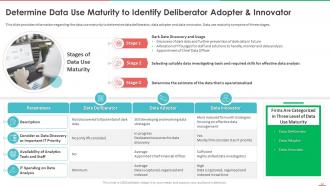
Slide 12: This slide provides information regarding the data use maturity to determine data deliberator, data adopter and data innovator.
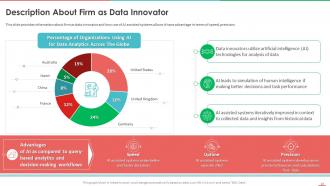
Slide 13: This slide provides information about firm as data innovator and how use of AI assisted systems allows it have advantage in terms of speed, precision.
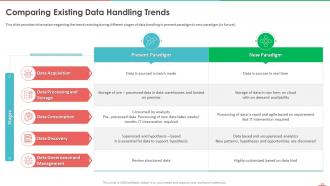
Slide 14: This slide provides information regarding the trends existing during different stages of data handling in present paradigm to new paradigm (in future).
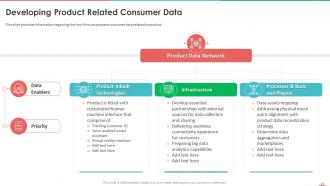
Slide 15: This slide provides information regarding the how firm can prepare consumer data related to product.
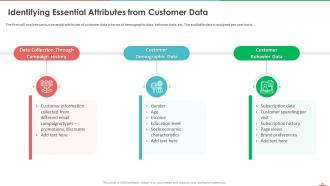
Slide 16: This slide will explore various essential attributes of customer data in terms of demographic data, behavior data, etc.
Slide 17: This slide depicts title for eleven topics that are to be covered next in the template.
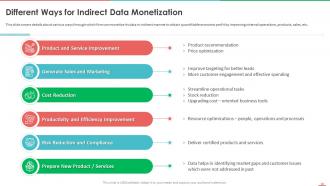
Slide 18: This slide covers details about various ways through which firm can monetize its data in indirect manner to obtain quantifiable economic profit.
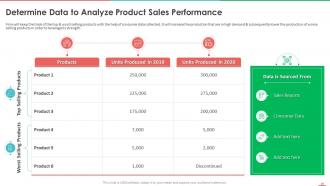
Slide 19: This slide will keep the track of the top & worst selling products with the help of consumer data collected.
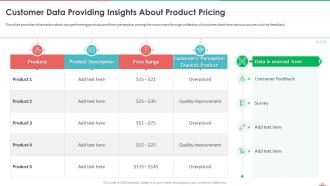
Slide 20: This slide provides information about top performing products and their perception among the consumers through collection of customer data.
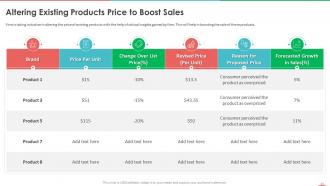
Slide 21: This slide will help in boosting the sale of these products.
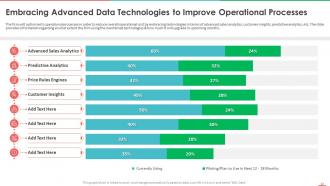
Slide 22: This slide will optimize its operational processes in order to reduce overall operational cost by embracing technologies in terms of advanced sales analytics.
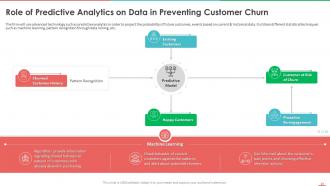
Slide 23: This slide will use advanced technology such as predictive analytics in order to project the probability of future outcomes.
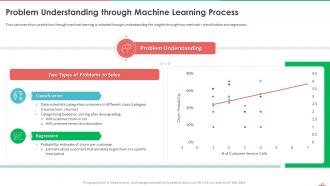
Slide 24: This slide will do prediction through machine learning is initiated through understanding the insights through two methods – classification and regression.
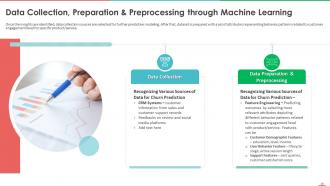
Slide 25: This slide showcases Data Collection, Preparation & Preprocessing through Machine Learning.
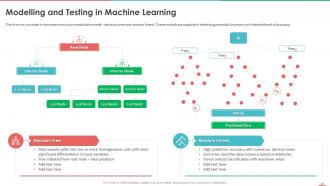
Slide 26: This slide highlights Modelling and Testing in Machine Learning.
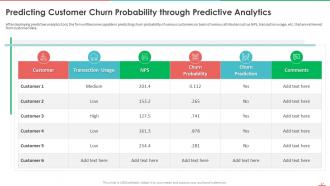
Slide 27: This slide illustrates Predicting Customer Churn Probability through Predictive Analytics.
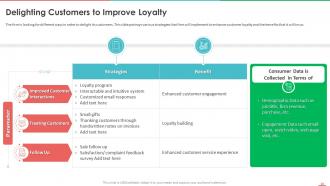
Slide 28: This slide displays Delighting Customers to Improve Loyalty.
Slide 29: This slide depicts title for two topics that are to be covered next in the template.
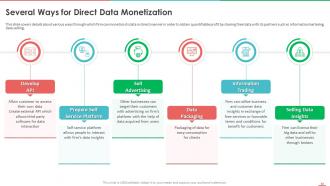
Slide 30: This slide covers details about various ways through which firm can monetize its data in direct manner.
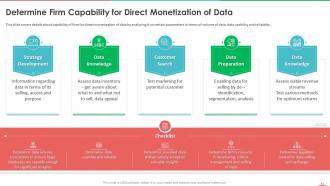
Slide 31: This slide covers details about capability of firm for direct monetization of data by analyzing it on certain parameters in terms of volume of data, etc.
Slide 32: This slide depicts title for two topics that are to be covered next in the template.
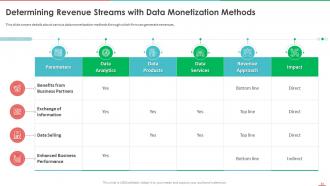
Slide 33: This slide covers details about various data monetization methods through which firm can generate revenues.
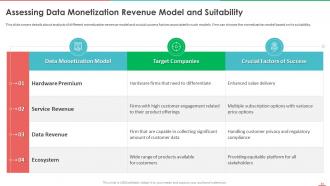
Slide 34: This slide covers details about analysis of different monetization revenue model and crucial success factors associated to such models.
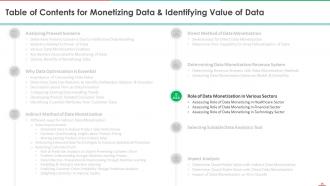
Slide 35: This slide depicts title for three topics that are to be covered next in the template.
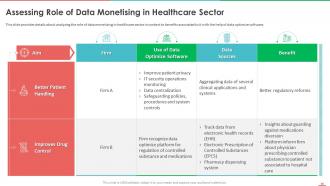
Slide 36: This slide provides details about analyzing the role of data monetizing in healthcare sector in context to benefits associated to it.
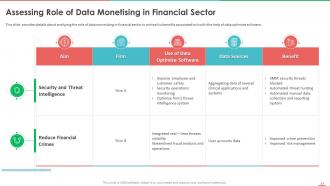
Slide 37: This slide provides details about analyzing the role of data monetizing in financial sector in context to benefits associated to it.
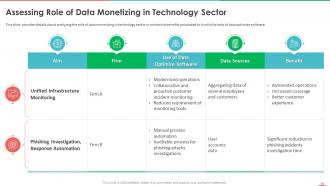
Slide 38: This slide provides details about analyzing the role of data monetizing in technology sector in context to benefits associated to it.
Slide 39: This slide depicts title for the topic that are to be covered next in the template.
Slide 40: This slide will help firm in choosing the suitable data analytics tool which is to handle existing bulk of data.
Slide 41: This slide depicts title for three topics that are to be covered next in the template.
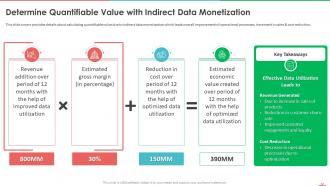
Slide 42: This slide covers provides details about calculating quantifiable value due to indirect data monetization.
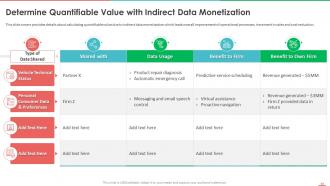
Slide 43: This slide covers provides details about calculating quantifiable value due to indirect data monetization.
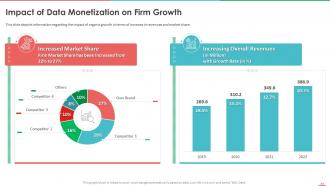
Slide 44: This slide depicts information regarding the impact of organic growth in terms of increase in revenues and market share.
Slide 45: This is the icons slide.
Slide 46: This slide presents title for additional slides.
Slide 47: This slide depicts 30-60-90 days plan for projects.
Slide 48: This slide exhibits weekly timeline of company.
Slide 49: This slide shows roadmap of company.
Slide 50: This slide presents goals of the company.
Slide 51: This slide exhibits funnel.
Slide 52: This slide displays mind map.
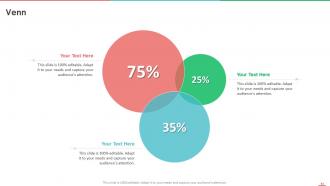
Slide 53: This slide displays Venn.
Slide 54: This slide depicts posts for past experiences of clients.
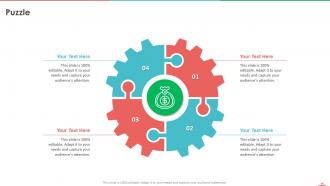
Slide 55: This slide shows puzzle for displaying elements of company.
Slide 56: This is thank you slide & contains contact details of company like office address, phone no., etc.
Monetizing Data And Identifying Value Of Your Data Powerpoint Presentation Slides with all 61 slides:
Use our Monetizing Data And Identifying Value Of Your Data Powerpoint Presentation Slides to effectively help you save your valuable time. They are readymade to fit into any presentation structure.







FAQs for Monetizing Data And Identifying Value Of Your Data
Honestly, there are three main ways to make money from your data. You can sell it directly to other companies, use it to make your own products better, or turn it into insights that become a whole new revenue stream. Some people build APIs that others pay to access, or they license their datasets. Targeted advertising is huge too if you have the right customer data. Just don't mess up the privacy compliance part - I've seen companies get absolutely wrecked by that. First step is figuring out what data you actually have and if it's any good, then pick whatever approach fits your business best.
Check what data you're already collecting first - most companies have way more than they think. Customer patterns, operations stuff, supply chain data. Transaction records too. The gold is usually in data that's unique to your specific industry or business model. Map out everything you've got and think "who else would actually pay for these insights?" Other businesses might need it for decisions or market trends. Honestly, it's kinda crazy how much valuable data just sits there unused. Oh, and focus on anything that could help companies improve efficiency - that's where the money is.
Honestly, just be upfront about what data you're grabbing and why. No one wants to dig through 50 pages of legal jargon to figure out what they're signing up for. Make consent actually mean something - people should get what they're agreeing to. Then ask yourself if your monetization screws anyone over, especially folks who are already getting the short end of the stick. Sure, you might legally own the data, but you're basically babysitting someone else's personal info. I'd do a quick audit of what you're doing now. Would you be cool with another company pulling this stuff with your data? That's usually a pretty good gut check.
Look, GDPR and CCPA completely changed the game. You can't just hoover up data and flip it for cash anymore. Users have to say yes first, and they can demand you delete everything whenever they want. The fines? Absolutely insane if you screw up. So now you've gotta focus on first-party data instead. Create actual value exchanges - give people something worthwhile for their info. Be upfront about what you're doing with it too. Honestly, the whole "collect first, ask questions later" approach is dead. You need to earn trust before you can make money off someone's data, which is probably how it should've been all along.
Cloud platforms are your best bet - AWS, Azure, GCP handle huge datasets without crazy infrastructure costs. Python with pandas is solid for analysis, though Tableau and Power BI make prettier dashboards if you're not super technical. APIs are clutch for packaging everything so customers can actually use your data. Honestly? The visualization part is where people get excited and open their wallets. I'd start by looking at what data you've got sitting around first - might be more valuable than you think. Power BI's gotten way better lately too, just saying.
Honestly, figure out what makes your data special first and how people actually want to use it. Check what competitors charge but tbh most data pricing is still pretty random across the board. Try different approaches - subscriptions work well for regular users, pay-per-query for the occasional folks. Tiered pricing catches different customer types too. Talk to potential buyers directly about their budgets and workflows. That's way more valuable than guessing. Pick one simple model to start, get their feedback, then tweak it. Don't overcomplicate things early on - you can always change pricing once you see how people actually use your stuff.
Honestly, data viz is your ticket to making actual money from all that data you're sitting on. People will pay for insights they can *see* - nobody wants to dig through spreadsheets. Build some killer dashboards and suddenly executives are nodding along instead of glazing over. The trick is finding your best data stories first, then making them look so good that clients think "damn, I need this." It's wild how much more people value something when it's presented beautifully versus just dumped in Excel. Your visuals become the thing that turns complex analysis into "yes, here's my credit card."
Honestly, it's mostly about messy data and not knowing where to begin. Your info is probably spread across like 5 different systems, half of it's inconsistent or missing the good stuff buyers actually want. Privacy regulations are a total headache too - GDPR and all that compliance nonsense will make your head spin. Most companies don't even have the tech setup to package data properly anyway. Oh, and infrastructure costs can sneak up on you. My take? Pick one solid dataset first. Focus on fixing an actual business problem instead of trying to turn everything into a money machine right away.
Look for partners with data that actually fills your gaps, not duplicates what you already have. Companies in adjacent industries work great - like a retailer teaming up with weather services for better demand forecasting. Joint products usually crush what either company could do solo. Tech partnerships can be solid too if you bring the data and they handle the analytics side. Honestly, I'd start by listing what data gaps your customers keep bugging you about. That'll point you toward the right partners way faster than just randomly reaching out to companies.
So Google and Facebook are killing it with this stuff - they've basically turned user data into their main cash cow. Financial companies aren't far behind, using customer info for personalized offers and figuring out who's risky to lend to. Healthcare's getting there too, but they've got all that privacy stuff to deal with (which honestly makes sense). Oh, and telecom companies are cashing in by selling location data and usage patterns. You should probably look at what these industries are doing first. See what makes sense for your situation.
Honestly, most people don't realize they're sitting on a goldmine with their data. Package up those user behavior insights and sell them to companies that'd actually pay - fitness apps do this with health trends, selling to insurance companies. Premium analytics dashboards are another solid route. But here's the thing - your biggest advantage isn't even selling it externally. Use that unique data to improve your own product way faster than competitors can keep up. I'd start by just auditing what you're already collecting (probably more than you think). Then figure out who else would find those insights valuable.
Honestly, I'd focus on both the money side and operations stuff. Revenue per data asset is huge - plus how much you're saving on customer acquisition and your profit margins from data products. Usage rates matter too, like how engaged customers actually are with your offerings. Time-to-market for new products is another big one. Oh, and data quality scores because bad data is basically useless, right? Customer satisfaction for your data services is pretty obvious but worth tracking. I'd probably start with maybe 3-4 metrics that actually match what you're trying to achieve, then add more once you've got those dialed in.
Honestly, if your leadership isn't buying into using data for decisions, you're fighting an uphill battle from day one. Get them on board first. Then focus on training people so they don't have to bug IT constantly - basic data literacy goes a long way. Dashboards and self-service tools are clutch here. Nobody's gonna dig for insights if it's a pain. Cross-functional teams work well too, mixing business folks with data people. Oh, and definitely celebrate the wins loudly when data actually moves the needle. Start with small pilot projects that show clear results, then expand from there.
Dude, you really don't want to mess around with privacy stuff - GDPR and CCPA fines are brutal. Customer trust is huge too. If people find out you're making money off their data without telling them, they'll be pissed. Data breaches hit way harder when you're monetizing that info. I learned this the hard way watching other companies get roasted online. Just be super upfront about what you're doing with their data. Get proper consent first. The regulatory stuff is honestly scarier than losing customers sometimes.
Honestly, ML is pretty great for finding weird patterns in your data that you can actually monetize. Like, you can predict customer stuff and sell those insights to partners, or build recommendation systems that bump up sales. The funny thing is - and I've seen this a ton - the data you think is valuable usually isn't. Start with auditing whatever data you've got lying around. Run some basic ML models to see what pops up. You can automate processing to cut costs while making everything better quality, or create predictive models other companies will pay for.
-
Excellent design and quick turnaround.
-
Crisp and neat slides. Makes it fun and easier to curate presentations.