


Monetarisieren von Daten und Identifizieren des Werts Ihrer Daten Powerpoint-Präsentationsfolien




Try Before you Buy Download Free Sample Product
 Impress Your
Audience
 100%
Editable
 Save Hours
of Time


Firmen können Einnahmen aus zwei Methoden erzielen, z. B. indirekten und direkten Methoden der Monetarisierung. Holen Sie sich unsere kompetent gestaltete Vorlage zum Monetarisieren von Daten und Identifizieren des Werts Ihrer Daten, die nützlich ist, um verschiedene Möglichkeiten zu demonstrieren, wie ein Unternehmen Einnahmen generieren kann. Die Vorlage enthält auch Informationen darüber, wie das Unternehmen den Datenwert bestimmen kann, um quantifizierbare wirtschaftliche Vorteile für das Unternehmen zu erzielen. Die Vorlage umfasst eine Analyse des Ist-Zustands, indem aktuelle Bedenken analysiert werden, die zu einer Ineffektivität der Datenverarbeitung führen, wie z. B. veraltetes Datenverwaltungssystem, schlechte Verkaufsleistung und hohe Kundenabwanderungsrate. Die Vorlage enthält Informationen zur Bedeutung von Daten für die Unternehmensrentabilität, zur Rolle von Dark Data und zu verschiedenen Akteuren, durch die wertvolle Daten erfasst werden. Es enthält Details zum Reifegrad der Datennutzung, um den Datenbearbeiter, -anwender und -innovator zu bestimmen. Benutzer können wesentliche Attribute aus Kundendaten identifizieren. Benutzer können fortschrittliche Technologien nutzen, um betriebliche Prozesse zu verbessern und die Kundenabwanderung durch prädiktive Analysen und maschinelles Lernen zu reduzieren. Es ermöglicht Benutzern, verschiedene Einnahmequellen zu bestimmen, die mit Datenmonetarisierungsmethoden verbunden sind. Passen Sie diese zu 100 Prozent bearbeitbare Vorlage jetzt an.
People who downloaded this PowerPoint presentation also viewed the following :
Inhalt dieser Powerpoint-Präsentation
Folie 1 : Diese Folie zeigt den Titel, z. B. „Monetarisierung von Daten und Identifizierung des Datenwerts“, und Ihren Firmennamen an.
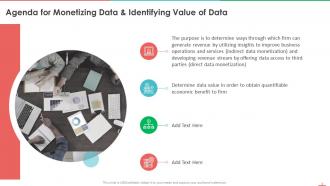
Folie 2 : Diese Folie präsentiert die Agenda.
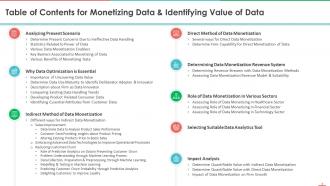
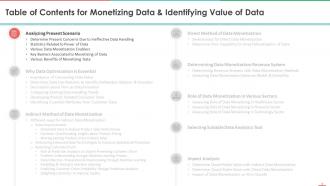
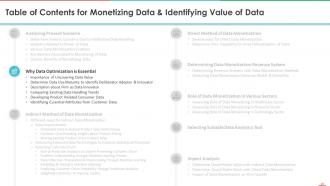
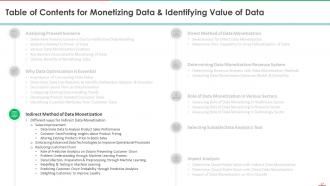
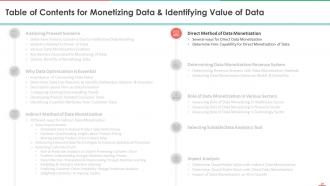
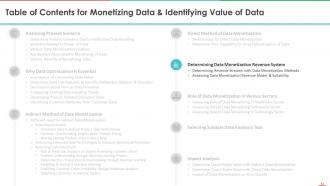
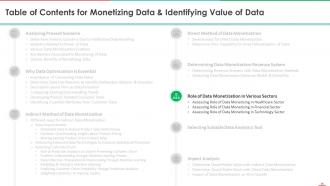
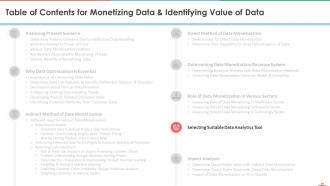
Folie 3 : Diese Folie zeigt das Inhaltsverzeichnis.
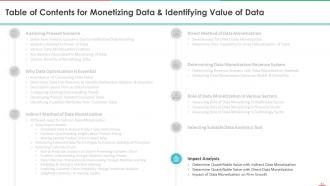
Folie 4 : Diese Folie zeigt Titel für fünf Themen, die als nächstes in der Vorlage behandelt werden sollen.
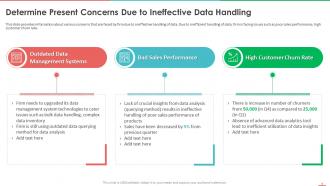
Folie 5 : Diese Folie enthält Informationen zu verschiedenen Bedenken, denen Unternehmen aufgrund eines ineffizienten Umgangs mit Daten gegenüberstehen.
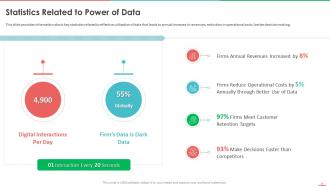
Folie 6 : Diese Folie enthält Informationen zu wichtigen Statistiken in Bezug auf die effektive Nutzung von Daten, die zu einer jährlichen Steigerung der Einnahmen usw. führen.
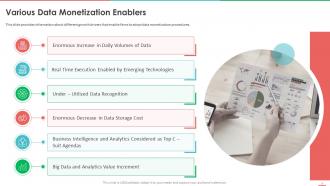
Folie 7 : Diese Folie enthält Informationen über verschiedene Wachstumstreiber, die es Unternehmen ermöglichen, Datenmonetarisierungsverfahren einzuführen.
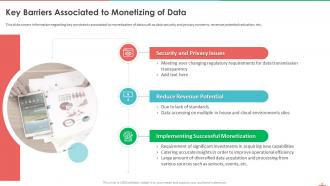
Folie 8 : Diese Folie enthält Informationen zu den wichtigsten Einschränkungen im Zusammenhang mit der Monetarisierung von Daten, wie z. B. Bedenken hinsichtlich Datensicherheit und Datenschutz usw.
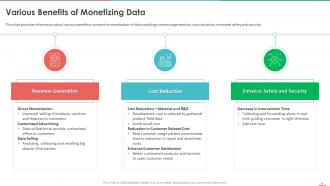
Folie 9 : Diese Folie enthält Informationen zu verschiedenen Vorteilen im Zusammenhang mit der Monetarisierung von Daten, die zu Umsatzgenerierung, Kostensenkung usw. führen.
Folie 10 : Diese Folie zeigt Titel für sechs Themen, die als nächstes in der Vorlage behandelt werden sollen.
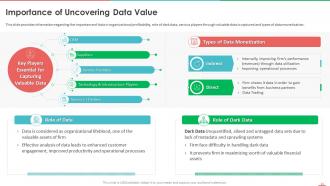
Folie 11 : Diese Folie enthält Informationen zur Bedeutung von Daten für die Unternehmensrentabilität, zur Rolle von Dark Data usw.
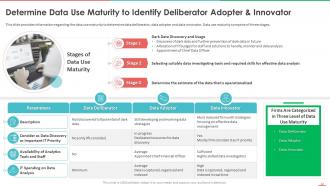
Folie 12 : Diese Folie enthält Informationen zum Reifegrad der Datennutzung, um den Datenbearbeiter, den Datenanwender und den Dateninnovator zu bestimmen.
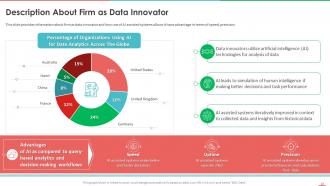
Folie 13 : Diese Folie bietet Informationen über das Unternehmen als Dateninnovator und darüber, wie der Einsatz von KI-gestützten Systemen es ihm ermöglicht, Vorteile in Bezug auf Geschwindigkeit und Präzision zu erzielen.
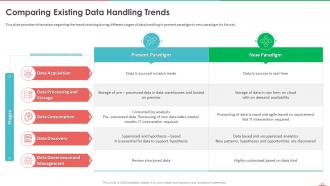
Folie 14 : Diese Folie enthält Informationen zu den Trends, die in verschiedenen Stadien der Datenverarbeitung im gegenwärtigen Paradigma zum neuen Paradigma (in der Zukunft) bestehen.
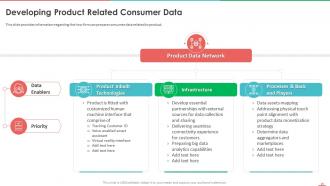
Folie 15 : Diese Folie enthält Informationen darüber, wie Unternehmen Verbraucherdaten in Bezug auf das Produkt aufbereiten können.
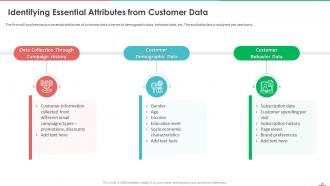
Folie 16 : Diese Folie untersucht verschiedene wesentliche Attribute von Kundendaten in Bezug auf demografische Daten, Verhaltensdaten usw.
Folie 17 : Diese Folie zeigt Titel für elf Themen, die als nächstes in der Vorlage behandelt werden sollen.
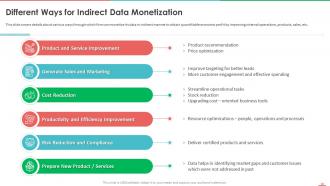
Folie 18 : Diese Folie enthält Einzelheiten zu verschiedenen Möglichkeiten, wie Unternehmen ihre Daten auf indirekte Weise monetarisieren können, um einen quantifizierbaren wirtschaftlichen Gewinn zu erzielen.
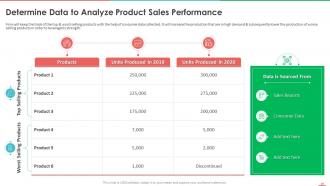
Folie 19 : Diese Folie verfolgt die meistverkauften und am schlechtesten verkauften Produkte mithilfe der gesammelten Verbraucherdaten.
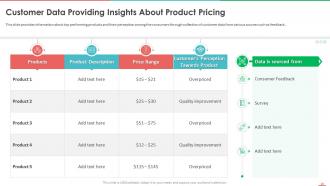
Folie 20 : Diese Folie bietet Informationen über leistungsstarke Produkte und ihre Wahrnehmung bei den Verbrauchern durch die Erhebung von Kundendaten.
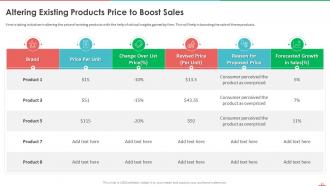
Folie 21 : Diese Folie wird dazu beitragen, den Verkauf dieser Produkte anzukurbeln.
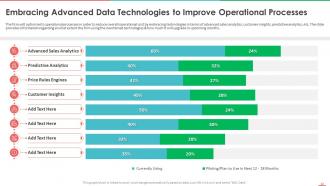
Folie 22 : Diese Folie optimiert seine Betriebsprozesse, um die Gesamtbetriebskosten zu senken, indem Technologien in Bezug auf fortschrittliche Verkaufsanalysen eingesetzt werden.
Folie 23 : Diese Folie verwendet fortschrittliche Technologien wie Predictive Analytics, um die Wahrscheinlichkeit zukünftiger Ergebnisse zu prognostizieren.
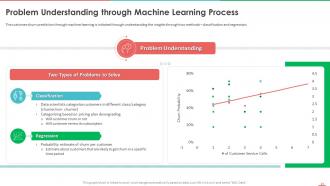
Folie 24 : Diese Folie wird Vorhersagen durch maschinelles Lernen machen, die durch das Verständnis der Erkenntnisse durch zwei Methoden initiiert werden – Klassifizierung und Regression.
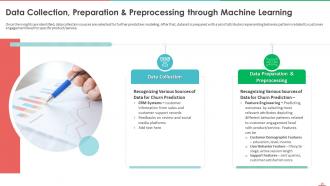
Folie 25 : Diese Folie zeigt die Datenerfassung, -aufbereitung und -vorverarbeitung durch maschinelles Lernen.
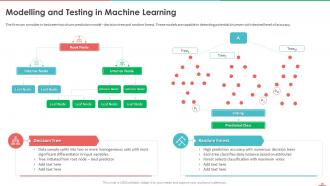
Folie 26 : Diese Folie beleuchtet Modellierung und Testen beim maschinellen Lernen.
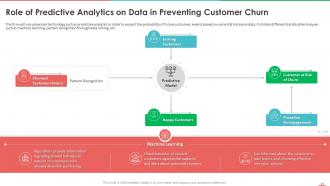
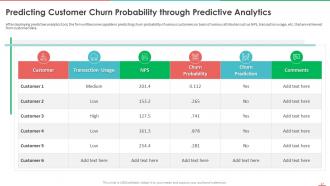
Folie 27 : Diese Folie veranschaulicht die Vorhersage der Kundenabwanderungswahrscheinlichkeit durch Predictive Analytics.
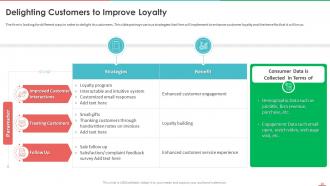
Folie 28 : Diese Folie zeigt Kunden begeistern, um die Loyalität zu verbessern.
Folie 29 : Diese Folie zeigt Titel für zwei Themen, die als nächstes in der Vorlage behandelt werden sollen.
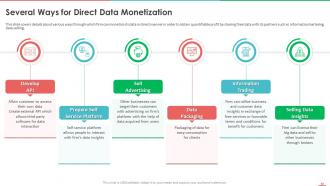
Folie 30 : Diese Folie enthält Einzelheiten zu verschiedenen Möglichkeiten, wie Unternehmen ihre Daten direkt monetarisieren können.
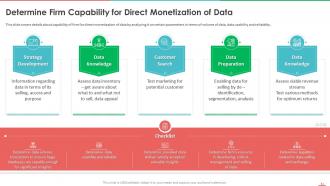
Folie 31 : Diese Folie enthält Einzelheiten zur Fähigkeit des Unternehmens zur direkten Monetarisierung von Daten durch Analyse bestimmter Parameter in Bezug auf das Datenvolumen usw.
Folie 32 : Diese Folie zeigt Titel für zwei Themen, die als nächstes in der Vorlage behandelt werden sollen.
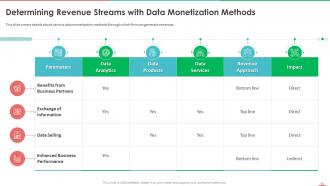
Folie 33 : Diese Folie enthält Einzelheiten zu verschiedenen Datenmonetarisierungsmethoden, mit denen Unternehmen Einnahmen erzielen können.
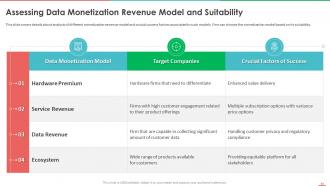
Folie 34 : Diese Folie enthält Details zur Analyse verschiedener Monetarisierungsertragsmodelle und entscheidender Erfolgsfaktoren im Zusammenhang mit solchen Modellen.
Folie 35 : Diese Folie zeigt Titel für drei Themen, die als nächstes in der Vorlage behandelt werden sollen.
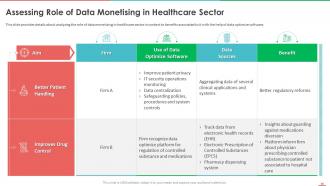
Folie 36 : Diese Folie enthält Details zur Analyse der Rolle der Datenmonetarisierung im Gesundheitssektor im Zusammenhang mit den damit verbundenen Vorteilen.
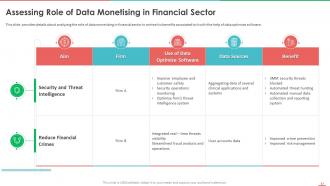
Folie 37 : Diese Folie enthält Einzelheiten zur Analyse der Rolle der Datenmonetarisierung im Finanzsektor im Zusammenhang mit den damit verbundenen Vorteilen.
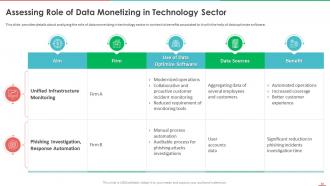
Folie 38 : Diese Folie enthält Details zur Analyse der Rolle der Datenmonetarisierung im Technologiesektor im Zusammenhang mit den damit verbundenen Vorteilen.
Folie 39 : Diese Folie zeigt den Titel für das Thema, das als nächstes in der Vorlage behandelt werden soll.
Folie 40 : Diese Folie hilft bei der Auswahl des geeigneten Datenanalyse-Tools, das die vorhandene Datenmenge verarbeiten soll.
Folie 41 : Diese Folie zeigt Titel für drei Themen, die als nächstes in der Vorlage behandelt werden sollen.
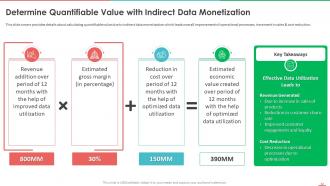
Folie 42 : Diese Folie enthält Einzelheiten zur Berechnung des quantifizierbaren Werts aufgrund der indirekten Datenmonetarisierung.
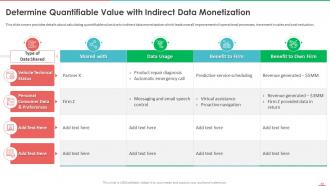
Folie 43 : Diese Folie enthält Einzelheiten zur Berechnung des quantifizierbaren Werts aufgrund der indirekten Datenmonetarisierung.
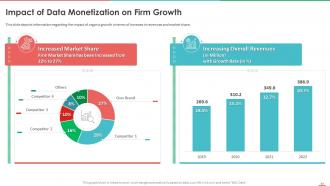
Folie 44 : Diese Folie zeigt Informationen zu den Auswirkungen des organischen Wachstums in Bezug auf die Steigerung von Umsatz und Marktanteil.
Folie 45 : Dies ist die Symbolfolie.
Folie 46 : Diese Folie enthält Titel für zusätzliche Folien.
Folie 47 : Diese Folie zeigt einen 30-60-90-Tage-Plan für Projekte.
Folie 48 : Diese Folie zeigt den wöchentlichen Zeitplan des Unternehmens.
Folie 49 : Diese Folie zeigt die Roadmap des Unternehmens.
Folie 50 : Diese Folie stellt die Ziele des Unternehmens vor.
Folie 51 : Diese Folie zeigt einen Trichter.
Folie 52 : Diese Folie zeigt eine Mindmap.
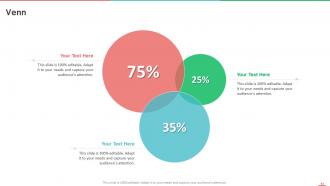
Folie 53 : Diese Folie zeigt Venn.
Folie 54 : Diese Folie zeigt Posts für frühere Erfahrungen von Kunden.
Folie 55 : Diese Folie zeigt ein Puzzle zum Anzeigen von Unternehmenselementen.
Folie 56 : Dies ist eine Dankesfolie und enthält Kontaktdaten des Unternehmens wie Büroadresse, Telefonnummer usw.
Monetarisieren von Daten und Identifizieren des Werts Ihrer Daten Powerpoint-Präsentationsfolien mit allen 61 Folien:
Verwenden Sie unsere Powerpoint-Präsentationsfolien zur Monetarisierung von Daten und zur Ermittlung des Werts Ihrer Daten, um Ihnen effektiv dabei zu helfen, wertvolle Zeit zu sparen. Sie sind gebrauchsfertig und passen in jede Präsentationsstruktur.







FAQs for Monetizing Data And Identifying Value Of Your Data
Honestly, there are three main ways to make money from your data. You can sell it directly to other companies, use it to make your own products better, or turn it into insights that become a whole new revenue stream. Some people build APIs that others pay to access, or they license their datasets. Targeted advertising is huge too if you have the right customer data. Just don't mess up the privacy compliance part - I've seen companies get absolutely wrecked by that. First step is figuring out what data you actually have and if it's any good, then pick whatever approach fits your business best.
Check what data you're already collecting first - most companies have way more than they think. Customer patterns, operations stuff, supply chain data. Transaction records too. The gold is usually in data that's unique to your specific industry or business model. Map out everything you've got and think "who else would actually pay for these insights?" Other businesses might need it for decisions or market trends. Honestly, it's kinda crazy how much valuable data just sits there unused. Oh, and focus on anything that could help companies improve efficiency - that's where the money is.
Honestly, just be upfront about what data you're grabbing and why. No one wants to dig through 50 pages of legal jargon to figure out what they're signing up for. Make consent actually mean something - people should get what they're agreeing to. Then ask yourself if your monetization screws anyone over, especially folks who are already getting the short end of the stick. Sure, you might legally own the data, but you're basically babysitting someone else's personal info. I'd do a quick audit of what you're doing now. Would you be cool with another company pulling this stuff with your data? That's usually a pretty good gut check.
Look, GDPR and CCPA completely changed the game. You can't just hoover up data and flip it for cash anymore. Users have to say yes first, and they can demand you delete everything whenever they want. The fines? Absolutely insane if you screw up. So now you've gotta focus on first-party data instead. Create actual value exchanges - give people something worthwhile for their info. Be upfront about what you're doing with it too. Honestly, the whole "collect first, ask questions later" approach is dead. You need to earn trust before you can make money off someone's data, which is probably how it should've been all along.
Cloud platforms are your best bet - AWS, Azure, GCP handle huge datasets without crazy infrastructure costs. Python with pandas is solid for analysis, though Tableau and Power BI make prettier dashboards if you're not super technical. APIs are clutch for packaging everything so customers can actually use your data. Honestly? The visualization part is where people get excited and open their wallets. I'd start by looking at what data you've got sitting around first - might be more valuable than you think. Power BI's gotten way better lately too, just saying.
Honestly, figure out what makes your data special first and how people actually want to use it. Check what competitors charge but tbh most data pricing is still pretty random across the board. Try different approaches - subscriptions work well for regular users, pay-per-query for the occasional folks. Tiered pricing catches different customer types too. Talk to potential buyers directly about their budgets and workflows. That's way more valuable than guessing. Pick one simple model to start, get their feedback, then tweak it. Don't overcomplicate things early on - you can always change pricing once you see how people actually use your stuff.
Honestly, data viz is your ticket to making actual money from all that data you're sitting on. People will pay for insights they can *see* - nobody wants to dig through spreadsheets. Build some killer dashboards and suddenly executives are nodding along instead of glazing over. The trick is finding your best data stories first, then making them look so good that clients think "damn, I need this." It's wild how much more people value something when it's presented beautifully versus just dumped in Excel. Your visuals become the thing that turns complex analysis into "yes, here's my credit card."
Honestly, it's mostly about messy data and not knowing where to begin. Your info is probably spread across like 5 different systems, half of it's inconsistent or missing the good stuff buyers actually want. Privacy regulations are a total headache too - GDPR and all that compliance nonsense will make your head spin. Most companies don't even have the tech setup to package data properly anyway. Oh, and infrastructure costs can sneak up on you. My take? Pick one solid dataset first. Focus on fixing an actual business problem instead of trying to turn everything into a money machine right away.
Look for partners with data that actually fills your gaps, not duplicates what you already have. Companies in adjacent industries work great - like a retailer teaming up with weather services for better demand forecasting. Joint products usually crush what either company could do solo. Tech partnerships can be solid too if you bring the data and they handle the analytics side. Honestly, I'd start by listing what data gaps your customers keep bugging you about. That'll point you toward the right partners way faster than just randomly reaching out to companies.
So Google and Facebook are killing it with this stuff - they've basically turned user data into their main cash cow. Financial companies aren't far behind, using customer info for personalized offers and figuring out who's risky to lend to. Healthcare's getting there too, but they've got all that privacy stuff to deal with (which honestly makes sense). Oh, and telecom companies are cashing in by selling location data and usage patterns. You should probably look at what these industries are doing first. See what makes sense for your situation.
Honestly, most people don't realize they're sitting on a goldmine with their data. Package up those user behavior insights and sell them to companies that'd actually pay - fitness apps do this with health trends, selling to insurance companies. Premium analytics dashboards are another solid route. But here's the thing - your biggest advantage isn't even selling it externally. Use that unique data to improve your own product way faster than competitors can keep up. I'd start by just auditing what you're already collecting (probably more than you think). Then figure out who else would find those insights valuable.
Honestly, I'd focus on both the money side and operations stuff. Revenue per data asset is huge - plus how much you're saving on customer acquisition and your profit margins from data products. Usage rates matter too, like how engaged customers actually are with your offerings. Time-to-market for new products is another big one. Oh, and data quality scores because bad data is basically useless, right? Customer satisfaction for your data services is pretty obvious but worth tracking. I'd probably start with maybe 3-4 metrics that actually match what you're trying to achieve, then add more once you've got those dialed in.
Honestly, if your leadership isn't buying into using data for decisions, you're fighting an uphill battle from day one. Get them on board first. Then focus on training people so they don't have to bug IT constantly - basic data literacy goes a long way. Dashboards and self-service tools are clutch here. Nobody's gonna dig for insights if it's a pain. Cross-functional teams work well too, mixing business folks with data people. Oh, and definitely celebrate the wins loudly when data actually moves the needle. Start with small pilot projects that show clear results, then expand from there.
Dude, you really don't want to mess around with privacy stuff - GDPR and CCPA fines are brutal. Customer trust is huge too. If people find out you're making money off their data without telling them, they'll be pissed. Data breaches hit way harder when you're monetizing that info. I learned this the hard way watching other companies get roasted online. Just be super upfront about what you're doing with their data. Get proper consent first. The regulatory stuff is honestly scarier than losing customers sometimes.
Honestly, ML is pretty great for finding weird patterns in your data that you can actually monetize. Like, you can predict customer stuff and sell those insights to partners, or build recommendation systems that bump up sales. The funny thing is - and I've seen this a ton - the data you think is valuable usually isn't. Start with auditing whatever data you've got lying around. Run some basic ML models to see what pops up. You can automate processing to cut costs while making everything better quality, or create predictive models other companies will pay for.
-
Excellent design and quick turnaround.
-
Crisp and neat slides. Makes it fun and easier to curate presentations.