

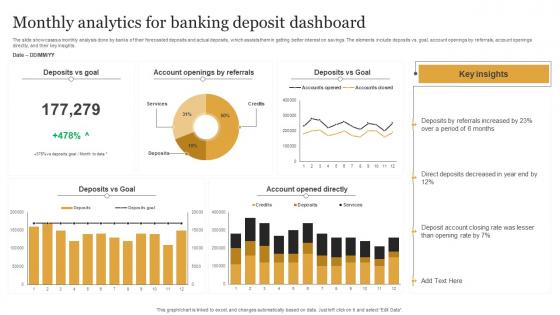
Monthly Analytics For Banking Deposit Dashboard




Try Before you Buy Download Free Sample Product
 Impress Your
 Audience
 100%
100% Editable
 Save Hours
 of Time


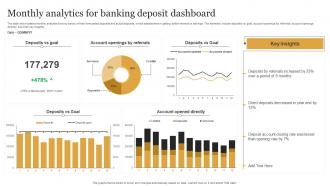
The slide showcases a monthly analysis done by banks of their forecasted deposits and actual deposits, which assists them in getting better interest on savings. The elements include deposits vs. goal, account openings by referrals, account openings directly, and their key insights.
People who downloaded this PowerPoint presentation also viewed the following :
Monthly Analytics For Banking Deposit Dashboard with all 7 slides:
Use our Monthly Analytics For Banking Deposit Dashboard to effectively help you save your valuable time. They are readymade to fit into any presentation structure.





FAQs for Monthly Analytics For
So banks use predictive analytics to catch problems before they blow up. They feed historical data into machine learning models that can predict loan defaults, flag sketchy transactions, and spot customers who might stop paying their cards. The accuracy is honestly crazy good these days. Everything gets thrown in - payment history, spending habits, you name it. Then algorithms spit out risk scores for customers and transactions. Way better to be proactive than scramble after someone's already defaulted. Saves them tons of money in the long run, which I guess is why every bank's doing it now.
Honestly, customer segmentation is where the magic happens. You group people by how they act, their age/income, spending habits - then actually talk to what they care about. Like instead of sending boring mortgage stuff to everyone, hit up millennials with first-time buyer deals and pitch retirement stuff to older folks. Your conversion rates will thank you later. The ROI difference is nuts because you're not just throwing spaghetti at the wall anymore. Start by digging into your transaction data - find maybe 3-5 solid customer types, then build campaigns around what keeps them up at night.
Start with transaction data - that's where you'll catch most fraud stuff. Look at spending patterns, amounts, timing, where they're shopping, all that. Customer profiles help too, like their usual behavior and account history. Real-time info is clutch though - IP addresses, device info, location data can stop fraud while it's actually happening. Oh and definitely use those external blacklists and threat feeds. Honestly, transaction patterns are probably your best bet since fraudsters always mess up there somehow. Don't ignore the demographic stuff either, it adds context to everything else.
So ML algorithms are honestly game-changers for credit scoring. They dig into way more data than old-school models - not just credit history but spending habits, payment timing, even how people fill out forms (which is kinda wild if you think about it). The algorithms get smarter over time too since they're constantly learning from new info. Processing is super fast compared to traditional methods. Oh, and here's the thing - if you're looking to upgrade your system, figure out which customer groups your current model sucks at evaluating. That's where you'll see the biggest improvement with machine learning.
Start with NPS - that's your best bet for tracking who'll actually recommend you. Customer Effort Score is clutch too, shows how much of a pain you're making things. CSAT gives you quick feedback on specific stuff. Honestly? Your app usage data might tell you more than surveys half the time. People vote with their feet. Track churn rate and how fast you fix complaints - those are like canaries in the coal mine. If you're just starting out though, stick with NPS and CES first. Don't overwhelm yourself trying to measure everything at once.
Dude, data viz tools are a game changer for banking. No more drowning people in endless spreadsheets - you get these interactive dashboards that actually make sense of risk patterns and customer stuff. Executives can see what's going on with loans or fraud in real-time, which speeds up decisions like crazy. It's honestly like showing someone a movie instead of making them read the book, you know? My advice though - don't go nuts right away. Pick one thing that's annoying everyone with reports and build something simple around that first. Way less overwhelming.
Honestly, latency's gonna be your biggest headache. Most legacy systems just weren't built for real-time stuff, so you're looking at major infrastructure overhauls. Then there's the regulatory nightmare - finance regulations make everything way more complicated since you can't just experiment freely with customer data. Data quality is another mess because info gets scattered across systems that barely communicate. Oh, and the transaction volumes? They're insane, so your analytics need to handle massive scale. My advice - don't try to go real-time everywhere at once. Pick your most critical use cases first and build from there.
Banking analytics is basically controlled by compliance rules - they dictate what data you can touch, how you store everything, and which insights you're actually allowed to use. Fair lending, AML, privacy stuff - you have to bake those checks right into your pipelines from day one. Honestly it's frustrating sometimes, but it does make you think harder about your models (probably a good thing). Oh, and definitely loop in your compliance people early. Trust me on this - there's nothing worse than building something brilliant only to have them shut it down because you missed some random regulation.
So basically you can set up sentiment analysis to watch all your customer touchpoints - emails, chats, social media, surveys, whatever. When it spots negative vibes, boom, instant alert. Call transcripts work too - supervisors get pinged if things start going downhill. Honestly, I think the coolest part is catching pissed off customers before they blow up your phone. You can track patterns to see what keeps ticking people off, then actually do something about it instead of just putting out fires all day.
So banks basically stalk all your spending habits and transaction history to figure out what you actually need. Wild stuff honestly. They'll suggest specific credit cards that match how you spend, or even predict when you might want a loan before you realize it yourself. Your app interface gets customized, budgeting tools pop up at the right moments - it's like they're reading your mind sometimes. The whole thing works because they're analyzing massive amounts of behavior patterns. Just hope they're using all that creepy knowledge to actually help rather than squeeze more money out of you, you know?
So basically, banks can track transaction data in real-time to spot trends way before anyone else does. Like if people suddenly start buying more eco-friendly stuff or using new payment apps - the data shows it immediately. Pretty wild how detailed it gets too. You can see spending patterns by location, age groups, which industries are about to explode or crash. Honestly, I'd probably get lost in all that data if I had access to it. Start with dashboards that flag weird spikes in spending categories - that's your early warning system right there.
You'll want to hit three main things: data governance, validation, and monitoring. Someone needs to own each data source - can't have quality without accountability. Build validation rules at every entry point because fixing bad data later is honestly such a pain. Set up dashboards that'll alert you when patterns look weird or data completeness tanks. Oh, and do regular audits comparing your analytics datasets back to the source systems. Start with your most critical feeds first. The automated monitoring piece is huge - saves you from those "wait, why are our numbers totally off?" moments that always happen at the worst times.
So banks use analytics to spot where things get stuck and predict when they'll need more people or resources. Machine learning catches process problems that people miss - honestly, it's kind of impressive how much faster it works than the old manual ways. You can forecast transaction volumes to staff branches better, plus it speeds up loan processing and even manages ATM cash levels. The fraud detection is probably the coolest part though. My advice? Pick one annoying problem your team deals with every day and see what data you've already got sitting around that might help fix it.
Honestly, banking analytics is a privacy nightmare because you're handling super sensitive financial data - like, this stuff shows people's entire life patterns. You'll need explicit consent and tight access controls, obviously. The hard part? Balancing useful insights with keeping customers happy about their data. People want better services but freak out if you misuse their mortgage info. Only collect what you actually need, be upfront about usage, and let customers control their data. Oh and audit everything regularly - can't stress that enough. Clear retention policies too.
Analytics can totally transform your loan underwriting game. Look beyond just credit scores and income - dive into transaction patterns, utility payments, even social media behavior. Machine learning catches risk patterns that slip past human reviewers, and honestly the accuracy is getting scary good. Your approval process speeds up like crazy too since automated scoring gives decisions in minutes, not days. Oh and definitely start with clean data first - garbage in, garbage out situation. Test everything against your historical performance to make sure you're actually improving approval rates, not just making things complicated.
-
I faced no difficulty while searching for the slide I wanted. Honestly, the website’s interface is easy to use and can be navigated easily!
-
Understandable and informative presentation.