

Monthly Financial Performance Result Reporting




Try Before you Buy Download Free Sample Product
 Impress Your
 Audience
 100%
100% Editable
 Save Hours
 of Time


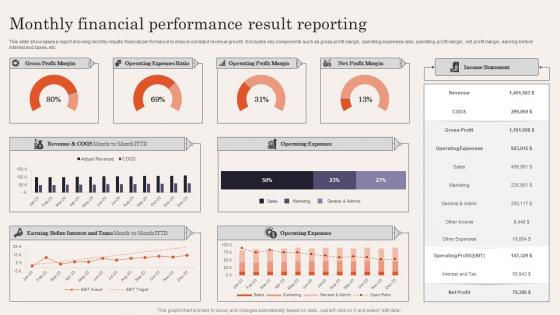
This slide showcases a report showing monthly results financial performance to ensure constant revenue growth. It includes key components such as gross profit margin, operating expenses ratio, operating profit margin, net profit margin, earning before interest and taxes, etc.
People who downloaded this PowerPoint presentation also viewed the following :
Monthly Financial Performance Result Reporting with all 7 slides:
Use our Monthly Financial Performance Result Reporting to effectively help you save your valuable time. They are readymade to fit into any presentation structure.





FAQs for Monthly Financial
You'll want the big four financial statements - income statement, balance sheet, cash flow, and statement of equity. Each one tells a different part of your company's story. Profitability, financial position, where cash is going, ownership stuff. Oh, and don't skip the notes section like everyone does - there's actually good info buried in there. Management discussion is clutch too since it explains what all those numbers actually mean. I'd say start broad with what each statement shows you, then zoom into specifics once you get the overall picture of your financial health.
So basically, international standards make your financial reports way more credible because everyone's playing by the same rules. IFRS keeps you consistent with how companies worldwide measure and report stuff - revenue recognition, asset valuation, all that. Investors love this since they can actually compare you to competitors without doing mental gymnastics. Your statements end up looking more transparent and trustworthy. Honestly, I'd just audit what you're doing now against IFRS requirements. You'll probably find some gaps - most companies do when they first check.
Honestly, cash flow statements are way more useful than people realize. They show actual money coming in and going out - not just profit on paper. I've seen profitable companies go under because they couldn't pay their bills! The statement breaks things into three parts: operating, investing, and financing activities. That way you can pinpoint exactly where your cash issues are happening. Income statements include all sorts of non-cash stuff that doesn't help when you're trying to figure out if you can make payroll next week. Focus on operating cash flow first - if it's positive and growing, you're in good shape.
So first off, get your internal controls locked down and do regular audits - that's like your safety net. GAAP compliance is non-negotiable, and yeah, document literally everything even though it's boring as hell. Multiple eyes on those financial statements before they go anywhere - trust me on this one. Training your accounting people properly makes a huge difference too. Oh and external auditors are worth it, they spot things your team might gloss over since they're too close to it. Basically just build those checks into your routine and stick with them every single time.
Dude, you're probably still doing way too much manual work. Most financial reporting is automated now - data pulls itself from different systems, reports run in real time, errors get flagged automatically. Your team can work on stuff from anywhere with cloud platforms. AI is actually decent at catching weird anomalies you'd miss (though sometimes it's overly paranoid). Compliance got easier too since software formats everything for different regulations. Honestly, if you're still wrestling with Excel and typing in data by hand, you're just torturing yourself at this point.
So banks are obsessed with capital ratios and loan losses - makes sense given 2008, right? Tech companies totally different story though. They're all about subscription numbers and how much they're burning on R&D. Manufacturing gets weird with inventory stuff and depreciation methods. Healthcare's probably the messiest since they have to account for clinical trials that might not even work out. Bottom line: figure out what GAAP rules hit your industry hardest, then focus on whatever metrics investors actually look at. Each sector's got its own quirks you can't ignore.
Data quality is honestly your biggest headache - missing info, departments using different systems, the whole mess. Regulatory stuff changes constantly too, which is super annoying when you finally think you've got it down. Complex transactions never fit into neat little boxes either. Oh, and everyone always wants everything yesterday while still being perfect. Start checking your data way earlier than you think you need to. Seriously, build in extra time because something will go wrong. Trust me on that one - learned it the hard way!
Look, financial reports are basically your roadmap for any investment decision. You're gonna want to dig into income statements, balance sheets, cash flow - all that stuff tells you if a company's actually profitable or drowning in debt. Without good financials? You're just throwing darts blindfolded, honestly. These reports help you catch red flags early, like when revenues are tanking or they're borrowing way too much. Oh, and always compare companies side by side - makes it way easier to spot the winners. Get at least three years of audited reports before you put real money down.
Look, non-GAAP metrics are great for highlighting your actual operating performance - you can strip out weird one-time hits, stock comp, M&A stuff that clouds the real picture. But here's the thing: you HAVE to reconcile everything back to GAAP and be crystal clear about exclusions. I've watched companies get absolutely roasted for looking like they're playing games with numbers. Oh, and always lead with your GAAP figures first. Consistency matters too - don't change your methodology every quarter or investors will lose trust fast.
Think of financial reports as your business GPS - they'll show you where your money's really going, not where you assume it's going. Cash flow statements are gold for timing big purchases or expansions. You can catch which departments are burning through budget and spot those seasonal patterns that mess with your planning. Honestly, quarterly reviews beat annual ones every time. It's like actually checking your route instead of just hoping you end up where you want. Revenue trends become super obvious when you're looking regularly too.
Look, don't mess with the numbers - that's rule
-
Editable, diversified, compatible with MS PPT and Google Slides, and on top of that finest graphics!! I mean in the words of the famous Ross Geller, “What more do you want!”
-
SlideTeam makes creating presentations easy. Unlimited products, premium quality designs and affordable.