


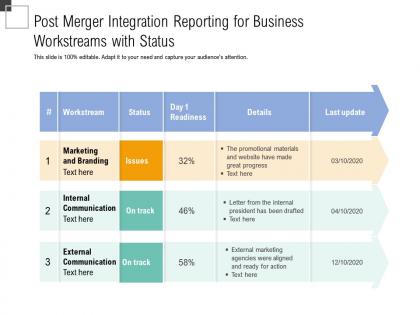
Post merger integration reporting for business workstreams with status




Try Before you Buy Download Free Sample Product
 Impress Your
 Audience
 100%
100% Editable
 Save Hours
 of Time


Our Post Merger Integration Reporting For Business Workstreams With Status are explicit and effective. They combine clarity and concise expression.
People who downloaded this PowerPoint presentation also viewed the following :
Post merger integration reporting for business workstreams with status with all 2 slides:
Give your audience a fulfilling experience. They will find our Post Merger Integration Reporting For Business Workstreams With Status elevating.
FAQs for Post merger integration reporting for business
Focus on the big four: revenue synergies, cost cuts, employee retention, and customer churn. Those will tell you the real story. System integration milestones matter too, obviously. For the softer stuff - employee engagement scores help track cultural integration, though honestly that's always messier to measure. I'd do weekly financial check-ins and monthly operational deep-dives. Start simple with a basic scorecard. Don't go crazy trying to track everything right away or you'll drown in data. Oh, and maybe grab coffee with some folks from both sides - sometimes the best intel doesn't show up in spreadsheets.
Look, you gotta talk to different people differently. Executives want quick weekly dashboards, employees need monthly check-ins, board members get the quarterly deep dives. Make everything visual - charts, trackers, whatever. Nobody reads paragraphs anymore (I learned this the hard way). Be honest about the good AND the bad stuff because people aren't stupid. Oh, and whatever schedule you pick? Stick to it religiously. Start by figuring out who needs what info and when. Also set up proper channels so you're not scrambling every time.
Dude, cultural alignment will totally make or break your PMI reporting. Different teams have their own ways of doing everything - communication styles, data standards, how they even define "success." I've watched finance teams argue for weeks over basic KPI definitions, which was honestly painful to witness. Map out each org's reporting culture first and spot the gaps. You'll need shared metrics and common processes early, or you'll waste months comparing completely different things. Trust me, fix this upfront before building anything new.
Check out Synaptiq or DealRoom first - they're actually designed for M&A stuff so the dashboards make sense. Monday.com works too but honestly gets chaotic once things get complicated. Your existing BI tools like Tableau are perfect for the financial side since they already connect to everything. Oh, and don't get fancy right away. Seriously, just pick whatever your team's comfortable with and expand later. I've seen people waste months trying to build the "perfect" system upfront when they could've been tracking deals already.
Honestly, start with weekly reports for the first 90 days - things move crazy fast and problems come out of nowhere. After that initial chaos, most stuff can go bi-weekly. Monthly works once you hit the 6-month mark, but I'd keep anything mission-critical on weekly check-ins because that's where things usually blow up. Match your reporting to how risky and fast-moving each piece is. Oh, and create a simple template that covers milestones, risks, and budget stuff so you're not reinventing the wheel every time.
Honestly, pulse surveys work really well - just keep them short and do them regularly. Anonymous feedback is clutch because people actually tell you what they're thinking. I'd also do stay interviews with your key players to figure out what might make them bolt. Focus groups are solid too, though some people clam up in groups. Pay attention to the weird stuff like who's calling out more or if Slack's gotten quieter. Oh, and don't forget one-on-ones with managers - they usually know what's up. Mix it up since everyone's different about sharing feedback. Just don't do it randomly or people won't take it seriously.
Honestly, mergers can totally wreck customer satisfaction if you're not careful. System integrations always cause service hiccups. Your staff gets confused about new processes - which makes sense, right? Customers end up getting inconsistent experiences depending on which location they visit. Communication breakdowns are probably the worst part though. People hate being kept in the dark about changes that actually affect them. Oh, and if you're consolidating products, some customers might lose features they actually used. You've got to watch those satisfaction scores like a hawk during integration. Have a real communication plan, not just generic corporate speak. Customers won't just deal with it - they want to know what's happening.
Data inconsistencies are the worst - you'll spend forever trying to figure out why the same metric shows three different numbers. Teams always rush to merge reporting systems when they should take it slow. Plus everyone starts measuring everything twice but with different formulas, which is just chaos. Historical data gets completely screwed up if you move too fast on consolidating formats. Oh, and nobody ever decides who actually owns each data stream during transitions. Super messy. Start with getting everyone on the same reporting schedule first. Then tackle the tech stuff bit by bit - trust me, the "rip the bandaid off" approach never works here.
Honestly, you'll need both combined and standalone numbers during the integration. Start with pre-merger baselines for each company, then track how the combined entity stacks up. Break out integration costs separately - stakeholders are obsessed with those details, it's kinda annoying but whatever. Focus on the big stuff: revenue synergies, cost savings, EBITDA improvements. Here's the key part though - separate your one-time expenses from ongoing operational stuff so leadership actually sees the real ROI. Build a dashboard showing progress toward synergy targets with clear timelines. Makes everything way easier to explain.
First thing - get neutral people to handle conflicts who aren't from either company. You'll want safe spaces where teams can vent without getting in trouble (and trust me, they'll need to vent). Instead of arguing about whose old methods were superior, push everyone toward common goals. Write down what's happening so you can spot patterns instead of just putting out fires. Quick, transparent communication is huge because silence just creates wild rumors. Oh, and definitely do regular check-ins with your key people - way easier to handle small issues before they blow up.
Honestly, dashboards are a game changer for this stuff. You'll actually see what's happening instead of staring at endless Excel rows like some kind of masochist. Heat maps show which departments are crushing it vs. totally behind. Timeline charts track your milestones across different teams. The visual thing just clicks better - patterns jump out, bottlenecks become obvious. Way easier to explain to your boss too when they want updates but don't have time for your 50-page report. I'd start basic with maybe 6 key metrics on one dashboard. Trust me, it beats spreadsheet hell every time.
Start with mapping out what both companies actually have - boring as hell but you can't skip it. Customer systems first since that's your money maker, then tackle ERP and financial stuff. Back everything up like crazy before you touch anything (learned that one the hard way). Run both systems side by side during the switch - trust me on this. Phase it out instead of ripping the band-aid off all at once. Get both IT teams talking early so they can spot the stuff that'll break before it actually does. Honestly, the planning phase takes forever but it's what saves your butt later.
Set up quick pulse surveys with your integration teams and grab weekly check-ins with key people from both companies. Make some standardized feedback forms - capture what's working and what's totally broken. Honestly, I've watched so many integrations crash because leadership thought no news was good news (spoiler: it's not). Monthly cross-functional reviews where you actually talk through the feedback and tweak your roadmap. The real trick is creating space where people feel safe flagging problems early instead of waiting for some big quarterly meeting. Just start with something simple this week, even a basic survey.
Watch out for confidentiality stuff - your reports can't accidentally spill competitive info or customer data that breaks NDAs. Labor law compliance is massive when you're reporting workforce changes or layoffs (WARN Act and all that). Integration reporting honestly feels like tiptoeing through landmines sometimes. Antitrust issues pop up too if you're sharing market data. Oh, and definitely get legal involved early - have them review your reporting templates before you actually start using them. Trust me, it's way easier than fixing problems later.
Break it into phases, honestly. First 100 days? Just make sure nothing's on fire - systems work, people aren't jumping ship, customers still like you. That's your baseline. Then track if you're actually hitting those synergy numbers you promised (spoiler: most companies don't). Revenue retention matters most here - lose customers and you've basically torched your ROI. Later on, it's about culture meshing and whether you delivered that strategic value to the board. Monthly red/yellow/green reports with clear owners keep everyone honest. Nothing fancy, just consistent check-ins.
No Reviews