


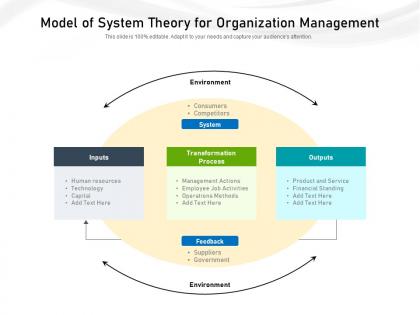
Model of system theory for organization management




Try Before you Buy Download Free Sample Product
 Impress Your
 Audience
 100%
100% Editable
 Save Hours
 of Time


Our Model Of System Theory For Organization Management never call it a day. You will always find them available.
People who downloaded this PowerPoint presentation also viewed the following :
Model of system theory for organization management with all 2 slides:
You will find our Model Of System Theory For Organization Management forever available. They never call it a day.

FAQs for Model of system theory
Think of your company like a spiderweb - touch one strand and the whole thing vibrates. When marketing changes their campaign, it hits sales, then customer service, then probably IT too. You've got stuff coming in (people, money, info), work happening in the middle, and results going out. Companies aren't sealed boxes though - they're constantly dealing with outside forces. The feedback loops are honestly what keep everything from falling apart. Try mapping how your decisions affect other teams. I did this once and found out my tiny process change was driving our finance team absolutely crazy.
Dude, systems theory is honestly a lifesaver for decision-making. Instead of tunnel vision on one problem, you see how everything connects. Like when I changed our team's meeting schedule last year - didn't realize it'd mess up the finance department's reporting cycle until after. Anyway, the whole point is spotting those ripple effects before they bite you. Map out who gets affected by your decision first. You'll catch weird connections you never thought of. Short version: think bigger picture, save yourself headaches later. Trust me on this one.
Honestly, most companies are terrible at this - they'll survey everyone and their mom, then just... nothing. Here's what actually works: pick one thing (maybe how you onboard new people?) and create a real cycle around it. Get feedback from customers and your team regularly. Then - and this is where it gets good - actually analyze what you're seeing and make changes based on it. Track if those changes worked. Rinse and repeat. I'd start small though, don't try to fix everything at once or you'll burn out.
So interdependence is what makes your org actually work well - when departments sync up, you get way better results than just adding individual efforts together. Picture a jazz band where everyone's playing off each other vs. separate solo acts. Changes in one area create good ripple effects everywhere else. But honestly? If coordination sucks between interdependent parts, problems get amplified too. I'd start by fixing communication and feedback between your main departments first - that's where you'll see the biggest impact.
Think big picture instead of getting stuck on individual issues. Map out how your departments and processes actually connect - the real problem is usually hiding somewhere you didn't expect. Honestly, it's like trying to untangle Christmas lights after they've been in storage all year. Look for feedback loops and bottlenecks that create ripple effects. Small tweaks in the right spots can fix way more than you'd think. Start by sketching out one problem you're dealing with and trace all its connections. The patterns that show up will probably surprise you.
Honestly, the biggest problem is getting stuck in analysis hell - you'll map out every single connection and never actually *do* anything about the problem. I've seen people spend weeks drawing these elaborate system diagrams when they could've just... fixed the issue, you know? Also, it treats humans like they're predictable machines, which is laughably wrong. People are messy and irrational. The models take forever to build too, so by the time you're done, everything's already changed. Don't get me wrong, it's useful! Just use it alongside other approaches instead of making it your whole thing.
So systems theory is basically looking at communication like it's a whole network instead of just random conversations. Map out who actually talks to who on your team - you'll probably find some wild patterns. Maybe Sarah's drowning because everyone dumps info on her, or updates just vanish between departments. It's honestly pretty eye-opening when you see it laid out. Track how info flows for like a week and you'll spot exactly where things fall apart. Then you can fix those specific chokepoints instead of just hoping communication magically gets better.
So systems theory is basically about seeing how everything connects when you're doing strategy stuff. Like, don't just look at departments separately - think about how changing one thing affects everything else. New tech system? That's gonna impact operations AND customer experience. I honestly think most leaders miss this completely. You start catching all these weird interdependencies and feedback loops that would otherwise bite you later. Oh, and try mapping your next big initiative with inputs, processes, outputs - sounds nerdy but you'll spot problems way earlier. It's pretty game-changing once you get it.
Honestly, focus on how your departments actually talk to each other - that's where you'll see real results. Track cross-functional project success and how fast you pivot when markets change. Information flow between teams is massive too. Employee engagement tells you tons because people work better when they get the whole picture, not just their little slice. I'd also watch how well your org learns from feedback loops. The trick is measuring connections between groups instead of just individual performance. Oh, and don't overcomplicate it - pick maybe 3-4 solid metrics that actually show collaboration happening.
Toyota's the classic case - their whole production system is built on feedback loops between every department. Supply chain talks to manufacturing, workers send suggestions up the chain, everything connects. Amazon does this obsessively with data (sometimes it's overkill honestly). Even Patagonia links their environmental mission across operations, marketing, and product development. The takeaway? Map out how your decisions actually affect other teams. It's surprising how much ripple effect one department can have. Start there and you'll see the connections pretty quickly.
You know how systems theory talks about everything being connected and needing to adapt fast? That's basically agile in a nutshell. Daily standups = feedback loops happening in real time. Cross-functional teams responding to changes? Pure systems thinking. The cool thing is, you can actually sell agile to your bosses by calling it "systematic organizational improvement" instead of just another trendy methodology - sounds way more legit, right? Both approaches get that when you change one thing, it affects everything else. Perfect match honestly.
So systems theory basically shows people how their job fits into everything else happening at work. Once employees get that they're not working in some weird bubble, they actually start caring more. It's pretty wild - suddenly they realize moving those puzzle pieces around actually builds something real. The whole thing focuses on how departments affect each other, which honestly breaks down all that stupid territorial nonsense. You should totally map out team connections in your next meeting (sounds boring but trust me). People finally understand where they fit in.
Get your people mapping out their decisions across the whole company, not just their little corner. Case studies work great - have them trace how one choice bounces between departments. Role-playing is honestly where the magic happens though. People swap jobs for an exercise and suddenly they're like "ohhhh, THAT'S why marketing always pushes back on our timelines." Feedback simulations help too. The whole point is getting them out of silo thinking. Before any big decision, make them sketch out all the relationships involved. It's wild how much they miss when they don't visualize it first.
Start with systems mapping - just draw out how info and resources actually move around your company. Root cause analysis is clutch for finding the real problems instead of band-aid fixes. Regular check-ins between departments help you see how changes affect everything else (feedback loops, basically). Lucidchart makes this stuff way less painful than sketching by hand - trust me on that one. Don't try to map your entire operation right away though. Pick whatever process is driving everyone crazy and start there. You'll get way better results focusing on one thing that's actually broken.
So systems theory actually works great with other management stuff. Think of it like your base layer - you map out your whole organizational picture first (processes, environment, relationships, all that). Then contingency theory helps you pick which approach fits your situation. Chaos theory is wild because it basically says "yeah, things will get unpredictable anyway" even with perfect planning. But that's fine! The systems framework lets you see everything, while the other theories handle specific problems as they pop up. Honestly, I'd start with mapping your system first, then figure out which theory works for whatever mess you're dealing with.
No Reviews