


Predictive Analytics IT Powerpoint Presentation Slides




Try Before you Buy Download Free Sample Product
 Impress Your
 Audience
 100%
100% Editable
 Save Hours
 of Time


Predictive analytics is applicable and valuable to nearly every industry. Check out our efficiently designed Predictive Analytics IT template. It gives a brief idea about predictive analytics, which uses statistical techniques, machine learning algorithms, and other tools to analyze historical data. It also makes predictions about future events or outcomes. In our Predictive Analytics deck, we have covered the introduction to predictive analytics, its framework, and different models. It shows the importance of predictive analytics with its usage. In addition, our Estimation Model PPT exhibits the different predictive analytics tools and their workflow. Further, it covers the difference between the four types of advanced analytics. Our Forecast Model PPT reveals multiple predictive analytics models like classification models, clustering models, etc. Furthermore, it caters to the prominent business sectors that are already using predictive analytics in their daily operations. These include the healthcare department, banking, finance, and many more. Moreover, this Prospective Analysis module comprises a training program and a budget to develop a predictive analytics model. Lastly, it showcases a checklist, a timeline, and a roadmap for predictive analytics model deployment with a performance tracking dashboard. Get access now.
People who downloaded this PowerPoint presentation also viewed the following :
Content of this Powerpoint Presentation
Slide 1: This slide introduces the Predictive Analytics (IT). Commence by stating Your Company Name.
Slide 2: This slide depicts the Agenda of the presentation.
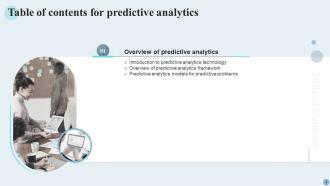
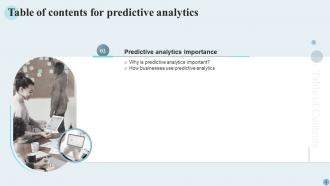
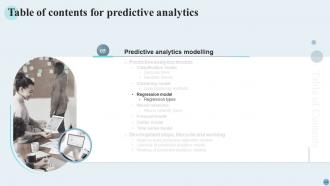
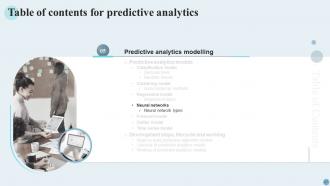
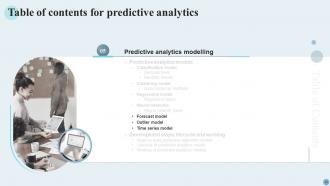
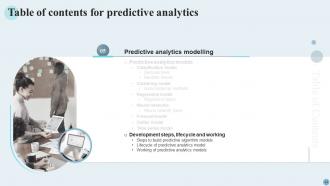
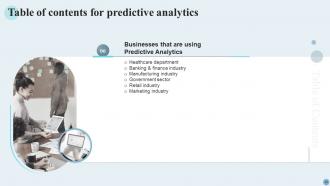
Slide 3: This slide incorporates the Table of contents.
Slide 4: This slide highlights the Title for the Topics to be discussed next.
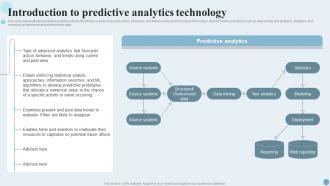
Slide 5: This slide represents the predictive analytics introduction that is used for forecasts action, behaviors, and trends using recent and past information.
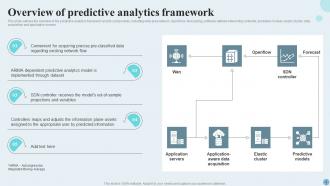
Slide 6: This slide outlines the overview of the predictive analytics framework and its components.
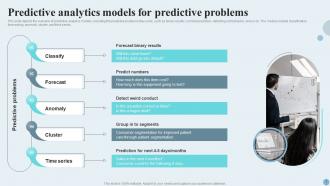
Slide 7: This slide depicts the overview of predictive analytics models, including the predictive problems they solve.
Slide 8: This slide elucidates the Heading for the Components to be discussed next.
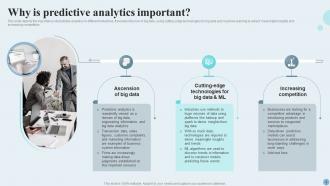
Slide 9: This slide showcases the importance of predictive analytics in different industries.
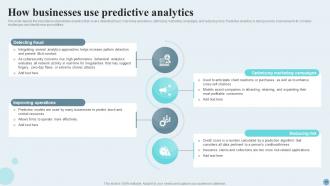
Slide 10: This slide presents the importance of predictive analytics that covers detecting fraud, improving operations, optimizing marketing campaigns, etc.
Slide 11: This slide displays the Title for the Ideas to be discussed next.
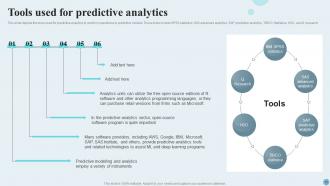
Slide 12: This slide depicts the tools used for predictive analytics to perform operations in predictive models.
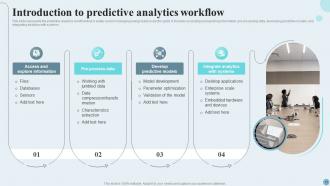
Slide 13: This slide represents the predictive analytics workflow that is widely used in managing energy loads in electric grids.
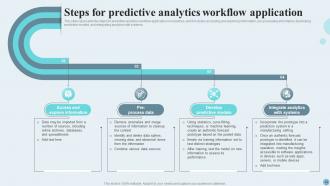
Slide 14: This slide states the steps for predictive analytics workflow application in industries.
Slide 15: This slide reveals the Heading for the Ideas to be covered further.
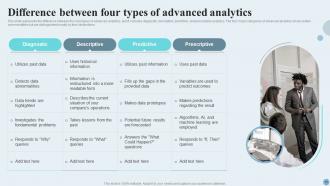
Slide 16: This slide shows the difference between the main types of advanced analytics, and it includes diagnostic, descriptive, predictive, and prescriptive analytics.
Slide 17: This slide incorporates the Title for the Components to be discussed next.
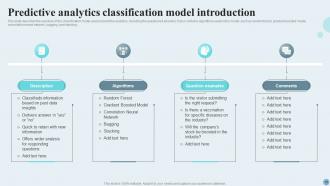
Slide 18: This slide describes the overview of the classification model used in predictive analytics.
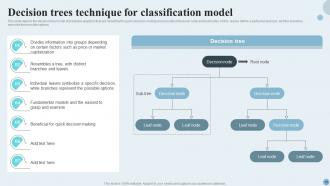
Slide 19: This slide exhibits the Decision trees technique for classification model.
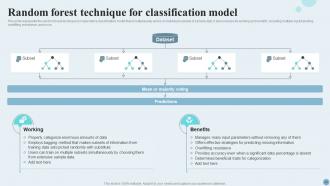
Slide 20: This slide represents the random forest technique to implement a classification model that simultaneously works on individual subsets of sample data.
Slide 21: This slide portrays the Heading for the Topics to be covered in the following template.
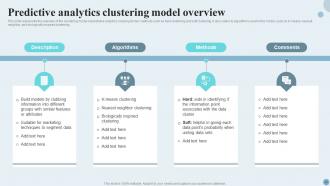
Slide 22: This slide talks about the Predictive analytics clustering model overview.
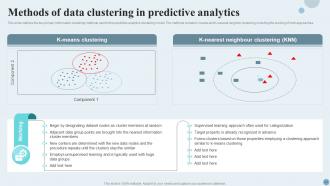
Slide 23: This slide outlines the two primary information clustering methods used in the predictive analytics clustering model.
Slide 24: This slide portrays the Title for the Topics to be covered further.
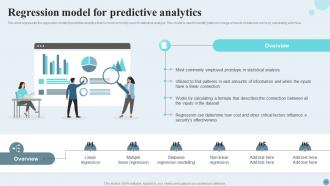
Slide 25: This slide represents the regression model of predictive analytics that is most commonly used in statistical analysis.
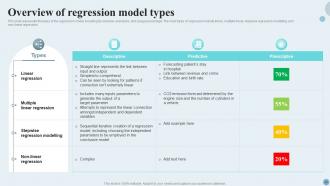
Slide 26: This slide showcases the types of the regression model, including its overview, examples, and usage percentage.
Slide 27: This slide reveals the Heading for the Components to be discussed next.
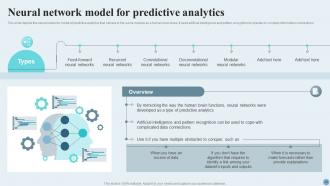
Slide 28: This slide depicts the neural networks model of predictive analytics that behave in the same manner as a human brain does.
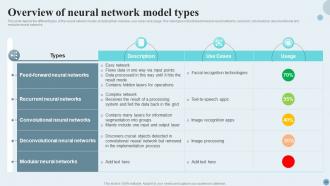
Slide 29: This slide presents the different types of the neural network model, including their overview, use cases and usage.
Slide 30: This slide indicates the Title for the Ideas to be discussed further.
Slide 31: This slide focuses on the Predictive analytics forecast model introduction.
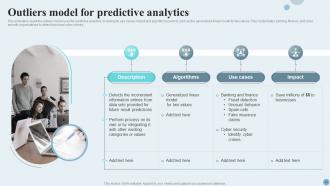
Slide 32: This slide talks about the outliers model used for predictive analytics, including its use cases, impact and algorithm.
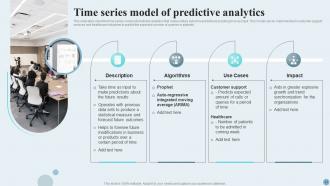
Slide 33: This slide elucidates the Time series model of predictive analytics.
Slide 34: This slide states the Heading for the Components to be covered in the forth-coming template.
Slide 35: This slide discusses the steps required to create predictive algorithm models for business processes.
Slide 36: This slide depicts the lifecycle of the predictive analytics model, and it includes highlighting & formulating a problem, data preparation, etc.
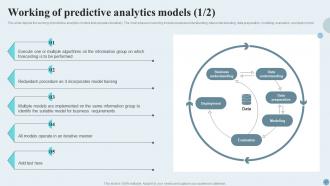
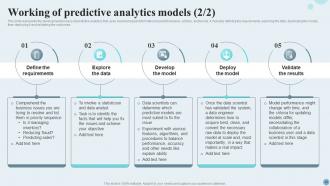
Slide 37: This slide shows the working of predictive analytics models that operates iteratively.
Slide 38: This slide represents the development process of predictive analytics that uses recent and past information to predict behavior, actions, and trends.
Slide 39: This slide contains the Title for the Contents to be discussed next.
Slide 40: This slide outlines the application of predictive analytics in the healthcare department for forecasting the probability of patients having particular medical disorders.
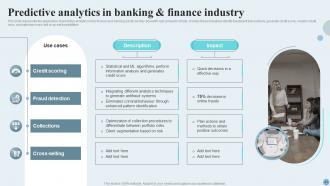
Slide 41: This slide presents the application of predictive analytics in the finance and banking sector as they deal with vast amounts of data.
Slide 42: This slide talks about using predictive analytics in manufacturing forecasting for optimal use of resources.
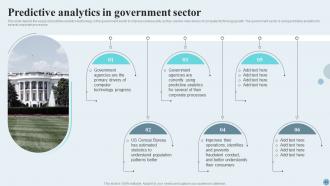
Slide 43: This slide depicts the usage of predictive analytics technology in the government sector to improve cybersecurity as they are the main drivers of computer technology growth.
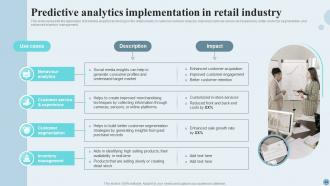
Slide 44: This slide represents the application of predictive analytics technology in the retail industry.
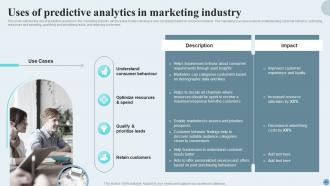
Slide 45: This slide elucidates the use of predictive analytics in the marketing industry, where active traders develop a new campaign based on customer behavior.
Slide 46: This slide presents the Heading for the Ideas to be covered further.
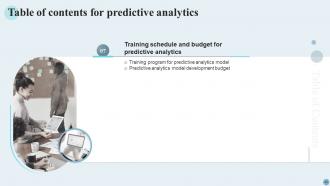
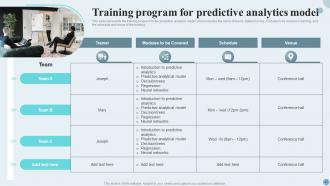
Slide 47: This slide represents the training program for the predictive analytics model, and it includes the name of teams, trainer names, modules to be covered in training, and the schedule and venue of the training.
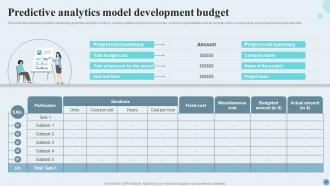
Slide 48: This slide describes the budget for developing predictive analytics model by covering details of project cost summary, amount, etc.
Slide 49: This slide displays the Title for the Ideas to be discussed in the following template.
Slide 50: This slide talks about the checklist for predictive analytics deployment that is necessary for organizations before deploying it and avoiding possible mistakes.
Slide 51: This slide mentions the Heading for the Topics to be covered in the forth-coming template.
Slide 52: This slide depicts the roadmap for predictive analytics model development, including describing the project, information collection, etc.
Slide 53: This slide indicates the Heading for the Contents to be covered in the forth-coming template.
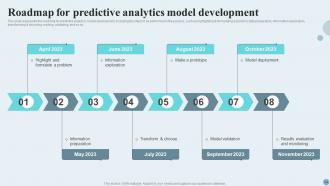
Slide 54: This slide presents the roadmap for predictive analytics model development, including the steps to be performed in the process, such as highlighting & formulating a problem, data preparation, etc.
Slide 55: This slide portrays the Title for the Topics to be discussed in the next template.
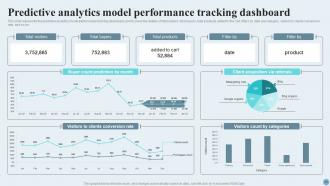
Slide 56: This slide reveals the Predictive analytics model performance tracking dashboard.
Slide 57: This slide is used for depicting Additional information.
Slide 58: This is the Icons slide containing all the Icons used in the plan.
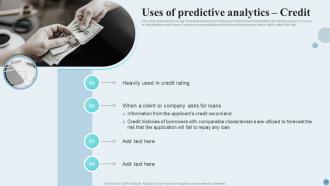
Slide 59: This slide describes the usage of predictive analytics in banking and other financial institutions for credit purposes.
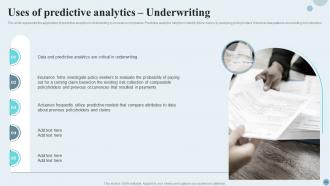
Slide 60: This slide exhibit the application of predictive analytics in underwriting by insurance companies.
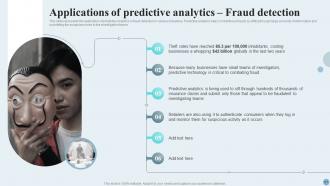
Slide 61: This slide showcases the Application of predictive analytics in fraud detection in various industries.
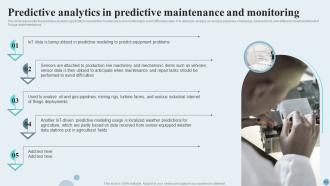
Slide 62: This slide represents the predictive analytics application in predictive maintenance and monitoring to avoid difficulties later.
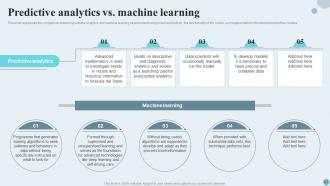
Slide 63: This slide discusses Predictive analytics vs. machine learning.
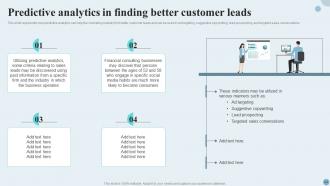
Slide 64: This slide focuses on Predictive analytics in finding better customer leads.
Slide 65: This slide depicts how predictive analytics help identifies prospects faster in the marketing industry.
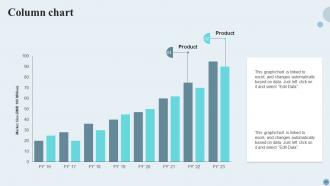
Slide 66: This slide reveals the Column chart.
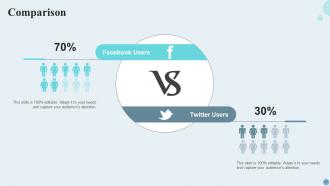
Slide 67: This slide is used for the purpose of Comparison.
Slide 68: This is the About Us slide for showcasing the company-related information.
Slide 69: This slide illustrates the Venn Diagram.
Slide 70: This slide exhibits the 30 60 90 days plan for effective planning.
Slide 71: This slide presents the Roadmap of the firm.
Slide 72: This is the Thank you slide for acknowledgement.
Predictive Analytics IT Powerpoint Presentation Slides with all 77 slides:
Use our Predictive Analytics IT Powerpoint Presentation Slides to effectively help you save your valuable time. They are readymade to fit into any presentation structure.


















FAQs for Predictive Analytics IT
Honestly, predictive analytics comes down to four things. First - and I can't stress this enough - your data has to be clean. Garbage in, garbage out, every single time. You'll also need the right models for whatever problem you're tackling, plus people who actually know how to read the results (this is where a lot of companies mess up). But here's what really matters: you need a specific business goal driving everything. Like, what exact problem are you trying to solve? The math part is actually pretty straightforward these days. It's connecting those predictions to real decisions that'll make or break you. Pick one problem and work backwards from there.
So predictive analytics is basically using your old data to guess what's coming next - customer behavior, equipment breaking down, inventory needs, that stuff. Instead of always playing catch-up, you're actually ahead of problems before they happen. Honestly, the customer churn prediction alone can save you tons of headaches. You can spot which clients might bail and do something about it early. Same with demand forecasting - no more scrambling when you run out of popular items. I'd say pick one thing to test it on first, maybe inventory since that's pretty straightforward, then build from there once you see how it works.
So ML is what actually does the heavy lifting in predictive analytics - it digs through your data to spot patterns and build prediction models. Rather than coding every rule by hand, these algorithms just learn from old data to forecast what's coming next. You know, stuff like figuring out which customers might bail, sales predictions, catching fraud. Honestly, the best part is they keep getting better as you throw more data at them. If you're starting out, go with something straightforward like linear regression or decision trees - way easier to explain to your boss later.
Honestly, it comes down to three things with predictive models. First off, your data has to be solid - clean, relevant, and actually matches what you're predicting. Cross-validate everything before you deploy it too. But here's where most people mess up: they think they're done once it's live. Wrong! Real-world stuff changes constantly, so you've gotta monitor performance religiously. I usually set up alerts when accuracy tanks below whatever threshold makes sense. Oh, and don't wait too long to retrain - I've seen models go completely sideways because someone ignored the warning signs for months.
Bias is the killer here - if your training data has baked-in discrimination, your model will just repeat those patterns. People deserve to know when algorithms are making decisions about them, plus you've gotta handle their personal info carefully. Privacy stuff gets messy fast, especially with health data or whatever. I swear, developers get so excited about the tech they forget real humans are affected. Oh, and definitely run bias checks regularly. Before launching anything, just ask yourself "who gets screwed over by this?" Sounds harsh but it'll save you later.
Predictive analytics in healthcare is actually pretty cool - you can spot which patients might get readmitted or need ICU care before it happens. Hospitals love using it for staffing too, especially when flu season hits and everything goes crazy. It's also great for catching diseases early by finding weird patterns in lab work. Treatment outcomes become way more personalized when you know what's likely to work. Honestly, I'd start with something simple like readmission risk since that's where you'll see results fast. My cousin works in hospital admin and says the difference is night and day once they got their system running.
Honestly, the worst part is always your data being way messier than expected - missing stuff everywhere, formats that don't match up, systems that basically hate each other. Plus stakeholders get super skeptical about algorithms they can't understand, which I get but it's frustrating. Good data scientists cost a fortune and they're always getting poached too. Oh, and that whole "garbage in, garbage out" thing? Yeah, that'll come back to haunt you if you're not careful. I'd say pick one small project first, something with obvious returns, then spend way more time cleaning data than you think you need.
Honestly, start with cleaning up your data first - that whole "garbage in, garbage out" thing is painfully true. Most predictive tools like Tableau or DataRobot can hook right into your current databases through APIs, so you won't need to rebuild everything from scratch. Pick one simple use case first, maybe churn prediction or something. Get your data governance figured out early (trust me on this one). Then set up automated flows so your models don't go stale. Power BI works pretty well too if you're already in that ecosystem. Once you nail the first project, scaling gets way easier.
So healthcare and finance are totally dominating predictive analytics right now. Hospitals can predict which patients might get readmitted, banks stop fraud in real-time - it's wild. Retailers basically read your mind and know what you'll buy next (honestly kind of scary). Manufacturing uses it to catch equipment failures before they happen. Energy companies predict when demand will spike too. Oh, and logistics - supply chain optimization is huge. If you're getting into this field, I'd probably start with healthcare since the money's really good and there are so many different ways to use it.
Dude, just use what you've got first - Google Analytics is free and shows tons of patterns. Excel works too for basic forecasting stuff. Your CRM probably has features you haven't even touched yet. Look at when customers actually buy vs. when you think they do. Which emails get clicks? Honestly, I've seen people overthink this so much when simple questions give the best answers. Mailchimp and HubSpot have predictive tools built right in. Pick one specific thing you're curious about - like why some customers come back and others don't. Then just dig into whatever data you're already collecting.
Honestly, I'd focus on just 2-3 metrics at first - trying to track everything is a nightmare. Precision and recall matter for accuracy, but don't stress if they're not perfect when your business results look good. That's where the real value is anyway. Track whatever KPI you're actually trying to move - ROI, cost savings, revenue bump, whatever. Oh and definitely watch adoption rates because I've seen amazing models just sit there unused. Pretty frustrating when that happens. Start simple and add more metrics later once you've got the basics down.
Honestly, this stuff can make or break everything you're doing. Your models are only as good as the data going into them - sounds obvious but you'd be surprised how many people skip this part. Messy, incomplete data? Your predictions will be trash regardless of how fancy your algorithms are. I've seen teams spend weeks fixing data issues they could've avoided upfront. Start with auditing what you actually have first. Set up some basic quality checks before anything touches your models. Trust me, it's way better than debugging weird results later because someone's data pipeline was held together with duct tape.
Honestly, real-time analytics is where things are going - people want insights now, not yesterday's batch data. AI explanations are finally getting better too, which is huge because nobody trusted those black box predictions anyway. Edge computing's massive for IoT stuff when you need predictions right at the source. Oh, and AutoML is pretty cool since it means your business people can build models without constantly pestering data science. I'd mess around with streaming architectures sooner rather than later. That's definitely the direction everything's moving.
Predictive analytics is basically reading your customers' minds before they know what they want. Analyze their past behavior and you'll predict who's about to churn, when someone's ready to upgrade, stuff like that. Honestly, it gets creepy how spot-on it can be sometimes. I'd start with something simple - maybe predicting purchase likelihood? Then build from there. You'll catch pain points before they turn into angry emails and time your outreach perfectly. The personalized recommendations alone will blow your mind.
Dude, you want clean historical data that actually connects to what you're predicting. Sales numbers, customer habits, timestamps, demographics - stuff you can measure that shows patterns. More isn't always better though, especially if it's garbage data. I'd rather have less high-quality info than tons of messy spreadsheets (been there, trust me). Quality beats quantity every time. Figure out what you're trying to predict first, then work backwards to find the data points that actually matter. You need enough examples to train properly, but don't overcomplicate it.
-
Unique design & color.
-
Spacious slides, just right to include text. SlideTeam has also helped us focus on the most important points that need to be highlighted for our clients.