

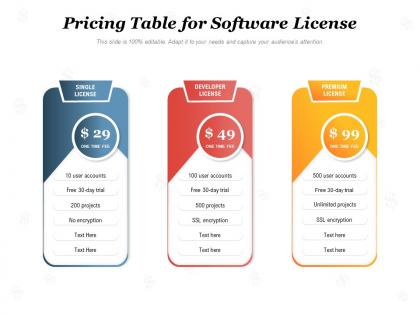
Pricing table for software license





Try Before you Buy Download Free Sample Product
 Impress Your
 Audience
 100%
100% Editable
 Save Hours
 of Time


Figure out how the incident happened with our Pricing Table For Software License. Be able to establish the cause of injury.
People who downloaded this PowerPoint presentation also viewed the following :
Pricing table for software license with all 2 slides:
Examine the incident with our Pricing Table For Software License. Find out how to avoid injury.
FAQs for Pricing table
Key factors include license type structure, user tiers, feature differentiation, competitive positioning, and renewal terms. These elements streamline decision-making by clearly defining value propositions, usage restrictions, and scalability options, with many software companies finding that transparent pricing tables enhance customer conversion rates while reducing sales cycle complexity and support inquiries.
Tiered pricing models enhance software sales by catering to diverse customer needs, reducing barriers to entry, and maximizing revenue potential across different market segments. This strategic approach enables businesses to capture price-sensitive customers with basic tiers while upselling premium features, ultimately delivering higher conversion rates and customer lifetime value.
User demographics significantly influence software license pricing through factors like company size, industry vertical, geographic location, user roles, and purchasing power. Enterprise clients in regulated sectors like healthcare or finance often face premium pricing due to compliance requirements and higher support needs, while startups or educational institutions frequently receive discounted tiers, enabling software companies to maximize market penetration and revenue optimization.
Software companies effectively communicate pricing tier value by highlighting specific features, usage limits, support levels, and target user segments for each option, while emphasizing scalability benefits. Through strategic positioning and clear differentiation, companies like Adobe and Salesforce demonstrate tier progression with concrete capabilities, ultimately enabling customers to self-select appropriate solutions while maximizing revenue potential.
Common pitfalls include overwhelming customers with too many options, unclear feature descriptions, poor visual hierarchy, hidden costs or fees, and inconsistent pricing logic across tiers. These design mistakes confuse potential buyers and reduce conversion rates, with many software companies finding that streamlined tables with clear value propositions, transparent pricing, and logical feature progression ultimately deliver higher sales and better customer satisfaction.
A pricing table impacts customer decision-making by simplifying complex information, highlighting value propositions, and enabling direct feature comparisons across different tiers. Through strategic design and clear differentiation, businesses streamline the purchase process, reduce decision fatigue, and guide customers toward preferred options, with many software companies finding that well-structured pricing tables increase conversion rates significantly.
Effective subscription pricing strategies include freemium models, tiered pricing with feature differentiation, usage-based billing, annual discounts, and value-based pricing aligned with customer outcomes. These approaches enable software companies to capture diverse market segments, reduce customer acquisition costs, and maximize lifetime value, with many SaaS organizations finding that strategic tier combinations ultimately deliver predictable revenue growth and enhanced customer retention.
Customer feedback can be integrated into pricing structures through usage analytics, feature preference surveys, willingness-to-pay studies, and direct customer interviews to identify value perception gaps. Many software companies leverage this data to create tiered pricing models, adjust feature bundling, and implement usage-based pricing that aligns with actual customer needs, ultimately delivering more competitive packages and improved customer satisfaction.
Freemium models offer user acquisition at scale, reduced sales friction, product validation through real usage, and natural conversion funnels from free to paid tiers. This approach enables software companies to demonstrate value before purchase, build large user bases for network effects, and gather usage data for product optimization, with many SaaS platforms finding significantly lower customer acquisition costs and higher lifetime value.
Showcasing customer testimonials within pricing tables significantly enhances perceived value by providing social proof, building trust through real user experiences, and demonstrating tangible ROI from actual implementations. These testimonials help prospects visualize success scenarios, reduce purchase anxiety, and justify higher-tier selections, with many SaaS companies finding that integrated testimonials increase conversion rates and average deal sizes.
International pricing considerations for software license tables include currency fluctuations, regional purchasing power, local compliance requirements, tax implications, and competitive market positioning. These factors enable companies to optimize revenue across diverse markets by adjusting pricing strategies for different regions, with many software providers finding that localized pricing approaches significantly enhance market penetration and customer adoption rates.
Competitors' pricing models significantly influence software pricing table design by establishing market benchmarks, feature tier expectations, and psychological pricing anchors that customers use for comparison. Companies strategically position their offerings through differentiated value propositions, competitive feature mapping, and strategic pricing gaps, with many software providers finding that transparent competitor analysis ultimately enables more compelling positioning and clearer competitive advantages.
Key metrics include conversion rates, time spent on pricing page, click-through rates on specific tiers, customer acquisition cost by plan, and revenue per visitor. These analytics enable organizations to optimize tier positioning, adjust feature presentations, and refine pricing strategies, with many software companies finding that A/B testing different table layouts ultimately delivers higher conversions and improved customer segmentation.
Discounts can be effectively displayed through highlighted percentage savings, strikethrough original prices with bold promotional rates, limited-time badges, and tiered discount structures based on license volume or subscription length. These visual techniques enhance transparency and urgency, with many software companies finding that clear promotional displays increase conversion rates by 20-30%, ultimately driving faster purchasing decisions.
Best practices for pricing tables include clear tier differentiation, strategic use of highlighting for recommended plans, consistent spacing and typography, prominent feature comparisons, and intuitive call-to-action placement. These design elements streamline decision-making by reducing cognitive load, enhancing visual hierarchy, and guiding prospects naturally toward conversion, with many SaaS companies finding that well-structured tables significantly improve subscription rates and reduce pricing confusion.
No Reviews