


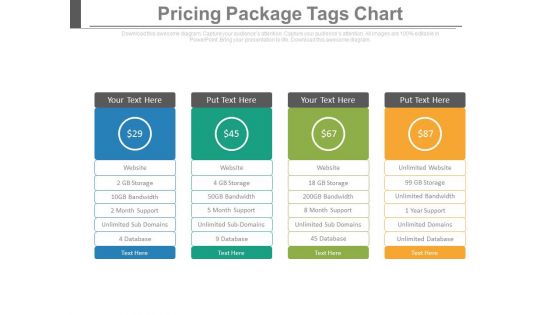
Pricing package tags chart ppt slides




Try Before you Buy Download Free Sample Product
 Impress Your
 Audience
 100%
100% Editable
 Save Hours
 of Time


You have got a plenty of products and services to offer your customers? A marketing strategy with a great promotional effect is must for you then. Pricing package tags chart PPT slides is one of the most effective tools to help cover the entire scenario. Whatever your product or the service is, a consumer is always concerned about the prices. With this clear price tag graphical PPT template icon, you can include all the specifications of a product under price tag of it. It is a must have for the business leaders while it focuses on customer satisfaction. Think of the enhancement in a business when the customers will easily get to compare the product services provided to them in a specific price range. It will make their task easier and will evoke them to frequently use the services. Such is the effect of this price tag presentation. A user shall not think twice in customizing this professional business price tag chart PPT icon. It is a stepping stone for every trade organization indeed. Go across with our Pricing Package Tags Chart Ppt Slides. They will effectively bridge the gap.
People who downloaded this PowerPoint presentation also viewed the following :
Pricing package tags chart ppt slides with all 4 slides:
Build your base on firm ground with our Pricing Package Tags Chart Ppt Slides. They bring out cardinal facts.
FAQs for Pricing package tags
Creating pricing packages for presentation templates requires considering target audience segments, template complexity and design quality, usage rights and licensing terms, competitive market positioning, and value-added services like customization support. These factors work together by aligning price points with customer perceived value, differentiating offerings across professional tiers, and ensuring sustainable profit margins, with many template businesses finding that tiered pricing based on usage volume and premium features delivers optimal market penetration and revenue growth.
Different pricing tiers can be structured through feature differentiation, usage limits, support levels, and access restrictions that align with distinct customer needs and budgets. By offering basic, professional, and enterprise packages, businesses enable startups to access core features affordably while providing advanced analytics, priority support, and custom integrations for larger organizations, ultimately maximizing market penetration and revenue growth.
Perceived value significantly influences pricing presentation templates by shaping how customers evaluate cost versus benefits, with effective templates highlighting ROI, competitive advantages, and unique value propositions through compelling visuals and strategic messaging. These presentations enhance perceived worth by demonstrating tangible outcomes, streamlining complex value communications, and positioning offerings strategically, ultimately enabling businesses to justify premium pricing while accelerating customer decision-making processes.
Customer feedback influences pricing package adjustments by revealing value perceptions, feature preferences, and price sensitivity across different market segments. Through surveys, usage analytics, and direct customer conversations, businesses can identify which features customers value most, which price points create barriers, and which packages need restructuring, ultimately enabling more competitive pricing strategies that enhance customer satisfaction and revenue optimization.
Effective promotional strategies for showcasing pricing packages include value-focused comparisons, limited-time offers, customer testimonials, free trials, and transparent feature breakdowns. These approaches enhance customer understanding by highlighting cost savings, demonstrating real-world success stories, and reducing purchase anxiety, with many businesses finding that clear value propositions and social proof ultimately drive higher conversion rates.
Bundling templates into packages enhances sales by creating higher perceived value, encouraging larger purchases, and simplifying decision-making for customers who need multiple design solutions. This strategic approach enables businesses to increase average order value while streamlining their offerings, with many organizations finding that comprehensive template bundles reduce customer acquisition costs and improve retention rates.
Seasonal trends significantly influence presentation template pricing through increased demand during business planning periods, back-to-school seasons, and year-end reporting cycles, with many platforms adjusting rates accordingly. These fluctuations enable strategic pricing models that capitalize on peak usage times, while offering promotional discounts during slower periods, ultimately delivering optimized revenue streams and enhanced customer acquisition opportunities.
Competitor pricing significantly influences package positioning by establishing market benchmarks, revealing pricing gaps, and highlighting differentiation opportunities across similar service tiers. While competitive analysis helps avoid overpricing or undervaluing services, successful packages ultimately balance market rates with unique value propositions, enabling businesses to capture optimal market share while maintaining profitable margins and sustainable growth.
Data analytics optimizes pricing strategies by analyzing customer behavior patterns, purchase histories, competitive benchmarks, and market demand fluctuations across different template categories and customer segments. Through predictive modeling and A/B testing, businesses can identify optimal price points, bundle configurations, and promotional timing, while tracking conversion rates and revenue impacts, ultimately delivering enhanced profitability and competitive positioning.
Psychological pricing strategies include charm pricing (ending in 9), anchoring with premium options, decoy pricing, bundling benefits, and scarcity indicators. These approaches enhance conversions by influencing perception of value, creating urgency, and simplifying decision-making, with many businesses finding that strategic price positioning, especially anchoring high-value options, ultimately drives customers toward preferred packages.
Effectively communicating premium package benefits requires emphasizing value through specific outcomes, exclusive features, and strategic advantages rather than just listing features. Highlight tangible returns like enhanced productivity, priority support, advanced analytics, and competitive differentiation, while using case studies from similar organizations that achieved measurable results, ultimately demonstrating how premium investment delivers superior business outcomes.
**INPUT**: What licensing options should be considered when pricing templates for commercial use? **OUTPUT**: Commercial template licensing should include single-use, multi-use, and unlimited licenses, along with attribution requirements, resale restrictions, and geographic limitations. These licensing tiers enable scalable pricing strategies by offering basic packages for individual projects, premium options for agencies and consultancies, and enterprise solutions for large organizations, ultimately delivering flexible revenue streams while protecting intellectual property rights. **Word count: 58 words**
**INPUT**: How can we ensure our pricing packages remain competitive within the industry? **OUTPUT**: Competitive pricing packages require regular market analysis, value-based positioning, flexible tier structures, and continuous customer feedback integration to align with industry standards. Through strategic benchmarking and adaptive pricing models, organizations can balance profitability with market competitiveness, while enhancing customer retention and acquisition, ultimately delivering sustainable growth and market positioning advantages.
Revenue per customer, customer acquisition cost, churn rate, conversion rates by package tier, and customer lifetime value are essential metrics for evaluating pricing package success. These metrics enable businesses to identify which packages drive profitability, optimize pricing structures, and enhance customer retention, with many organizations finding that regular analysis delivers improved revenue growth and competitive positioning.
Pricing packages should be reviewed quarterly for market alignment, with major adjustments made annually or when significant competitive shifts occur. Many organizations find that regular monitoring of customer feedback, competitor pricing, and market demand enables strategic adjustments that maintain competitive advantage, while quarterly reviews ensure packages remain relevant and profitable in increasingly dynamic markets.
-
Informative design.
-
Excellent design and quick turnaround.