


Project Risk Management Progress Dashboard




Try Before you Buy Download Free Sample Product
 Impress Your
 Audience
 100%
100% Editable
 Save Hours
 of Time


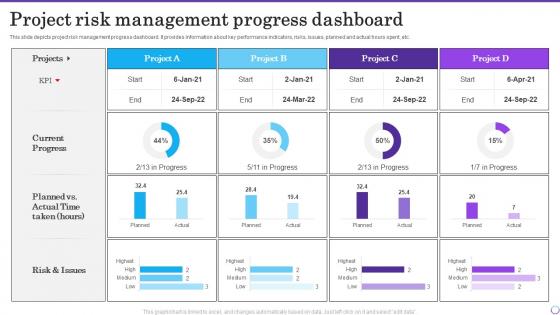
This slide depicts project risk management progress dashboard. It provides information about key performance indicators, risks, issues, planned and actual hours spent, etc.
People who downloaded this PowerPoint presentation also viewed the following :
Project Risk Management Progress Dashboard with all 7 slides:
Use our Project Risk Management Progress Dashboard to effectively help you save your valuable time. They are readymade to fit into any presentation structure.





FAQs for Project Risk
Key components include risk identification processes, assessment matrices, mitigation strategies, contingency planning, and continuous monitoring frameworks. These elements work together by systematically cataloging potential threats, evaluating their probability and impact, and establishing proactive responses, with many organizations finding that structured risk management reduces project delays by up to 40% while enhancing stakeholder confidence.
Qualitative risk analysis improves project decision-making by prioritizing risks based on probability and impact, enabling focused resource allocation and strategic planning. This systematic approach helps project managers identify critical vulnerabilities early, develop targeted mitigation strategies, and communicate risk implications to stakeholders effectively, ultimately delivering better project outcomes and enhanced organizational resilience.
Effective risk identification tools include risk registers, SWOT analysis, brainstorming sessions, expert interviews, and assumption analysis. These methodologies enhance project visibility by systematically capturing potential threats, leveraging team expertise, and documenting vulnerabilities, with many organizations finding that combining multiple approaches delivers comprehensive risk coverage and enables proactive mitigation strategies.
Risk tolerance varies significantly across industries, with financial services and healthcare maintaining strict risk-averse approaches due to regulatory requirements, while technology and construction sectors often embrace higher risk levels for innovation and competitive advantage. These variations enable organizations to optimize resource allocation and decision-making frameworks, with many finding that industry-specific risk strategies ultimately deliver enhanced operational efficiency and strategic positioning.
Stakeholder communication serves as the foundation for effective project risk management by enabling early risk identification, facilitating transparent risk assessment, and ensuring coordinated response strategies across all project participants. Through regular updates and collaborative discussions, project managers can leverage diverse perspectives to anticipate potential issues, while stakeholders remain informed and engaged, ultimately delivering more resilient project outcomes and stronger organizational alignment.
Project managers can prioritize risks effectively by assessing probability and impact through risk matrices, categorizing threats by severity levels, and focusing resources on high-probability, high-impact scenarios first. This strategic approach enables teams to allocate mitigation efforts efficiently, address critical vulnerabilities proactively, and maintain project momentum, with many organizations finding that systematic prioritization reduces overall project delays and cost overruns significantly.
High-priority risk mitigation strategies include risk avoidance, transfer, reduction, and contingency planning, each tailored to specific risk profiles and organizational contexts. These approaches streamline project delivery by implementing preventive controls, securing insurance coverage, and establishing backup protocols, with many organizations finding that strategic combinations ultimately deliver enhanced project success rates and reduced financial exposure.
Project risk assessment should be conducted at key project milestones, monthly during active phases, and whenever significant changes occur in scope, timeline, or resources. This continuous monitoring approach enables project managers to identify emerging threats early, adjust mitigation strategies proactively, and maintain project momentum, with many organizations finding that regular assessments significantly reduce costly surprises and delivery delays.
Agile risk management best practices include continuous risk identification through daily standups, sprint retrospectives, regular stakeholder feedback sessions, iterative risk assessment during sprint planning, and maintaining visible risk boards. These practices enhance project outcomes by enabling rapid response to emerging threats, fostering team collaboration around risk mitigation, and integrating risk considerations into development cycles, ultimately delivering more resilient products with reduced project failures.
Historical data enables project risk prediction through trend analysis, pattern recognition, variance tracking, and outcome correlation from past projects. By examining previous project timelines, budget overruns, and failure points across similar initiatives, organizations can identify recurring risk indicators, ultimately allowing proactive mitigation strategies and more accurate project planning decisions.
Common pitfalls include inadequate risk identification, poor stakeholder communication, reactive rather than proactive planning, insufficient risk monitoring, and lack of contingency resources. These oversights significantly impact project timelines, budgets, and deliverables, with many organizations finding that systematic risk assessment frameworks and regular review processes ultimately deliver better project outcomes and competitive advantage.
Technology streamlines project risk management through automated risk identification, real-time monitoring dashboards, predictive analytics, and centralized documentation systems. These digital solutions enable project managers to detect potential issues earlier, track mitigation progress seamlessly, and maintain comprehensive risk registers, with many organizations finding that automated alerts and data-driven insights significantly reduce project delays and budget overruns.
Key metrics for evaluating risk management strategy effectiveness include risk reduction percentages, incident frequency rates, financial impact assessments, response time measurements, and stakeholder satisfaction scores. These metrics enable organizations to track performance across manufacturing, healthcare, and financial services sectors, with many companies finding that comprehensive measurement frameworks ultimately deliver enhanced operational efficiency and stronger competitive positioning in increasingly complex business environments.
Team collaboration significantly enhances risk identification by leveraging diverse perspectives, cross-functional expertise, collective brainstorming sessions, and shared institutional knowledge from different departments. Through collaborative workshops and regular communication channels, teams uncover blind spots that individual assessments might miss, while fostering a culture of transparency where potential issues surface early, ultimately delivering more comprehensive risk mitigation strategies.
Project managers should adapt risk management for remote teams by implementing digital risk tracking tools, establishing frequent virtual check-ins, creating transparent communication protocols, and developing contingency plans for technology failures. These approaches enable distributed teams to identify risks earlier, maintain accountability across time zones, and ensure seamless collaboration, with many organizations finding that structured remote risk frameworks actually enhance visibility and deliver faster response times than traditional in-person methods.
-
Nothing beats the well-formatted and professionally designed templates offered. Kudos to SlideTeam for their amazing collection of PPT slides.
-
Topic best represented with attractive design.