


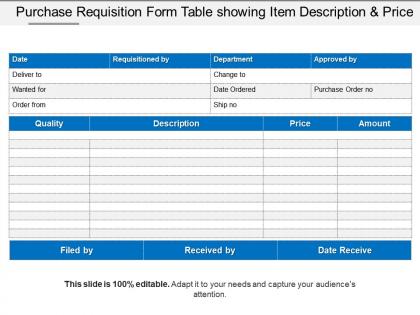
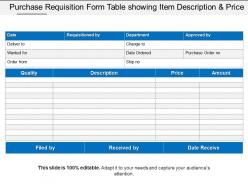
Purchase requisition form table showing item description and price




Try Before you Buy Download Free Sample Product
 Impress Your
 Audience
 100%
100% Editable
 Save Hours
 of Time


Our Purchase Requisition Form Table Showing Item Description And Price don't deal in half truths. They ensure they apprise you of all the facts,
People who downloaded this PowerPoint presentation also viewed the following :
Purchase requisition form table showing item description and price with all 5 slides:
Appeal for increased donations with our Purchase Requisition Form Table Showing Item Description And Price. Add to the coffers of charitable institutions.


FAQs for Purchase requisition form table showing item
So a purchase requisition is basically how you formally ask for stuff your department needs. Fill one out for equipment, supplies, services - whatever. Then it goes through approval before becoming a real purchase order. Honestly, the whole process can be annoying but it serves a purpose - controls spending, tracks budgets, creates paper trails, stops random unauthorized purchases. Plus procurement gets better deals when they can shop around with your req. My advice? Submit early because approvals take forever, and be super specific about what you want or you'll just get it kicked back with questions.
So a purchase requisition is just your internal "hey boss, can I buy this thing?" request. It goes through your company's approval process first. Once that's approved, you create the purchase order - that's what actually goes to the vendor with all the official details, pricing, delivery info, whatever. The PO is legally binding, while the requisition isn't really anything more than asking permission. I always think of it like this: requisition gets internal approval, purchase order makes the external commitment. Pretty straightforward once you see it that way.
Make sure you've got the basics covered first - what you're buying, how many, and when you need it delivered. Your cost center or budget code is crucial too. If there's a specific vendor you want, definitely mention them because procurement will bug you about it later anyway. Business justification is key - explain WHY you need this stuff. Any technical specs should go in there too, obviously. Oh, and if it's over your spending authority, get your manager's sign-off beforehand. Honestly, the more details you include upfront, the less back-and-forth you'll have to deal with later.
Honestly, start by figuring out where things are getting stuck right now - that's your roadmap. Automate the approval stuff and set clear spending limits for different people so requests don't sit around forever. Those digital forms where vendor info auto-fills are a game changer, trust me. Nobody has time to keep typing the same supplier details. Make sure everything routes automatically based on department and how much they're spending. Oh, and definitely connect it to your accounting system so you can actually see budget numbers in real time. Just tackle whatever's eating up the most time first.
Hey! So purchase reqs are basically how you avoid getting yelled at by finance later. They check your spending against your department's budget before any money actually goes out - super helpful for not accidentally blowing through your allocation. The system will literally flag you if you're about to go over, which honestly saves everyone a headache. Managers can see what's coming down the pipeline too, so they're not blindsided by costs. Just submit yours early though - if there's a budget issue, you'll want time to figure out plan B instead of scrambling last minute.
Dude, automating your purchase requisitions will save you so much headache. No more chasing people down for signatures - the system routes everything based on dollar amounts automatically. You get real-time updates on where stuff stands instead of wondering if your request got lost in someone's inbox. The spend analytics catch budget problems before they blow up, which is clutch. Oh, and it plays nice with whatever ERP system you're already using, so no double data entry. Honestly beats the hell out of spreadsheets and email chains. Just map out your current approval flow first, then find software that fits.
Ugh, where do I even start? Incomplete requisitions are the worst - missing budget codes, vendor info, you name it. Then you've got approval chains that move like molasses because requests just sit there forever. Departments never talk to each other so you get duplicate orders constantly. Emergency purchases that skip everything entirely? Yeah, that's fun too. Budget conflicts happen all the time, plus you'll get these super vague specs that result in totally wrong orders. Half the vendors people want aren't even on your approved list. Honestly, just make some standard templates and set up auto-reminders for approvers - saves your sanity.
Start by figuring out where things actually get stuck - that's half the battle right there. Set spending limits that make sense (like, why does a $300 supply order need the CEO's signature?). Run approvals in parallel when you can instead of making everyone wait in a single line. Finance and department heads can totally review stuff at the same time. Oh, and definitely set up auto-reminders because people forget, plus escalation rules for when someone's out of office. Honestly, most companies just copy whatever approval process they inherited without thinking if it actually fits their risk tolerance. Map out what could genuinely hurt the business vs busywork.
Okay so first thing - get super detailed with your item descriptions and cost estimates. Don't halfass the justification part either, explain WHY you actually need this stuff. I learned this the hard way when my urgent request sat there for like 3 weeks because I forgot to get pre-approval (ugh). Budget codes need to be spot-on, and attach quotes or specs if you have them. Honestly, setting up those approval workflows ahead of time is clutch - everyone knows what they're supposed to do and things actually move. Way better than playing email tag with procurement forever.
Honestly, purchase reqs make supplier relationships way smoother than you'd think. Your vendors get predictable communication instead of random urgent requests - and trust me, they appreciate knowing what's coming. Everything's documented upfront, so no more annoying back-and-forth about specs or delivery dates. Suppliers can actually plan their inventory better when you're consistent with detailed requisitions. Your procurement team gets better performance data too, which helps during contract talks. I'd start with a standard format and see how much easier vendor conversations become. It's kind of a win-win situation.
Honestly, purchase requisitions are lifesavers for audit season. They document who asked for what and when - super helpful when compliance people start poking around. The approval process makes everyone pause before buying random stuff (guilty as charged lol). Your manager gets to review everything before the money actually leaves, which is smart. The paper trail thing is clutch though. If someone questions a purchase later, you've got receipts showing it went through proper channels. Way better than scrambling to remember why you bought that weird equipment six months ago. Trust me, future you will thank present you for following the system.
Honestly, start with cycle time - that's how long requests sit around waiting for approval. Nobody wants to deal with slow processes, so employee satisfaction matters too. Track your approval rates and why things get rejected. Emergency purchases are a red flag that your system isn't smooth enough. Cost per requisition and compliance with procurement rules are solid metrics, plus whether you're actually hitting budget targets. I'd pick maybe 2-3 that match your biggest headaches right now rather than trying to measure everything at once.
Seriously, training your team on purchase requisitions makes a huge difference. People fill them out right the first time instead of you chasing down missing info constantly. Way faster approvals too since everyone actually knows the workflow - requests don't just sit on someone's desk forever. I think we cut our procurement time by like 30-40% once people got the hang of it. Oh and make sure they understand WHY each field matters, not just how to fill it out. That's what really clicked for our team anyway.
Honestly, you're headed for a mess without proper purchase requisitions. Each department starts doing their own thing - different approvals, inconsistent spending limits. Your finance team gets buried under random paperwork formats (trust me, they'll complain). Budget overruns become inevitable because nobody has visibility into what's actually being bought. Vendor negotiations? Forget it - you can't leverage spending patterns you can't track. The compliance issues alone should worry you. Oh, and good luck finding duplicate purchases when there's no audit trail. I'd map out your current chaos first, then tackle the worst problems.
Honestly, connecting purchase requisitions to your ERP is a game changer. No more hunting down paper forms or dealing with approval bottlenecks - everything routes automatically. Your finance team can actually see spending commitments before the money goes out the door, which is huge for staying on budget. Real-time visibility into inventory and spending? Yes please. The whole workflow just becomes so much smoother. Oh, and definitely map out your current approval process first - you'll be shocked at how many unnecessary steps you're doing. Trust me, your procurement team will thank you later.
-
Qualitative and comprehensive slides.
-
Really like the color and design of the presentation.