


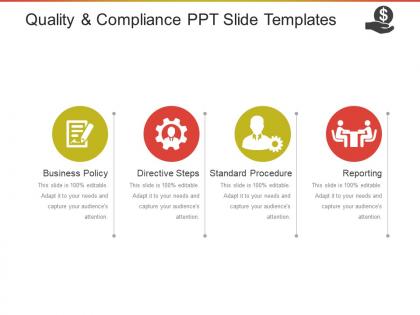
Quality and compliance ppt slide templates




Try Before you Buy Download Free Sample Product
 Impress Your
 Audience
 100%
100% Editable
 Save Hours
 of Time


Perform compliance activities for your company with our quality and compliance PPT slide template. It helps in supporting you production department functions and also results in improving the turnaround time for your business orders. You can also use this quality control PowerPoint slide design to further comply with the industry regulations se for your concern. Use this QA compliance PowerPoint layout to act as a standard operating system which can be used by your employees to check the quality of your products. It further helps in maintaining as well as controlling your product value which simply results in improving your brand value. It also results in improving your customer retention rate which directly results in enhancing your company profits. By complying with the industry standards, it allows you to take a competitive edge also. Thus, use this Quality management system PowerPoint image diagram to improve your brand value. Click on the download link now. Arrive at decisions after deep introspection with our Quality And Compliance Ppt Slide Templates. Insist on a balanced judgement.
People who downloaded this PowerPoint presentation also viewed the following :
Quality and compliance ppt slide templates with all 5 slides:
Give everyone the incentive to act with our Quality And Compliance Ppt Slide Templates. It helps delegate different functions.



FAQs for Quality and compliance
You'll need policies and procedures, plus some kind of risk assessment process. Monitoring and auditing systems are key too. Oh, and don't forget corrective action protocols when things go sideways. Clear documentation standards will save your butt during audits - trust me on that one. Training programs help keep everyone on the same page. Define who's responsible for what, because nobody likes confusion when compliance issues pop up. Regular performance metrics let you track if this stuff actually works. Start by mapping what you already have though - you might be surprised how much is already there.
Honestly, you'll want both leading and lagging indicators - otherwise you're flying blind. Real-time dashboards are a game changer compared to those useless monthly reports that tell you about problems from three weeks ago. Track stuff like defect rates, customer complaints, and compliance training completion. Oh, and don't forget corrective action closure times - those drag on forever if nobody's watching. I'd start with maybe 3-5 key metrics instead of going crazy trying to measure everything. Make the data visible to your whole team and review it regularly. Process controls help catch issues early too.
Honestly, training is like the backbone of staying compliant. Without it, you're basically flying blind even if you've got solid processes in place. Your team needs to actually get the standards and procedures - not just have them sitting in a binder somewhere collecting dust. Regular training helps people catch problems early too, which saves your butt later. Oh, and don't do that one-and-done approach most companies try. Requirements shift all the time. You'll want refreshers for current staff and really thorough onboarding for newbies. It's way cheaper than dealing with compliance nightmares down the road.
So ISO standards are basically your quality roadmap - everyone globally agrees on these frameworks. Take ISO 9001, for example. You're building processes that catch problems early instead of just ticking boxes (though honestly, sometimes it does feel like box-ticking). Your documentation gets consistent. Teams know what's expected. Audits become less of a nightmare - trust me on this one. Here's the thing: customers and regulators already trust these standards, so compliance flows smoother. I'd start by comparing your current processes to the ISO requirements you need. Shows you exactly where the gaps are.
Honestly, start with an audit of what you've got now - that'll show you where the biggest holes are. Three things matter most: documentation that people will actually read (skip the novel-length manuals), consistent training, and keeping an eye on your metrics in real-time. I learned this the hard way, but you've got to catch problems early before they snowball. Write everything in plain English. Track compliance as it happens, not weeks later. The real trick is getting everyone to care about quality, not just treat it like another box to check. Culture beats processes every time.
Yeah, you can automate a bunch of compliance stuff if you pick the right tools. Document management systems are clutch for keeping SOPs organized - way better than digging through folders. Workflow automation handles the boring approval chains and sends notifications automatically. Quality management software tracks your CAPAs and non-conformances in real-time (seriously beats the hell out of Excel). Digital audit trails save you from manual logging, which is such a time suck. Analytics dashboards show your metrics instantly too. Oh, and don't try to automate everything at once - that's a recipe for chaos. Start with one process, nail it, then expand.
Honestly, it's mostly about money and keeping up with rules that change every five minutes. Your team will probably have different processes everywhere, which gets messy fast. Documentation is the worst - nobody wants to do it but auditors live for that stuff. Training's tough because when people quit, all their knowledge goes with them. Leadership often treats compliance like it's just burning cash instead of protecting the business. Oh, and if you're growing quickly or have remote spots, forget about consistency. Start with your biggest risks first, then work your way down. Way easier than trying to fix everything at once.
Think of audits as your early warning system - they catch problems before they blow up into something worse. You'll spot where things are falling through the cracks compared to what you're supposed to be doing. Teams definitely step up their game when they know someone's coming to check their work (kind of annoying but it works). The real trick is using those findings to actually fix stuff instead of just checking boxes. Look for patterns in what keeps going wrong - that's where you can make real improvements. Short version: audits aren't just about compliance, they're about getting better at what you do.
So basically a QMS gives you this solid framework for hitting all your regulatory stuff consistently. You can document everything, track your compliance numbers, and catch problems early - which honestly saves so much headache later. Audits become way less painful when you're already organized. Plus it standardizes how you train people so everyone actually knows what compliance looks like day-to-day, not just in theory. Regular reviews keep everyone accountable. Just don't let it turn into busy work though - you've gotta actually use it to change how your team operates.
So here's the thing - customer complaints and quality audits basically back each other up. When customers whine about late deliveries, then your audit finds gaps in logistics? Boom, you've got your answer right there. I always tell people to let customer feedback guide where you dig deeper during audits. Then flip it - use those audit results to make sense of why customers keep complaining about the same stuff. It's pretty satisfying when both point to the exact same problem. That's when you know you've found the real issue that's screwing with customer experience.
Here's my take - when you nail quality compliance, customers actually trust your stuff and stick around longer. No more scrambling to fix disasters or dealing with recalls that tank your budget. Honestly, I've seen companies waste so much money on firefighting instead of just getting it right upfront. Your team won't be stressed constantly putting out fires either. Look, start with whatever's your messiest compliance gap right now - that's where you'll see results fastest. Better margins usually follow since you're not hemorrhaging cash on fixes. Plus your brand stops looking unreliable, which is huge.
Honestly, you've gotta make everyone feel like they own this stuff, not just the compliance folks. Train people on why standards actually matter - and I mean really matter, not just "regulations blah blah." Give them power to hit pause when something looks sketchy. This part's huge - celebrate the hell out of people who flag problems instead of sweeping them under the rug. Regular check-ins help too, where everyone can vent about what's broken. Show them that following quality rules makes their lives easier. Trust me, once they see that connection, you're golden.
Dude, non-compliance will absolutely wreck your business. Regulatory fines hit hard, but losing major contracts honestly stings way worse. Customers bail fast when they stop trusting your quality - and good luck getting that reputation back. You'll deal with product recalls, potential lawsuits if people get injured, plus suppliers might dump you if they think your processes are sketchy. I've watched companies spiral after compliance issues because partners just won't work with them anymore. Stay on top of regular audits and keep your docs updated, or you're basically asking for trouble.
Your industry regs basically control your whole quality game - no shortcuts there. Pharma means dealing with FDA's crazy validation stuff, manufacturing leans ISO, healthcare brings HIPAA into the mix. Honestly, the healthcare crossover gets messy sometimes. First thing you'll want to do is figure out which regulatory bodies actually matter for your processes. Then build your quality systems around those specific requirements. It's pretty overwhelming when you start, but once you map out the main standards that hit your operations, everything else clicks into place way easier.
Honestly, you'll want to keep an eye on AI compliance monitoring and real-time analytics - that stuff is taking off. Manual audits are basically dying out, replaced by systems that catch problems as they happen. Risk-based compliance is getting big too. Instead of checking every little thing, companies focus on what actually matters most. Smart move, really. Sustainability compliance is blowing up thanks to all the ESG requirements (ugh, so much paperwork). My advice? Start looking into automation tools now. They'll save you tons of time on documentation workflows and all that tedious stuff. Trust me, staying manual isn't gonna work much longer.
-
Unique research projects to present in meeting.
-
The content is very helpful from business point of view.