


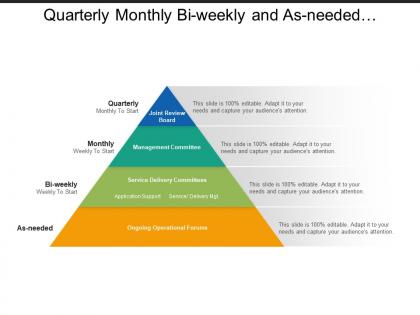
Quarterly monthly bi weekly and as needed governance pyramid




Try Before you Buy Download Free Sample Product
 Impress Your
 Audience
 100%
100% Editable
 Save Hours
 of Time


Discover a host of effective alternatives with our Quarterly Monthly Bi Weekly And As Needed Governance Pyramid. Experience freedom of choice.
People who downloaded this PowerPoint presentation also viewed the following :
Quarterly monthly bi weekly and as needed governance pyramid with all 5 slides:
Introduce a bit of joie-de-vivre with our Quarterly Monthly Bi Weekly And As Needed Governance Pyramid. Allow folks to enjoy being carefree.


FAQs for Quarterly monthly bi weekly and as
So there's basically three levels to this governance thing. Strategic sits at the top - board decisions, big picture stuff. Below that you've got tactical governance handling policies and risk management (which tbh is where all the actual heavy lifting happens). Operational governance is your bottom layer - daily processes, controls, compliance paperwork. Picture it like a wedding cake where each tier holds up the next one. Oh, and definitely figure out where your current stuff fits first. Most companies have weird gaps they don't even know about until they actually map it out.
So basically, the governance pyramid cuts through decision paralysis by sorting out who handles what. Bottom level deals with day-to-day stuff, middle tier takes strategic calls, and only the massive decisions bubble up to executives. Works like a charm once everyone knows their lane. Your team won't be sitting around waiting for the CEO to approve expense reports (thank god), but the big moves still get proper review. When you're stuck on something, just figure out which level owns that type of decision. Honestly saves so much time and confusion.
So your board and executives are at the top calling the big shots and taking responsibility for everything. Middle management takes those decisions and turns them into actual policies - they're basically translating between the suits and everyone else. Frontline staff handle the day-to-day stuff. Communication up and down is crucial or things get messy fast. I've seen this go sideways when nobody's talking to each other properly. You want to check regularly that what your board thinks is happening actually matches reality on the ground, because trust me, it doesn't always.
Look at three main things: how fast decisions get made, who's actually accountable for what, and whether info flows properly up and down. Time how long choices take at different levels - see where stuff gets stuck. Most companies totally bomb on the accountability piece, so really dig into whether people know their roles. Also check if important details reach the right people without getting twisted along the way. Survey your teams about bottlenecks and confusion. Oh, and here's the real kicker - when something urgent pops up, does it move through your structure or do people just go around it completely? That tells you everything.
Honestly, the biggest pain points are usually around who's supposed to do what. You'll get people stepping on each other's toes or stuff just gets forgotten completely. Communication gets messy too - info takes forever to travel up and down the chain. And there's always that one person who tries to go around their manager (guilty as charged lol). What actually works is figuring out how decisions really get made in your company first. Map that out before you worry about the fancy org chart. Most places have this disconnect between what the structure says should happen versus reality.
So instead of everything flowing down from the top, this flips it - decisions get spread out across different levels. The people doing the actual work handle day-to-day stuff, while higher-ups focus on big picture strategy. Way more democratic than typical corporate BS, honestly. Most companies bottleneck everything through senior leadership, but this pushes authority down where it belongs. Decisions happen faster and people actually buy in since they have a voice. You should map out who really makes decisions at your place - I bet it's more centralized than you think. Makes such a difference when teams feel heard.
Tech makes your whole governance structure way more efficient - communication flows better, you can track decisions as they happen, and compliance stuff gets automated. Real-time data beats playing telephone any day. Honestly, the transparency aspect is probably the biggest win since people can actually see what's going on instead of guessing. But don't get carried away - you still need actual humans making the big decisions. Focus on where info gets bottlenecked in your current setup first. That's where you'll see the biggest impact from whatever tools you pick.
Yeah, you can definitely tweak the governance pyramid for your specific industry. Tech companies usually put data privacy and cybersecurity front and center. Healthcare orgs go heavy on patient safety and HIPAA stuff. Manufacturing companies - they're all about operational safety higher up the chain. It's actually pretty adaptable once you figure out the basics. First step is identifying your top 3 industry risks, then see where they fit in your current setup. I'd start there and work backwards honestly. The whole thing revolves around mapping your critical success factors to the right governance layers.
So basically you need different metrics for each level of your governance setup. Top level = big picture stuff like whether you're actually hitting your goals and keeping stakeholders happy. Middle management should track process things - how fast decisions get made, compliance rates, that kind of thing. Bottom tier is more tactical - project completions, budget stuff. The trick (and this took me forever to figure out) is making sure everything connects upward. Each layer feeds into the next one. Start by figuring out what "winning" looks like at each level, then just work backwards to find the KPIs that'll actually tell you if it's working.
Look, your culture is what makes or breaks the whole governance thing. All those policies and committees? Totally useless if people don't actually care about doing the right thing. You'll just get everyone gaming the system or pretending to follow rules. It's like - and I know this sounds dramatic - building on quicksand. When people genuinely buy into the values, everything clicks. The processes actually work because folks understand why they matter. Honestly, just compare what behaviors get rewarded at your company versus what's written in those dusty policy docs. That gap tells you everything.
So basically the governance pyramid works because everyone knows exactly who they report to and what they're responsible for. No more "that's not my job" BS. Decisions have to flow through actual channels, which means stuff can't just disappear into the void. Each level watches the one below it - think of it like having backup systems instead of crossing your fingers and hoping. The trick though? You need real power at each level, not just people with impressive job titles who can't actually do anything. Otherwise you're just playing corporate theater.
Start with your board and C-suite - get that locked down first. Then figure out how decisions trickle down to managers below. Each level needs super clear boundaries on what they can decide vs. what gets bumped upstairs. Honestly, overlapping authority is where companies go to die. Keep your top layer small and let it get wider as you go down. Document the hell out of who reports where. Info has to flow both ways or people will just make stuff up. Oh, and definitely test this with real situations before you unleash it on everyone.
So basically the pyramid gives you a super clear chain of who's accountable for what - makes compliance way less of a headache. When auditors show up, you're not panicking because you can actually see your controls at every level. Board policies flow down to daily operations without weird gaps or role confusion. Regulators eat up that kind of clean paper trail too. Honestly, just map what you're already doing to each pyramid level first. You'll spot the holes and overlaps pretty fast, then you can fix the messy bits.
Look, good leadership is what actually makes governance work instead of just existing on paper. Strong leaders at every level translate big-picture strategy into real action - they're basically the glue holding everything together. Without them, you've got this pretty org chart that does absolutely nothing. Here's what I'd focus on: develop leaders everywhere, not just at the top. One weak manager can mess up your whole chain of command. Oh, and they set the tone too - people copy what they see from above. So if your governance feels broken, honestly? Start by looking at who's running each piece of it.
Honestly, you've gotta nail the basics first - regular reporting up and down the chain so everyone knows what's happening. Document everything too (meetings, decisions, why you chose what you chose). Yeah, it's tedious paperwork but trust me, it beats having people confused about who decided what later. I'd start by figuring out where your communication totally sucks right now. Those gaps are probably obvious if you think about it. Fix the worst ones first, then work your way down. The whole thing falls apart without consistent info flow.
No Reviews