

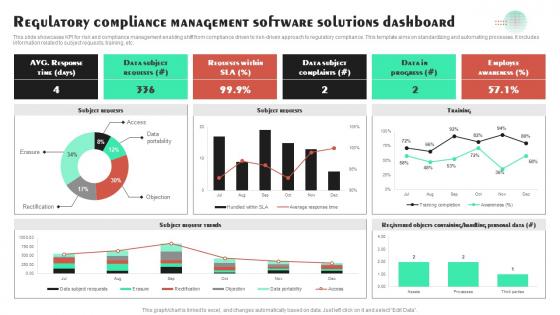
Regulatory Compliance Management Software Solutions Dashboard




Try Before you Buy Download Free Sample Product
 Impress Your
 Audience
 100%
100% Editable
 Save Hours
 of Time


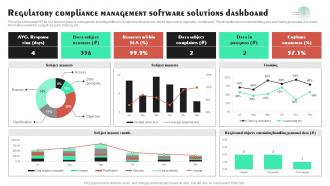
This slide showcases KPI for risk and compliance management enabling shift from compliance driven to risk driven approach to regulatory compliance. This template aims on standardizing and automating processes. It includes information related to subject requests, training, etc.
People who downloaded this PowerPoint presentation also viewed the following :
Regulatory Compliance Management Software Solutions Dashboard with all 7 slides:
Use our Regulatory Compliance Management Software Solutions Dashboard to effectively help you save your valuable time. They are readymade to fit into any presentation structure.





FAQs for Regulatory Compliance Management
Key components include compliance monitoring systems, risk assessment frameworks, policy management platforms, audit trail capabilities, and regulatory reporting tools. These technologies streamline compliance by automating documentation, tracking regulatory changes, and ensuring consistent adherence across operations, with many financial institutions and healthcare organizations finding that integrated systems significantly reduce compliance costs while enhancing transparency.
Organizations adapt to rapidly changing regulatory environments by implementing continuous monitoring systems, establishing cross-functional compliance teams, leveraging regulatory technology solutions, and maintaining flexible policy frameworks that can be quickly updated. Through automated compliance tracking and real-time regulatory alerts, companies in sectors like financial services, healthcare, and manufacturing streamline their adaptation processes, reduce compliance costs, and minimize regulatory risks, ultimately delivering competitive advantage in increasingly complex regulatory landscapes.
Common regulatory compliance challenges include keeping pace with evolving regulations, managing complex multi-jurisdictional requirements, ensuring consistent documentation, and maintaining staff training across departments. Organizations increasingly struggle with resource allocation and data integration, with many financial services and healthcare institutions finding that manual processes create vulnerabilities, ultimately requiring strategic automation and centralized compliance management systems.
Technology assists compliance management by automating regulatory monitoring, documentation tracking, audit trail creation, risk assessment protocols, and reporting workflows. Through AI-powered platforms and integrated compliance software, organizations streamline regulatory updates, minimize manual oversight errors, and ensure consistent adherence across departments, ultimately delivering faster compliance responses and reduced regulatory risk exposure.
Employee training serves as the foundation for regulatory compliance success by ensuring staff understand requirements, recognize violations, and implement proper procedures consistently across all operations. Through comprehensive training programs, organizations significantly reduce compliance risks, minimize costly penalties, and enhance operational efficiency, with many financial services and healthcare institutions finding that well-trained employees proactively identify and address potential compliance issues before they escalate.
Businesses can measure compliance program effectiveness through key performance indicators like audit scores, violation frequencies, training completion rates, incident response times, and regulatory penalty costs. These metrics enable organizations to identify gaps, streamline processes, and demonstrate value to stakeholders, with many financial services and healthcare institutions finding that comprehensive measurement frameworks ultimately deliver reduced risk exposure and enhanced operational confidence.
Non-compliance implications include substantial financial penalties, legal sanctions, operational disruptions, reputational damage, and loss of business licenses or market access. These consequences can severely impact organizational sustainability and growth, with many companies finding that compliance violations result in decreased investor confidence, customer attrition, and significantly higher regulatory scrutiny across all business operations.
Companies should prioritize compliance risks by assessing potential financial penalties, regulatory scrutiny levels, operational impact severity, and reputational consequences across different business units. Through risk mapping and materiality analysis, organizations can allocate resources strategically, focusing first on high-impact areas like data privacy and financial reporting, ultimately ensuring comprehensive protection while optimizing compliance investments.
Best practices for documenting compliance efforts include maintaining detailed audit trails, creating standardized reporting templates, establishing real-time monitoring dashboards, implementing version control systems, and ensuring secure data storage with access controls. These documentation strategies streamline regulatory reviews by providing transparent evidence of compliance activities, reducing audit preparation time, and enabling organizations across finance, healthcare, and manufacturing to demonstrate accountability while minimizing regulatory risks and potential penalties.
Cross-border regulation affects multinational corporations by creating complex compliance requirements across different jurisdictions, increasing operational costs, and demanding standardized processes that meet varying regulatory standards. Through strategic regulatory frameworks, companies streamline compliance management, reduce legal risks, and maintain consistent operations globally, with many financial services and pharmaceutical organizations finding that proactive cross-border strategies ultimately deliver competitive advantage.
Engaging third-party compliance consultants delivers specialized expertise, objective assessments, cost-effective solutions, regulatory updates, and risk mitigation strategies. These consultants streamline compliance processes by providing industry-specific knowledge, identifying gaps organizations might miss internally, and ensuring adherence to evolving regulations, while enabling companies to focus resources on core business activities and maintain competitive advantage.
Organizations foster compliance culture through clear communication of regulatory expectations, regular training programs, leadership accountability, and integrated compliance metrics into performance evaluations. By embedding compliance responsibilities into daily workflows, recognizing compliant behaviors, and ensuring consistent enforcement across departments, companies create environments where regulatory adherence becomes second nature, ultimately delivering reduced risk exposure and enhanced operational integrity.
Industry-specific regulations significantly shape compliance strategies by dictating specialized frameworks, reporting requirements, data protection standards, and operational procedures unique to each sector. Financial services must navigate Basel III and SOX requirements, while healthcare organizations focus on HIPAA and FDA guidelines, ultimately requiring tailored compliance programs that address sector-specific risks and regulatory expectations.
Organizations leverage data analytics for enhanced compliance monitoring by implementing automated surveillance systems, predictive risk modeling, real-time transaction monitoring, and comprehensive audit trails. Through advanced analytics platforms, financial institutions and healthcare organizations streamline regulatory reporting, identify potential violations before they occur, and maintain continuous oversight across operations, ultimately reducing compliance costs while improving regulatory transparency and organizational accountability.
Emerging trends in regulatory compliance management include AI-powered monitoring systems, real-time risk assessment platforms, automated reporting tools, blockchain-based audit trails, and integrated governance frameworks. These technologies streamline compliance processes by reducing manual oversight, accelerating regulatory reporting, and enhancing transparency across operations, with financial services and healthcare organizations finding that automated systems significantly minimize compliance risks while delivering faster regulatory responses.
-
The templates are the best in class. Very clear and innovative graphics! I am excited to explore and download more presentations.
-
Superb! The innovative and inspiring template designs provide an edge to the presentation.