


Risk Based Approach Powerpoint Presentation Slides




Try Before you Buy Download Free Sample Product
 Impress Your
 Audience
 100%
100% Editable
 Save Hours
 of Time


Grab our PowerPoint presentation on Risk-based approach. It highlights an approach to quality management that focuses on identifying and mitigating risks. Our Risk-based approach deck includes various elements like assessing, controlling, communicating, and reviewing quality concerns that are particularly relevant to the pharmaceutical industry. It also details different tools and methodologies used in quality risk assessment and information on stakeholder risk tolerance capacity. Additionally, our QRM PPT offers a tracker for identifying potential risks in the future. It also outlines the processes involved in risk assessment, including risk identification, analysis, and evaluation. Further, our quality assurance template covers the risk control process and describes various risk management methodologies, like risk ranking and filtering, fault tree analysis, etc. Finally, it provides information on risk tolerance capacity and a risk tracker. Get access to this powerful template now.
People who downloaded this PowerPoint presentation also viewed the following :
Content of this Powerpoint Presentation
Slide 1: This slide introduces Risk-Based Approach. Commence by stating Your Company Name.
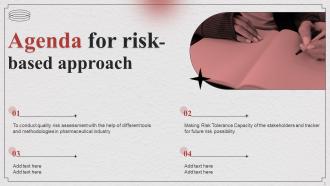
Slide 2: This slide depicts the Agenda of the presentation.
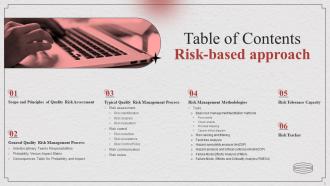
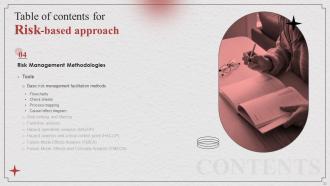
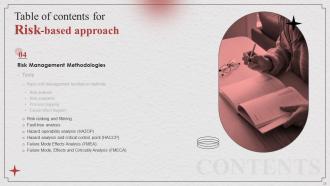
Slide 3: This slide incorporates the Table of Contents.
Slide 4: This slide highlights the Title for the Topics to be discussed further.
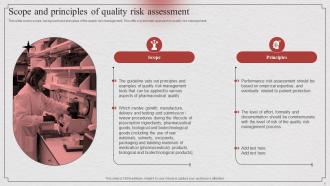
Slide 5: This slide covers scope, background and principles of the quality risk management.
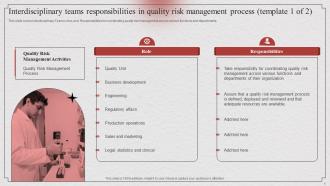
Slide 6: This slide focuses on the Interdisciplinary teams responsibilities in quality risk management process.
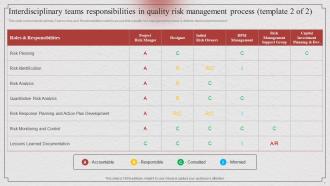
Slide 7: This slide continues the Interdisciplinary teams responsibilities in quality risk management process.
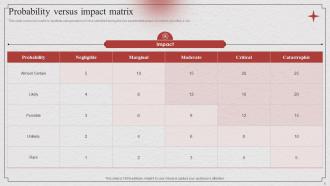
Slide 8: This slide showcases the Probability versus impact matrix.
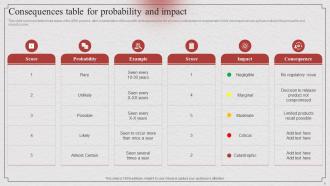
Slide 9: This slide reveals the Consequences table for probability and impact.
Slide 10: This slide includes the Heading for the Contents to be covered next.
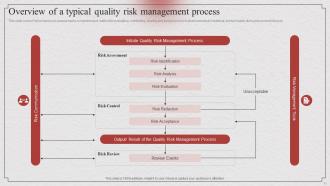
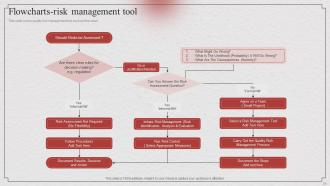
Slide 11: This slide reveals the Overview of a typical quality risk management process.
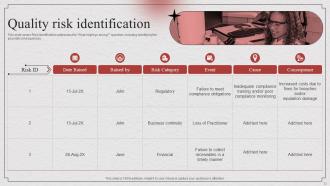
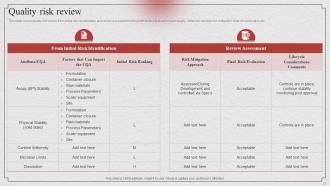
Slide 12: This slide deals with the Quality risk identification.
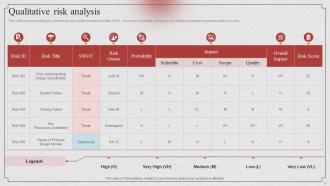
Slide 13: This slide showcases the Qualitative risk analysis.
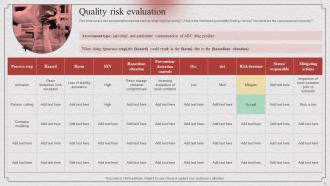
Slide 14: This slide portrays the Quality risk evaluation.
Slide 15: This slide mentions the Title for the Ideas to be further discussed.
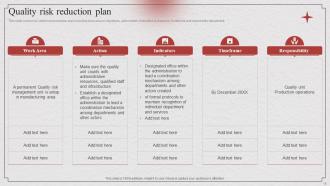
Slide 16: This slide exhibits the Quality risk reduction plan.
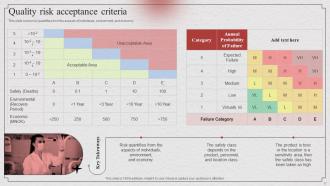
Slide 17: This slide covers risk quantifies from the aspects of individuals, environment, and economy.
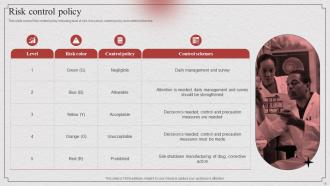
Slide 18: This slide displays the Risk control policy.
Slide 19: This slide includes the Heading for the Ideas to be covered in the forth-coming template.
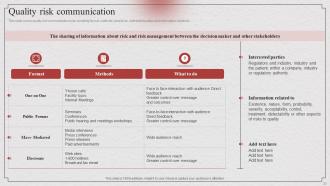
Slide 20: This slide reveals the Quality risk communication.
Slide 21: This slide portrays the Quality risk review.
Slide 22: This slide contains the Title for the Contents to be discussed further.
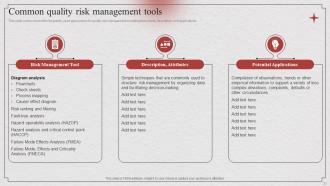
Slide 23: This slide covers most of the frequently used approaches for quality risk management.
Slide 24: This slide depicts the Heading for the Topics to be covered in the next template.
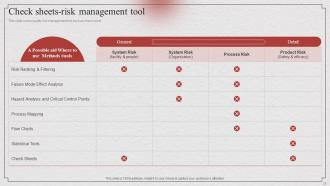
Slide 25: This slide covers quality risk management tool such as check sheet.
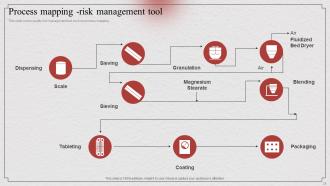
Slide 26: This slide presents the Process mapping -risk management tool.
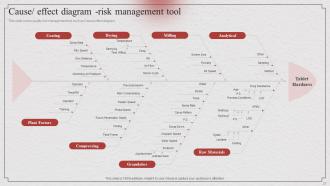
Slide 27: This slide showcases the Cause/ effect diagram -risk management tool.
Slide 28: This slide depicts the Title for the Topics to be discussed in the following template.
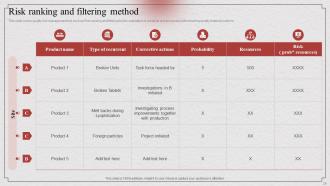
Slide 29: This slide highlights the Risk ranking and filtering method.
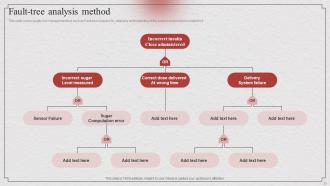
Slide 30: This slide exhibits the Fault-tree analysis method.
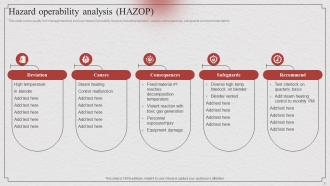
Slide 31: This slide shows the Hazard operability analysis (HAZOP).
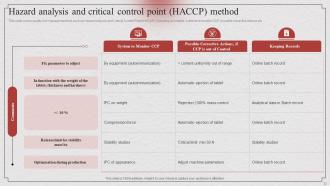
Slide 32: This slide reveals the Hazard analysis and critical control point (HACCP) method.
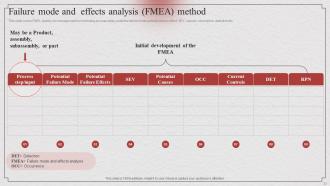
Slide 33: This slide displays the Failure mode and effects analysis (FMEA) method.
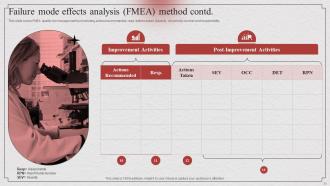
Slide 34: This slide continues the Failure mode effects analysis (FMEA) method.
Slide 35: This slide covers FMECA quality risk management tool.
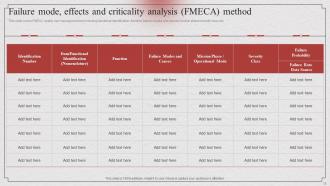
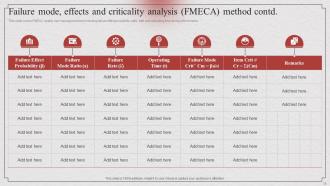
Slide 36: This slide continues the Failure mode, effects and criticality analysis (FMECA) method.
Slide 37: This slide includes the Heading for the Contents to be covered further.
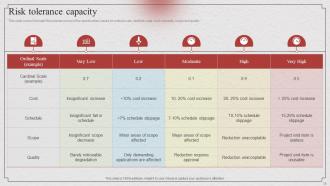
Slide 38: This slide reveals the Risk tolerance capacity.
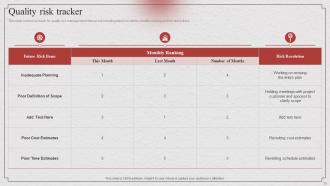
Slide 39: This slide shows the Quality risk tracker.
Slide 40: This is the Icons slide containing all the Icons used in the plan.
Slide 41: This slide is used for depicting Additional information.
Slide 42: This is the Line chart slide.
Slide 43: This slide elucidates information related to the Financial topic.
Slide 44: This is the Puzzle slide with related imagery.
Slide 45: This is Our target slide. State your organization's targets here.
Slide 46: This is the Venn slide with related imagery.
Slide 47: This is the Thank you slide for acknowledgement.
Risk Based Approach Powerpoint Presentation Slides with all 52 slides:
Use our Risk Based Approach Powerpoint Presentation Slides to effectively help you save your valuable time. They are readymade to fit into any presentation structure.







FAQs for Risk Based Approach
You need the basics first - risk identification, assessment, treatment, and monitoring. Map out your current risks and figure out who's actually responsible for each one (this step alone will expose tons of gaps). Set up clear governance so everyone knows who owns what. Document your day-to-day processes too, otherwise people just wing it. Communication is where most companies totally screw up - if your team doesn't get their role in managing risk, your framework's useless. Oh, and build in regular reviews since risks change all the time. Honestly, just start with that risk mapping exercise and you'll see exactly what you're missing.
Start by mapping out what could actually go wrong in your business - cyber attacks, supply chain mess, new regulations, natural disasters, whatever applies to you. Get people from different teams involved because they'll catch stuff you'd never think of. Honestly, a simple grid works best: plot everything by how likely it is vs how bad it would hurt. Focus on the high-probability, high-impact stuff first. Don't make this a one-and-done thing though. Set up quarterly check-ins to spot new risks as things change. Your business isn't static, so your risk planning shouldn't be either.
Honestly, tech has completely changed the game for risk management. AI can crunch through massive amounts of data to spot patterns you'd never catch manually. Real-time monitoring flags problems instantly, and predictive analytics actually show you what's coming down the pipeline. There's tons of compliance software now that tracks regulations automatically - total game changer if you ask me. Instead of making educated guesses, you can quantify risks with real precision. I'd start by figuring out where you're flying blind right now, then find tools that'll give you better visibility in those areas.
Honestly, compliance is like keeping a messy room clean - you've got to build habits or you'll drown. First figure out what regulations actually hit your business (there's always some random one you missed). Document literally everything - I can't stress this enough. Set up processes for spotting and tracking risks, then audit yourself regularly before someone else does it for you. The game changer? Don't treat compliance like this separate annoying thing. Weave it into how you already work. Train your people on the rules and - this sounds boring but trust me - make a calendar with all your deadlines or you'll forget something important.
Honestly, **Monte Carlo simulation** is where it's at for complex stuff - you can run thousands of scenarios and the data viz is actually pretty satisfying to watch. For simpler projects though? Just use a **probability/impact matrix**. Plot likelihood against impact on a grid and you're good. **EMV calculations** are your friend when stakeholders want hard numbers (they always do). Really depends on how complex your project is and what data you've got to work with. Oh, and don't overthink it - pick the method that matches your situation and roll with it.
Honestly, the trick is baking risk thinking right into your planning process from day one. Don't wait until you're already in trouble to figure out what could go sideways. When you're mapping out goals, ask yourself what might tank them - then build backup plans directly into the strategy. I always add a "what if this bombs" section to planning docs now. Sounds dramatic but it works. Make sure someone actually owns monitoring each risk too, otherwise it just becomes busy work that nobody watches. Think of it like checking the weather before a road trip instead of getting caught in a storm.
Honestly, the worst thing companies do is turn risk management into some bureaucratic nightmare that sits in a binder somewhere. Like, they'll spend months building these fancy frameworks that everyone ignores because they're way too complicated. Most teams also get tunnel vision - they obsess over the obvious stuff but completely miss those sneaky risks that actually screw you over. I've seen risk registers so bloated that people just give up on them entirely. Start small with the risks that actually threaten your goals. Build habits around those first. Once people get comfortable with that, you can expand. Simple beats perfect every time.
Look, people won't speak up about problems if they think they'll get blamed for it. Set up regular meetings where folks can actually voice concerns without getting thrown under the bus. Skip the corporate jargon - just talk normal. When you share updates, include what you're doing about the issues, not just doom and gloom. Here's the thing though: you've got to celebrate people who flag problems early. Like, actually thank them publicly. Otherwise everyone stays quiet until things explode. Oh, and make sure the info gets to people who can actually do something about it.
Honestly, culture is everything when it comes to risk management. People need to feel safe calling out problems without getting their heads chopped off. When there's a blame game going on, issues just get swept under the rug until they blow up in everyone's faces. I've watched this disaster play out more times than I can count. Leadership sets the whole tone too - if the C-suite actually cares about risk instead of just paying lip service, that trickles down fast. Before you roll out some expensive new framework, figure out if your culture will even support it. Otherwise you're just wasting money.
Honestly, when the economy tanks you've got to get way more careful about risk. Like that whole "safe bet" mindset? Throw it out the window. You'll want to stress-test everything against worst-case scenarios and build up more cash reserves. Credit policies need tightening too since people default way more when times get tough. Think of it like the weather suddenly shifting from perfect to stormy - what seemed fine before might wreck you now. The smart move is adjusting your whole approach early when you see trouble coming, not scrambling after it hits.
Depends on your budget and what you're trying to do, really. Big companies usually go with ServiceNow or MetricStream - those handle everything from compliance to risk registers. For project stuff, RiskyProject is solid, or @RISK if you want to get fancy with Monte Carlo simulations. Honestly though? Don't sleep on a good Excel template if you're just starting out. LogicGate and Riskonnect are decent cloud options too, way easier to set up than the enterprise monsters. I'd figure out exactly which processes you want to streamline first, then demo a couple that match your scope.
Honestly, just make a simple risk matrix - likelihood vs impact. The stuff in the top right corner? That's what matters. Skip the small potatoes and focus on what would genuinely freak out leadership. I'm talking things that could tank operations, blow up finances, or wreck your reputation. Pick your top 5-10 worst-case scenarios first. Once you've got those handled (or at least managed), then maybe circle back to the smaller risks if you have time. But seriously, don't spread yourself too thin trying to fix everything at once.
Honestly, it comes down to being straight with people about who might get screwed over. Don't just dump risks on whoever can't fight back or kick problems down the road for someone else to deal with. Ask yourself who's gonna suffer if things go sideways - and actually listen to those people when you're planning stuff. Fair solutions aren't always the cheapest ones, which sucks but that's reality. Oh, and vulnerable groups usually get hit hardest, so pay extra attention there. Basic rule: transparency beats covering your ass every time.
Honestly, risk management has to get way more agile these days. New tech keeps throwing curveballs - I mean, deepfakes weren't even on anyone's radar a few years back and now they're a legit reputation nightmare. Build processes that can actually adapt instead of rigid policies. Get continuous monitoring tools running. Cross-train your people on emerging threats. Set up quick response protocols for when weird new stuff hits. Oh, and ditch the annual review thing - you need ongoing conversations with your tech folks or you'll always be playing catch-up.
Oh man, there are some solid examples! The Tylenol thing from the 80s is probably the gold standard - J&J just pulled everything immediately and was super transparent about it. Toyota's massive recall situation around 2010 actually shows how you can bounce back if you really fix your processes. NASA's a darker example, but after Challenger and Columbia they basically rebuilt their whole safety approach from scratch. Honestly, the pattern seems pretty clear: act fast when things go sideways, don't try to hide stuff from people, and actually change your systems so it won't happen again.
-
I was really impressed with the presentation I created with their templates. I’ll be using their services moving forward.
-
They guys always go the extra mile to meet the expectations of their customers. Almost a year has been associated with them.