


Roadmap 5 Year Financial Career Development Plan





Try Before you Buy Download Free Sample Product
 Impress Your
 Audience
 100%
100% Editable
 Save Hours
 of Time


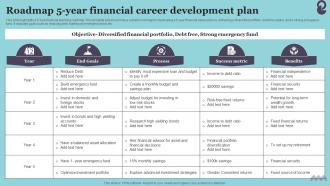
This slide highlights a 5 Year financial planning roadmap. This template aims to provide a sample roadmap for developing a 5 year financial career plan by achieving a diversified portfolio, debt free status, and a strong emergency fund. It includes goals such as reducing debt, starting an emergency fund, etc.
People who downloaded this PowerPoint presentation also viewed the following :
Roadmap 5 Year Financial Career Development Plan with all 6 slides:
Use our Roadmap 5 Year Financial Career Development Plan to effectively help you save your valuable time. They are readymade to fit into any presentation structure.





FAQs for Roadmap 5 Year Financial
A roadmap should include clear timeline phases, defined deliverables, resource allocation requirements, milestone dependencies, and stakeholder responsibilities. Through visual clarity and strategic sequencing, organizations streamline project communication, enhance team alignment, and minimize scheduling conflicts, with many finding that well-structured roadmaps ultimately deliver improved project visibility and accelerated achievement of business objectives.
Visual design enhances roadmap clarity through consistent color coding, clear typography, logical flow structures, and strategic use of whitespace to guide audience attention. These design elements streamline complex timeline information by creating visual hierarchy, distinguishing phases and milestones, and enabling stakeholders to quickly grasp project progression, ultimately delivering more effective presentations and faster decision-making processes.
Strategic roadmaps work best with timeline-based layouts showing quarterly or annual milestones, while product roadmaps benefit from feature-swim-lane formats organizing capabilities by themes, and project-based roadmaps excel with Gantt-style layouts displaying task dependencies and resource allocation. These distinct formats enable teams to communicate effectively across different audiences, with strategic roadmaps serving executives, product roadmaps guiding development teams, and project roadmaps coordinating operational delivery.
Tailoring roadmaps involves adjusting detail levels, terminology, and focus areas based on audience needs and decision-making requirements. Stakeholders typically need high-level strategic milestones, budget implications, and business outcomes, while development teams require granular technical tasks, dependencies, and resource allocations, with many organizations finding that creating complementary views of the same roadmap enhances communication effectiveness.
PowerPoint, Google Slides, Visio, Lucidchart, and Roadmunk are top tools for creating compelling roadmap presentations, each offering unique templates and visualization capabilities. These platforms enhance strategic communication by enabling timeline customization, stakeholder collaboration, and visual storytelling, with many organizations finding that well-designed roadmaps streamline project alignment and accelerate decision-making processes.
Ensuring roadmap flexibility requires building in regular review cycles, maintaining modular project phases, and establishing clear change management processes that allow for scope adjustments without derailing timelines. Organizations increasingly use agile methodologies and buffer periods between milestones, with many finding that quarterly roadmap reassessments enable teams to pivot strategically while maintaining overall project momentum and stakeholder alignment.
Common pitfalls include overloading slides with excessive detail, creating unrealistic timelines, lacking stakeholder alignment, and failing to show dependencies between initiatives. These mistakes undermine credibility and confuse audiences, with many organizations finding that successful roadmap presentations balance high-level vision with achievable milestones, ultimately delivering clear direction and stakeholder buy-in.
Incorporating stakeholder feedback into roadmaps involves regular review cycles, priority reassessment, and transparent communication channels throughout the planning process. Through structured feedback sessions and data-driven evaluation, organizations can adapt timelines, reallocate resources, and adjust deliverables while maintaining strategic alignment, with many finding that continuous stakeholder engagement ultimately enhances project outcomes and organizational buy-in.
Time management plays a crucial role in roadmap development by establishing realistic timelines, prioritizing strategic initiatives, and ensuring resource allocation aligns with business objectives. Through effective scheduling and milestone planning, organizations streamline project coordination, minimize bottlenecks, and accelerate delivery cycles, with many companies finding that structured time management ultimately enhances operational efficiency and competitive positioning.
Data and metrics support roadmap narratives by providing quantitative validation for strategic priorities, measuring progress against defined milestones, and demonstrating ROI through performance indicators like customer satisfaction scores and revenue targets. These evidence-based insights enable organizations to justify resource allocation, communicate value to stakeholders, and make data-driven pivots when market conditions change, ultimately delivering credible roadmaps that stakeholders trust.
Best practices for presenting roadmaps in virtual meetings include using clear visual hierarchy, interactive elements, engaging storytelling techniques, frequent check-ins with participants, and screen annotation tools. These approaches streamline communication by maintaining audience attention, facilitating real-time feedback, and ensuring strategic alignment, with many organizations finding that structured virtual roadmap presentations enhance stakeholder engagement and accelerate decision-making processes.
Storytelling techniques enhance roadmap presentations by creating narrative flow, establishing clear problem-to-solution arcs, and connecting milestones to customer outcomes rather than just timelines. Through compelling opening scenarios, relatable stakeholder journeys, and strategic tension-resolution patterns, organizations transform technical roadmaps into persuasive business narratives, ultimately delivering greater stakeholder buy-in and clearer strategic alignment across teams.
Roadmaps provide high-level strategic direction with flexible timelines and key milestones, while Gantt charts offer detailed project scheduling with specific tasks, dependencies, and exact dates. Roadmaps work best for long-term planning, stakeholder communication, and product strategy across organizations, whereas Gantt charts excel in operational project management, resource allocation, and tracking detailed execution phases.
Effective roadmap prioritization involves evaluating tasks by business impact, resource requirements, dependencies, and strategic alignment with organizational goals. By using frameworks like MoSCoW or value-versus-effort matrices, teams can sequence milestones based on customer value and technical feasibility, while maintaining flexibility for market changes, ultimately delivering maximum business outcomes within realistic timelines.
Interactive visualizations, dynamic filtering, stakeholder-specific views, real-time progress tracking, and collaborative commenting features represent key innovations transforming roadmap engagement. These approaches streamline communication by enabling personalized experiences, enhancing transparency through live updates, and facilitating cross-functional collaboration, with many organizations finding that interactive roadmaps significantly improve alignment and strategic buy-in.
-
“One of the best experiences with SlideTeam for my presentation.Everything on time, communication is efficient and price is reasonable. All good in one place.”
-
The slides come with appealing color schemes and relevant content that helped me deliver a stunning presentation without any hassle!