

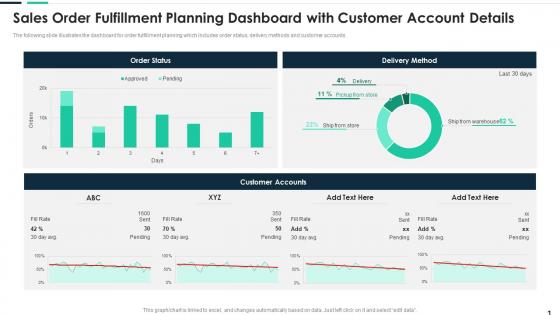
Sales Order Fulfillment Planning Dashboard With Customer Account Details




Try Before you Buy Download Free Sample Product
 Impress Your
 Audience
 100%
100% Editable
 Save Hours
 of Time


The following slide illustrates the dashboard for order fulfillment planning which includes order status, delivery methods and customer accounts.
People who downloaded this PowerPoint presentation also viewed the following :
Sales Order Fulfillment Planning Dashboard With Customer Account Details with all 7 slides:
Use our Sales Order Fulfillment Planning Dashboard With Customer Account Details to effectively help you save your valuable time. They are readymade to fit into any presentation structure.





FAQs for Sales Order Fulfillment Planning Dashboard With
So basically you get the order, double-check payment and customer info first. Then see if you actually have their stuff - trust me, overselling is a nightmare. After that it's warehouse time: grab the items, pack them up (don't cheap out on bubble wrap), slap on shipping labels. Once it ships, track everything and let your customer know it's coming. Oh and keep them updated the whole time because people get weird when they don't know where their package is. Pretty simple process but the communication part makes or breaks it honestly.
Honestly, start with order cycle time - that's like your main thing to watch. Track from when someone hits "buy" to when it shows up at their door. Fill rates matter too (what percentage ships complete), plus picking accuracy and shipping costs per order. On-time delivery is where I'd focus most though - customers don't care about your internal metrics if their stuff's late. Oh, and definitely watch return rates and satisfaction scores. High returns usually mean you're rushing orders out the door with problems. Pick maybe 2-3 metrics that match your biggest headaches first. Way easier than trying to track everything at once.
Honestly, start with an ERP system - that's your foundation for connecting sales, inventory, and shipping data. Then grab a warehouse management system to optimize how you pick orders and store stuff. The automated communication tools are clutch too, saves you from constantly updating customers manually. Integration between everything is where you'll see real results though. I'd audit what you're working with now first, then tackle your biggest pain points. WMS made the biggest difference for us personally, but every setup's different.
Honestly, inventory management makes or breaks your whole fulfillment game. Without knowing what you actually have in stock, you're basically guessing on delivery dates. That leads to overselling and pissed off customers, or worse - leaving money on the table because you think you're out of something you're not. Real-time tracking is huge here. Smart warehouse placement speeds things up too and cuts shipping costs. I've seen companies mess this up so many times. Bottom line? Get your inventory accuracy locked down first. Everything else falls into place after that.
Look, the biggest thing is just mapping out your whole process first - you'll be shocked where orders are just sitting around doing nothing. Automate the boring stuff like data entry and inventory checks, that's where most people waste tons of time. Batch similar orders together, set up auto-reorders for your bestsellers. The real magic happens when your systems actually talk to each other though. Information should flow from order to fulfillment without someone manually typing everything twice (which honestly drives me crazy when I see businesses doing this). Oh, and definitely look for bottlenecks in your workflow - that's usually the low-hanging fruit.
Dude, the main issues you're gonna hit are inventory problems, picking mistakes, and shipping delays. Some days it feels like total chaos honestly. Manual processes kill you - half the time what's "in stock" on paper isn't actually there. Real-time tracking helps a ton, plus barcode scanning cuts down on human error. Set up automated alerts when you're running low on stuff. Oh and definitely connect your warehouse system to your order system if they're not talking already. Those manual handoffs between systems? That's where orders disappear into the void.
Customer complaints are basically free advice - if someone's always griping about late packages, you gotta tighten up your shipping or find better carriers. Packaging issues? Time to rethink how you're wrapping stuff up. The positive feedback matters too though (people forget this part). Shows you what's actually working so you can keep doing more of it. Main thing is don't just collect feedback and let it sit there gathering digital dust. Look for patterns and actually do something about them. It's honestly one of the easiest ways to figure out what needs fixing without hiring expensive consultants.
Dude, automation is a total game changer for order fulfillment. It handles all the boring stuff automatically - processing orders, updating inventory, sending shipping alerts. Way fewer mistakes since there's no human typing errors or forgotten steps. Your team can actually deal with real customer problems instead of mindlessly clicking through orders (which honestly sounds soul-crushing). The best part? You get real-time tracking from start to finish without lifting a finger. I'd start with whatever manual tasks eat up most of your time and automate those first. Trust me, you'll wonder why you waited so long.
Honestly, you gotta nail the returns process right from the start or it'll bite you later. Set up clear policies and automate that RMA stuff - nobody wants to jump through hoops when they're already annoyed about returning something. Integration with your inventory system is huge because you don't want returned items sitting in limbo forever. Track everything in real-time so your team can actually see what's happening. Pay attention to return patterns too - they'll tell you if there's something wrong with specific products or your shipping. I'd start by looking at your current process and figuring out where things get stuck.
Honestly, your shipping partners can totally make or break your whole operation. Pick solid carriers with decent tracking and you'll actually hit those delivery dates. But go with sketchy ones? Good luck dealing with "lost" packages and customers freaking out in your inbox. I learned this the hard way once - never again. Mix up your carriers so you're not screwed when one has a meltdown. Get those service agreements nailed down upfront too. Transit times matter way more than you think. Always keep a backup ready because stuff happens.
Start forecasting demand like 3-4 weeks out and build up your inventory buffers. Hire seasonal staff or partner with a 3PL for overflow - the staffing thing is always such a crapshoot but better safe than sorry. Focus on your most profitable orders first. Maybe offer expedited shipping at higher prices? Set up real-time inventory tracking so you catch problems early. Oh and definitely be upfront with customers about potential delays - people appreciate honesty way more than radio silence. The whole thing's stressful but planning ahead makes it manageable.
Dude, you absolutely need your sales, inventory, warehouse, and shipping teams talking to each other constantly. When departments work in silos? Total disaster. Orders get delayed, customers lose their minds, and you're stuck putting out fires all day. I learned this the hard way at my last job - what a mess that was. The key is getting everyone to share updates about stock levels, shipping issues, customer changes, all of it. Set up regular check-ins and maybe some shared dashboards so everyone can actually see what's happening with orders. It'll save your sanity.
Honestly, fulfillment can totally make or break everything with customers. Get their stuff to them fast and right? They'll love you forever. Screw up the delivery or send wrong items though, and they'll remember that way longer than whatever amazing pitch you gave them initially. I've seen it happen - one bad shipping experience and suddenly customers start doubting if you're reliable at all. Retention just tanks. My advice? Watch those fulfillment numbers like a hawk, and if something's gonna be late, tell them before they have to hunt you down asking where their order is. Way less painful that way.
Pull your last 6 months of order data first - that's where the magic happens. Historical patterns show you which products sell together, when orders spike, and exactly where your warehouse gets jammed up. Honestly, some teams I know dropped their fulfillment time by 30% just from doing this basic digging. Track stuff like order-to-ship times and how fast inventory moves to nail down optimal stock levels. Oh, and don't forget peak order timing - that'll save you headaches during busy periods. Map out those slowdown spots and you've got your roadmap for improvement.
Get decent inventory software first - spreadsheets will kill you once you hit any real volume. Trust me on that one. Set up your order process so anyone on your team can jump in without screwing things up. Batch your shipping days instead of doing random orders whenever, and definitely get those auto confirmation emails going. Oh, and find shipping partners early who actually give small business discounts. Document everything as you go because you'll want to delegate this stuff later without having orders go sideways.
-
SlideTeam, Please don’t stop sharing discount coupons! I love your occasional discounts and tend to buy your products around that corner.
-
Innovative and Colorful designs.