


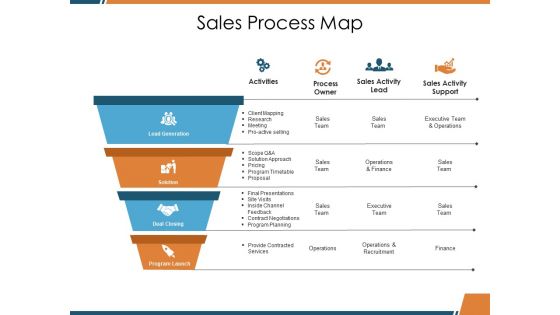
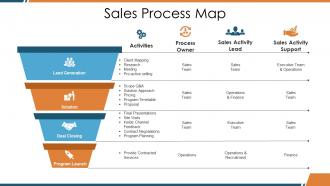
Sales Process Map Ppt Visual Aids Beispieldatei





Try Before you Buy Download Free Sample Product
 Impress Your
 Audience
 100%
100% Editable
 Save Hours
 of Time


Unsere Sales Process Map Ppt Visual Aids Beispieldatei hat ein elegantes Aussehen. Sie sind alle dekorativ gestaltet.
People who downloaded this PowerPoint presentation also viewed the following :
Verkaufsprozesskarte Ppt Visual Aids Beispieldatei mit allen 5 Folien:
Die eigentliche Erklärung wird anhand unserer Sales Process Map Ppt Visual Aids Beispieldatei deutlich. Es stellt sicher, dass versteckte Agenden auseinander fallen.
FAQs for Sales process map ppt visual
Start with the basics: lead generation, qualification, needs discovery, proposal, negotiation, and closing. Oh, and definitely add follow-up - nobody talks about this enough but the sale isn't really done when they sign. You'll probably need to tweak these stages though. Enterprise B2B? Add stakeholder mapping or technical demos. Quick transactional stuff? Combine a few steps. Most important thing is having clear exit criteria for each stage. Otherwise your team won't know when to actually move people forward. I'd map out what you're doing now first, then clean it up from there.
Honestly, a sales process map is like giving everyone the same cheat sheet. No more of that annoying stuff where marketing sends over a "hot lead" and sales is like "this person isn't even interested." Clear handoffs between teams, same language for talking about deals - you know the drill. New hires can actually see the whole picture instead of figuring it out through office gossip and random Slack messages. Oh, and definitely get input from each team when you're mapping it out. Trust me, sales will have very different opinions than marketing about what actually happens.
Honestly? Lucidchart and Visio are your best bets - they're made for this stuff and have templates already. Miro's awesome if your team likes working together visually (way more fun than it sounds). HubSpot and Salesforce actually have mapping features built right into their CRMs, which is pretty convenient. For basic stuff, Google Drawings works fine too. I'd probably just use whatever you already pay for first. You can always switch later if it sucks. Oh, and Canva's surprisingly decent for simple process maps if you're already using it for other things.
So basically a sales process map lets you see where deals are getting stuck. Track how long stuff sits at each stage - you'll start noticing patterns real quick. Like maybe everything's piling up during proposal reviews or contracts are taking way too long (ugh, legal teams am I right?). Once you map it all out, the bottlenecks become super obvious. I'd focus on fixing the worst problem areas first. It's honestly like getting a overhead view of your whole pipeline instead of just guessing where things are breaking down.
Honestly, you can't build a decent sales process without knowing who you're actually selling to first. Customer personas are everything - they shape how you design each step. A CEO doesn't want the same approach as some middle manager, you know? Different people have totally different pain points and ways of making decisions. I'd start small though - maybe 2 or 3 main personas max. Then you can map out their specific buyer journeys and build your process around that. Otherwise you're just guessing at what'll work.
Look at your last 20 deals first - you'll spot patterns fast. Some buyers obsess over price, others want every feature demo'd. Committee approvals vs one decision maker changes everything too. Most companies screw this up by shoving everyone through identical funnels, then act shocked when half their leads bail. Create 2-3 different process maps instead. Price-sensitive buyers need different content than feature-focused ones. Adjust your stages and touchpoints based on how each persona actually buys. Way more work upfront but your conversion rates will thank you later.
Conversion rates at each stage are clutch - that's where you'll spot your bottlenecks. I'd also watch how long deals sit in each phase and your average deal size. Lead velocity matters too (basically how fast people move through). Activity stuff is huge - calls, emails, meetings booked. Those numbers directly drive your results. Win/loss ratios tell you a ton about what's actually working. Honestly, start small with maybe 3-4 metrics instead of going crazy measuring everything. You can always add more once you get the hang of it.
Honestly, having a sales process map is like having a checklist so you're not just making it up as you go. You'll know exactly what questions to ask at each stage and can spot the time-wasters way earlier. I used to chase after every lead like an idiot until I realized most weren't even qualified buyers. Now you can see patterns in your data - like where people usually bail out - and tighten up your criteria. The best part? No more gut feelings about whether someone's serious. Just map out where you currently qualify leads and fill in the gaps where you're missing crucial info.
Honestly? I'd check it quarterly minimum, but really whenever things start feeling weird or your numbers drop. Your conversion rates tanking? Time for a review. Team creating their own shortcuts around your "official" process? Yeah, that's a red flag your map's getting outdated. Customer feedback changing? Same deal. Most companies do major overhauls every 6-12 months, though if you're in tech or something that moves super fast, might need to be more frequent. Just set a recurring reminder and actually stick to it - I know it sounds boring but your revenue literally depends on this stuff staying current. Trust me on that one.
Honestly, the worst thing you can do is overcomplicate it. I see people all the time trying to map out every single edge case and exception - total waste of time. Just focus on how most of your deals actually flow, not some perfect theoretical process. Talk to your sales team first though! They'll tell you what really happens vs what you think happens. Trust me on this one. Start basic and build from there. Your first version doesn't need to be perfect - actually, it shouldn't be. Get something workable out there, then tweak it based on feedback from people actually using it daily.
Honestly, visuals are a game-changer for sales process maps. Nobody wants to read through endless bullet points - I definitely don't. Try color coding your different stages first, that alone makes everything clearer. Flowcharts with arrows show the progression way better than paragraphs ever could. Icons help too, though I sometimes go overboard with those. Your team will spot bottlenecks faster when they can actually see what's happening. Even simple visual cues during reviews make a huge difference. Trust me, once you add some color to your current stages, you'll wonder why you didn't do it sooner.
Honestly, your sales process map is just the blueprint for your CRM. Can't build effective workflows without knowing your actual process first - that's like constructing a house without plans (learned that the hard way at my last job). Here's how it works: the map defines your stages, activities, and handoffs. Your CRM then automates and tracks those exact steps. They're pretty useless apart but powerful together. The process map keeps everyone consistent, while the CRM captures data and moves deals through each stage. Start by documenting what you're currently doing, then set up your CRM to match it perfectly.
So basically, a sales process map is like giving your new hire a GPS instead of just saying "good luck, figure it out." You show them every step from finding leads to closing deals. They'll know exactly when to qualify someone, what questions to ask, and which tools to grab at each stage. Honestly, role-playing through each part with the map is clutch - I've seen it work way better than just handing them a manual. Plus everyone stays on the same page with your approach. It's training wheels, but the good kind that actually help people not crash and burn.
Honestly, get your team involved from day one - when people help build something, they actually want it to work. Talk to your sales reps and managers before you even start mapping anything out. The "why" matters more than you think. Show them how this makes their day easier, not more complicated. I'd run a small pilot first with whoever seems game. Once you have some wins, those success stories do the convincing for you. Oh, and don't get married to your first version. You'll need to tweak things based on what people tell you - that's just how it goes.
Sales process maps are actually killer for keeping customers around. Here's why - your team delivers the same solid experience every time, whether customers get Sarah or Mike. Nobody gets dropped after closing, which honestly happens way too often. You can also pinpoint exactly where people get annoyed and bounce (usually the boring paperwork stages, let's be real). The cool part? It forces you to think past just making the sale. You'll spot problem areas fast. I'd start by comparing your current process to what customers actually tell you - that's where the gaps show up.
-
Innovative and Colorful designs.
-
Great quality slides in rapid time.