

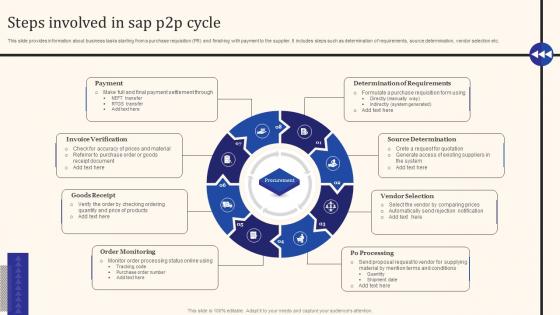
Steps Involved In Sap P2p Cycle




Try Before you Buy Download Free Sample Product
 Impress Your
 Audience
 100%
100% Editable
 Save Hours
 of Time


This slide provides information about business tasks starting from a purchase requisition PR and finishing with payment to the supplier. It includes steps such as determination of requirements, source determination, vendor selection etc.
People who downloaded this PowerPoint presentation also viewed the following :
Steps Involved In Sap P2p Cycle with all 6 slides:
Use our Steps Involved In Sap P2p Cycle to effectively help you save your valuable time. They are readymade to fit into any presentation structure.





FAQs for Steps Involved In
So you've got four main steps to track. Start with a Purchase Requisition when someone needs stuff, then convert that to a PO for the actual buying. Goods Receipt happens when everything shows up - honestly, this is where things usually go sideways if your receiving team is slacking. Invoice Verification comes last to match everything up. Finance handles payment after that. Oh, and definitely track each step in SAP because missing pieces will absolutely screw you over during month-end. Trust me on that one.
P2P basically hits every SAP module - your POs and requisitions run through MM, then FI and CO handle all the financial postings and cost center stuff. WM/EWM comes into play for warehouse inventory, PM connects when you're buying maintenance supplies, and HR jumps in for services. Honestly, the connections are what'll trip you up most of the time. When something breaks in P2P, I always check those integration points first - like 90% of the time that's where you'll find your problem hiding. Each module dependency just creates another place for things to go sideways, you know?
Vendor management is like the backbone of your whole P2P process - nothing works if you don't have suppliers set up right. Keep your vendor master data clean and handle new supplier onboarding properly. Banking details, payment terms, all that stuff needs to stay updated. Sounds super boring, I know, but trust me - when it breaks, nobody gets paid and everyone loses their minds. Bad vendor data screws up everything downstream. Purchase orders get messy, invoices won't match, payments fail. Set up solid processes for creating vendors and clean up your data regularly. Otherwise you'll be dealing with headaches forever.
Start with cleaning up your master data - vendors, materials, cost centers. Everything breaks if that's messy. Set up three-way matching to catch problems early, and automate approvals with workflow rules. Vendor catalogs help standardize purchasing too. The reporting tools are actually decent once you figure them out - they'll show you bottlenecks and where people are going rogue with spending. Oh and don't forget proper purchase requisitions with clear approval chains. Honestly I'd tackle invoice processing first since it's usually the biggest pain point, then expand from there.
Honestly, the biggest headaches you'll deal with are approval workflows that just sit there forever and vendor data that's either missing half the info or totally outdated. Three-way matching is brutal - the GR, PO, and invoice amounts never seem to line up right. Super frustrating. Purchase reqs get stuck because release strategies weren't set up properly, and don't even get me started on duplicate invoices. People love their manual workarounds too, which breaks everything. Start with cleaning up vendor master data - that'll solve like 70% of your problems right there.
So purchase requisitions are basically how you formally ask for stuff your team needs - they start the whole purchase-to-pay process. You fill out what you want, how much, budget info, then it goes through whoever needs to approve it based on cost centers and spending limits. Honestly, they're kind of a pain but super necessary for keeping spending under control. Procurement gets visibility into what everyone's buying, and auditors eat this stuff up. Without PRs it'd be total chaos - people just ordering random things left and right. Oh, and definitely check if your item's already in the catalog first, saves you tons of time.
So e-invoicing automates your whole invoice thing and makes P2P way smoother. Your electronic invoices flow straight into SAP and match against POs automatically. When everything lines up, the system posts them without you lifting a finger - which honestly feels like magic the first time you see it. Processing time drops like crazy. Fewer errors too. Your vendors get paid faster so they stop bugging you about late payments (you know how that goes). Audit trails are cleaner. I'd start with your biggest suppliers first since that's where you'll see the most impact right away.
Here's the thing - SAP basically forces you to follow the rules, which is annoying but actually saves your butt. It won't let you skip approvals or bypass three-way matching between POs, receipts, and invoices. The system automatically flags sketchy vendors and weird spending patterns before they blow up. Plus it tracks everything for audits. I learned this the hard way when I tried rushing a purchase last month and got stuck waiting for proper approvals. But honestly? Set it up right from the start and it runs smooth without slowing everyone down.
Check out the standard MM and FI reports first - they cover your basic POs, goods receipts, and invoice stuff. SAP Analytics Cloud is where you'll want to go for real-time dashboards though. Takes some setup but honestly worth it. Query Designer works great if you need custom reports for weird edge cases. Oh, and Crystal Reports is still around if you're into that whole retro vibe. I'd start with what's already built-in, see what's missing, then get fancy with the custom analytics later.
So SAP basically gives both teams access to the same real-time data - finally, no more spreadsheet chaos! The workflows automatically handle approvals and catch policy violations before they blow up. Procurement can't just do whatever they want anymore, and finance actually knows what's coming. Honestly, the integrated reporting is clutch because everyone pulls from one source instead of arguing about different numbers. I'd start with shared dashboards so you're all literally staring at the same stuff. Makes those budget meetings way less painful when nobody can claim they're looking at different data.
Honestly, start with three-way matching in SAP - that automation will save you so much headache verifying POs, receipts, and invoices. Set up those approval workflows with clear dollar limits too, because nobody wants invoices sitting in someone's vacation inbox for three weeks. Electronic invoicing and vendor portals are clutch for cutting down manual stuff. The master data thing is boring but crucial - clean vendor records and standardized GL codes make everything else actually work. Oh, and definitely hit your biggest vendors first. You'll see results way faster that way.
So SAP's approval engine is actually pretty solid - it automatically routes purchase requests based on whatever rules you set up. You can configure it by dollar amounts, departments, material types, all that stuff. Honestly, the email notifications and escalation features work great when people actually check their inboxes. Set up your thresholds so small purchases just go through automatically while the big stuff hits the right approvers. You can do parallel or sequential approvals depending on how your company rolls. My advice? Map out your current approval process first, then just mirror that in the system. Way easier than trying to reinvent everything.
Start with cycle time and exception rates - they'll hit you with the biggest pain points right away. Track how long it takes from PO creation to payment, plus invoice processing time and cost per invoice. PO accuracy matters too because nobody wants to deal with endless amendments (trust me on this one). Three-way match success rates are key. Also watch your days payable outstanding and contract compliance percentages. Don't forget supplier performance metrics either. These will show you exactly where things are getting stuck in your P2P flow.
Check with your manager first about company training - that's honestly your best move since it'll cover how your specific system actually works. SAP's Learning Hub is solid too, has modules for procurement and invoicing stuff. Internal sessions are usually way better than generic courses though, just saying. YouTube has some decent tutorials if you need quick help with something specific. Oh and the SAP community forums are pretty useful for troubleshooting weird issues. I'd definitely go the company route first, then fill in gaps with the official SAP modules that match whatever part of P2P you're doing.
So yeah, you can totally bake this into your SAP P2P setup without too much hassle. First thing - update your vendor master data with environmental certs, carbon footprint stuff, ethical sourcing requirements. Then configure the approval workflows to automatically flag purchases that don't hit your green criteria. Way better than chasing this down manually later, trust me. Oh and set up spend analytics to track sustainable vs regular procurement percentages - your boss will love those reports. I'd start with your biggest spend categories and build sustainability checks into those requisition templates first.
-
Graphics are very appealing to eyes.
-
I am really satisfied with their XYZ products. Used their slides for my business presentations and now I am taking their help for my son's high-school assignments. Super satisfied!!