

Strategic Financial Planning And Management Powerpoint Presentation Slides





Try Before you Buy Download Free Sample Product
 Impress Your
Audience
 100%
Editable
 Save Hours
of Time


Having a well-organized financial strategy is crucial for effective fund procurement and utilization. Grab our Strategic Financial Planning and Management template that aims to ensure a steady and sufficient flow of funds to meet the present and future needs of the business organization and improve its financial performance. Our Company Financial Planning deck covers financial planning and management across four stages, including sources and uses of funds management. It showcases financial management components, such as financing, investment, and dividend decisions, demonstrating the companys financial management. Additionally, our Strategic Financial Plan depicts budgeting and forecasting, which estimate the firms future financial needs, allowing for the appropriate allocation of funds. Moreover, it includes slides that identify the likelihood and severity of various financial risks and suggests strategies to mitigate them. Further, our Finance Management also provides insights into various financial tools and techniques, such as income statements, balance sheets, and ratio analysis. Finally, it offers financial analysis software solutions, impact assessments to reduce expenses, and dashboards that track new economic improvements, revenue, and profitability. Access it now to enhance your financial planning and management practices.
People who downloaded this PowerPoint presentation also viewed the following :
Content of this Powerpoint Presentation
Slide 1: This slide introduces Strategic Financial Planning and Management. Commence by stating Your Company Name.
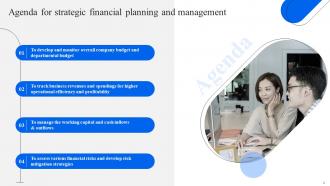
Slide 2: This slide depicts the Agenda of the presentation.
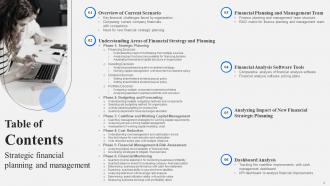
Slide 3: This slide includes the Table of Contents.
Slide 4: This slide highlights the Title for the Topics to be discussed further.
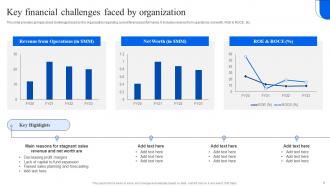
Slide 5: This slide provides glimpse about challenges faced by the organization regarding current financial performance.
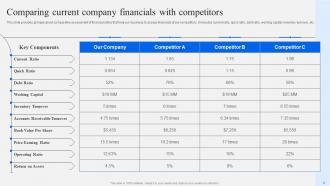
Slide 6: This slide focuses on Comparing current company financials with competitors.
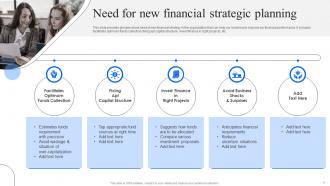
Slide 7: This slide exhibits the Need for new financial strategic planning.
Slide 8: This slide contains the Heading for the Contents to be covered in the following template.
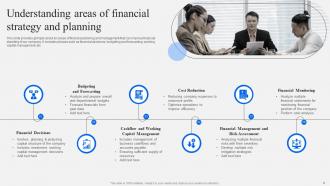
Slide 9: This slide deals with Understanding areas of financial strategy and planning.
Slide 10: This slide includes the Title for the Ideas to be covered in the following template.
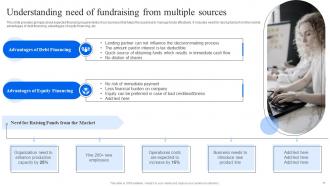
Slide 11: This slide shows expected financing requirements of our business that helps the business to manage funds effectively.
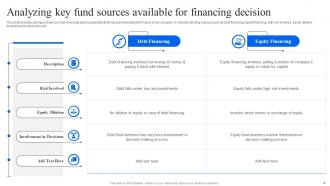
Slide 12: This slide focuses on Analyzing key fund sources available for financing decision.
Slide 13: This slide provides glimpse about current financing sources that our business is using to finance assets and run operations.
Slide 14: This slide contains the Heading for the Ideas to be discussed next.
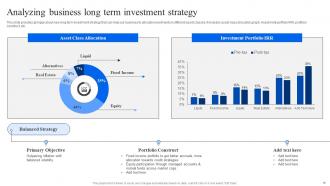
Slide 15: This slide deals with Analyzing business long term investment strategy.
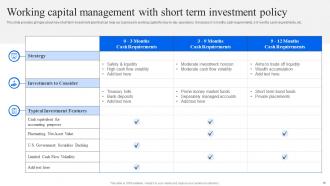
Slide 16: This slide provides a glimpse about new short term investment plan for day-to-day operations.
Slide 17: This slide displays the Title for the Contents to be covered in the following template.
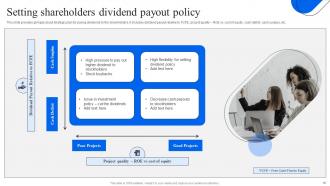
Slide 18: This slide provides glimpse about strategic plan for paying dividends to the shareholders.
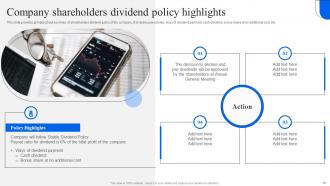
Slide 19: This shows the summary of shareholders dividend policy of the company.
Slide 20: This slide depicts the Heading for the Topics to be discussed further.
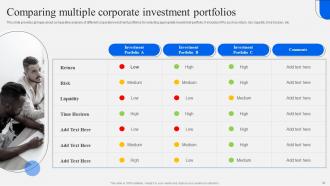
Slide 21: This slide deals with Comparing multiple corporate investment portfolios.
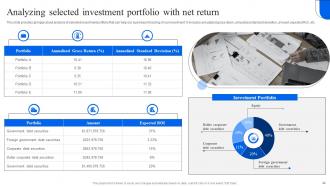
Slide 22: This slide focuses on Analyzing selected investment portfolio with net return.
Slide 23: This slide displays the Title for the Topics to be covered in the following template.
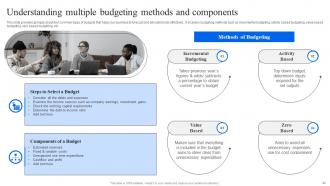
Slide 24: This slide provides glimpse about four common types of budgets that helps our business to forecast and allocate funds effectively.
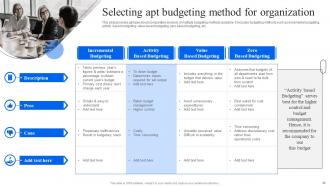
Slide 25: This slide highlights comparative analysis of multiple budgeting methods available.
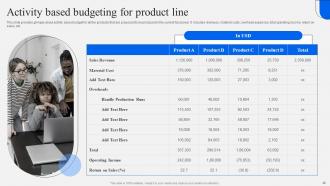
Slide 26: This slide portrays the Activity based budgeting for product line.
Slide 27: This slide provides glimpse about quarterly budget plan for each business unit that can help our business to allocate funds easily.
Slide 28: This slide mentions the Heading for the Contents to be discussed next.
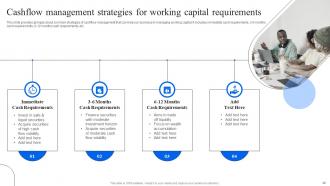
Slide 29: This slide showcases the common strategies of cashflow management that can help our business in managing working capital.
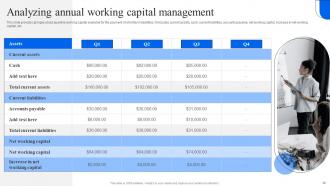
Slide 30: This slide emphasizes on Analyzing annual working capital management.
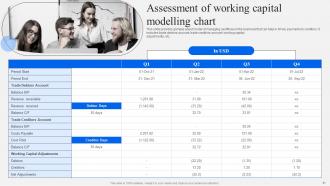
Slide 31: This slide presents the model of managing cashflows in the business that can help in timely payments to creditors.
Slide 32: This slide displays the Title for the Ideas to be covered in the following template.
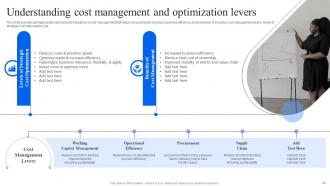
Slide 33: This slide emphasizes on Understanding cost management and optimization levers.
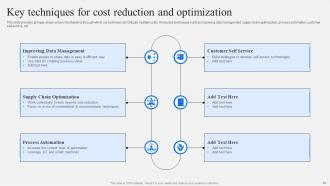
Slide 34: This slide provides glimpse about various mechanisms through which our business can mitigate multiple costs.
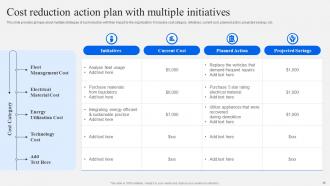
Slide 35: This slide showcases Cost reduction action plan with multiple initiatives.
Slide 36: This slide reveals the Heading for the Ideas to be discussed next.
Slide 37: This slide provides glimpse about assessing various financial risks with their severity and probability of occurrence.
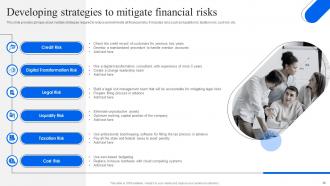
Slide 38: This slide displays Developing strategies to mitigate financial risks.
Slide 39: This slide includes the Title for the Contents to be covered in the following template.
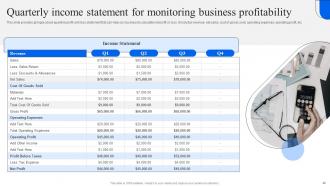
Slide 40: This slide provides glimpse about quarterly profit and loss statement that can help our business to calculate net profit or loss.
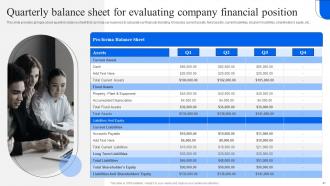
Slide 41: This slide illustrates the Quarterly balance sheet for evaluating company financial position.
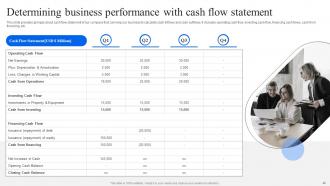
Slide 42: This slide provides a glimpse about cash flow statement of our company that can help our business to calculate cash inflows and cash outflows.
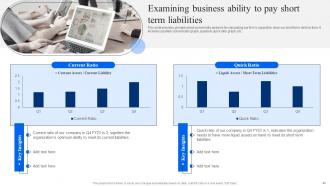
Slide 43: This slide focuses on Examining business ability to pay short.
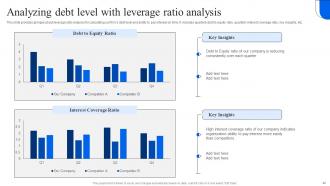
Slide 44: This slide showcases Analyzing debt level with leverage ratio analysis.
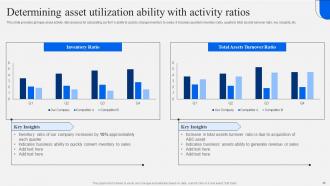
Slide 45: This slide provides glimpse about activity ratio analysis for calculating our firm’s ability to quickly change inventory to sales.
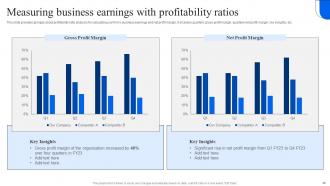
Slide 46: This slide deals with Measuring business earnings with profitability ratios.
Slide 47: This slide contains the Heading for the Topics to be discussed further.
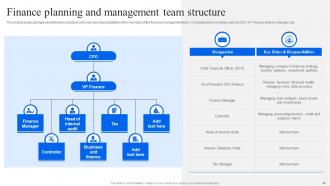
Slide 48: This slide provides glimpse about the team structure and roles and responsibilities of the members of the financial management team.
Slide 49: This slide illustrates the RACI matrix for finance planning and management team.
Slide 50: This slide displays the Title for the Topics to be covered next.
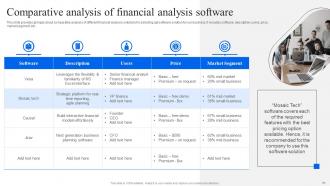
Slide 51: This slide represents the Comparative analysis of financial analysis software.
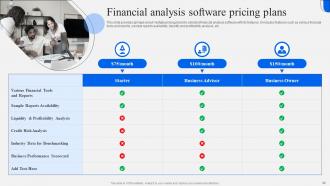
Slide 52: This slide provides glimpse about multiple pricing plans for selected financial analysis software with its features.
Slide 53: This slide indicates the Heading for the Contents to be discussed further.
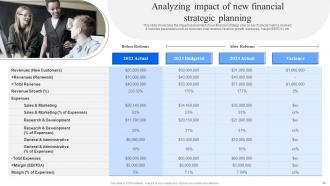
Slide 54: This slide showcases the impact assessment of new financial strategy plan on key financial metrics involved.
Slide 55: This slide incorporates the Title for the Ideas to be covered next.
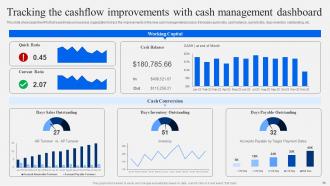
Slide 56: This slide showcases the KPIs that would help our business organization to track the improvements in the new cash management process.
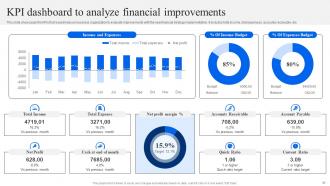
Slide 57: This slide reveals the KPI dashboard to analyze financial improvements.
Slide 58: This is the Icons slide containing all the Icons used in the plan.
Slide 59: This slide is used for depicting some Additional information.
Slide 60: This slide presents the Company overview with mission and vision statement.
Slide 61: This slide reveals the SWOT analysis.
Slide 62: This is the About us slide stating the company-related information.
Slide 63: This slide presents the organization's mission, vision, and goals.
Slide 64: This is Our team slide. State your team-related information here.
Slide 65: This slide indicates the Line chart.
Slide 66: This slide contains the Post it notes for reminders and deadlines.
Slide 67: This slide is used for the purpose of Comparison.
Slide 68: This slide displays the Company Roadmap.
Slide 69: This is the Thank you slide for acknowledgement.
Strategic Financial Planning And Management Powerpoint Presentation Slides with all 74 slides:
Use our Strategic Financial Planning And Management Powerpoint Presentation Slides to effectively help you save your valuable time. They are readymade to fit into any presentation structure.

















FAQs for Strategic Financial Planning And Management
So you need clear financial goals first - that's your foundation. Build a realistic budget from there, plus cash flow projections so you're not caught off guard. Risk management is huge too. I'd definitely do some "what if" scenarios because honestly, stuff always comes up you don't expect. Performance metrics are where most people mess up though - pick a few key ones and actually track them. Oh, and figure out your funding approach early, whether it's loans, investors, or just reinvesting what you make. Start by writing down where you are financially right now, then work forward.
Look, risk assessment basically drives every big money decision you make. You check out market volatility, regulatory stuff, competition - all that gives you the info to spend wisely. Risky ventures? Give them smaller budgets or keep more cash on hand. Safer bets can handle more aggressive investment. Honestly, I learned this the hard way on a few deals. It's like checking weather before a picnic - sounds obvious but people skip it constantly. Match your comfort level with your goals, then have backup plans ready. Always test your assumptions before throwing serious money around.
Tech integration is honestly what separates modern financial planning from those old spreadsheet days. You can automate data collection now, run real-time scenario modeling, get predictive analytics that actually help you make better decisions instead of just looking backward. The AI forecasting tools are getting scary good too - like, almost freaky good. But here's the catch: the tech only works if you're feeding it clean data and you actually understand what the outputs mean. I'd start by auditing your current data sources first, then pick one automation tool to pilot.
Start with your actual business goals, then figure out the money stuff after. Like if you're expanding to new markets, budget for R&D and marketing to match that. Don't just pull financial targets out of thin air - I see teams do this constantly and it's such a waste. Map each budget item to what you're actually trying to accomplish. Quarterly check-ins are clutch since priorities change. Oh, and that mapping exercise I mentioned? It's pretty eye-opening when you realize half your spending doesn't connect to anything meaningful. Work backwards from goals, not forwards from last year's numbers.
Track your net worth growth and debt-to-income ratio first - those are the big ones. Emergency fund should cover 3-6 months of expenses, and compare your investment returns to benchmarks. Savings rate is honestly my favorite metric because it shows you're actually being disciplined with money. Cash flow matters too; you want positive money left over each month after expenses and savings. Oh, and check these quarterly, not every day. I learned that the hard way - watching daily changes will just stress you out when the long-term trend is what actually counts.
Look, the economy's always changing and it forces you to pivot your financial plans constantly. Interest rates mess with your loans and investments. Inflation eats into what your money can actually buy - plus it drives up your daily costs. Your assets? Market swings make their values jump around like crazy (I swear I check my portfolio way too much). Then there's regulatory stuff that can flip your whole budget upside down. Currency changes are another headache if you're dealing with international anything. Honestly, you've got to build some wiggle room into your plans. Test different scenarios regularly so you're not caught off guard.
Don't get too rosy with your numbers - I've watched friends crash hard on this one. Stress test everything, seriously. Cash flow timing will bite you even when you're profitable, so map that out carefully. Also avoid putting all your eggs in one revenue basket or thinking growth happens in a straight line (spoiler: it never does). The worst mistake though? Creating a plan then never touching it again. I swear, update that thing every quarter or it becomes useless pretty fast. Your assumptions change constantly, so roll with it.
So scenario planning is basically stress-testing your money strategy with different "what-if" situations. Think economic crashes, supply issues, market chaos - you know, fun stuff. You create a few scenarios (best case, worst case, realistic) and see if your plan survives each one. Way more useful than a magic 8-ball, honestly. This helps you spot blind spots and prep backup plans before everything hits the fan. The trick? Keep updating your scenarios as things change. I learned this the hard way during 2020 - old assumptions become useless fast when the world flips upside down.
Honestly, diversification is your best friend right now. Don't put all your eggs in one basket - spread stuff across different investments and regions. Keep more cash on hand than you normally would. Scenario planning is where most people mess up, but it's seriously a game changer. Map out what happens if things go south vs. if they stay stable. Lock in good rates while you can find them. Oh, and stay liquid enough to jump on deals when everyone else is panicking. That's usually when the real opportunities show up.
Look at your past sales data first - spot those seasonal patterns and growth trends. Market conditions matter too, plus any new products you're launching. Honestly, forecasting is half guesswork even when you do everything "right" lol. Don't just make one big prediction though. Break it down by different revenue streams instead. I'd try a couple methods - maybe trend analysis and bottom-up projections - then see how they compare. Oh, and actually update the thing regularly! New data comes in all the time, so your forecast should change too.
Look, here's the thing - your fancy financial plan is worthless if nobody's on board with it. People will just ignore changes they didn't help create (learned that the hard way). Get the key players involved early because they actually know what works day-to-day, unlike us sitting here crunching numbers. When someone helps build the plan, they'll stick to it. Oh and map out who really matters before you start - you don't need everyone, just the people who can make or break execution. Trust me on this one.
Don't make compliance an afterthought - work it into your planning from the start. Figure out which regulations actually matter for your business (there's SO much noise out there). Get your legal team in the loop early so they can catch issues before they get expensive. Build those check-ins right into your financial timeline. Honestly, quarterly reviews have saved my butt more than once. The whole point is making it part of your regular workflow instead of panicking about it later.
Dude, globalization totally changes how you handle money stuff. Currency swings will mess with your plans constantly - I learned that the hard way. Different countries mean different rules and tax headaches too. Your cash flow planning gets way more complicated when supply chains can break anywhere in the world. But hey, at least you get access to funding and investments from everywhere now. Build in some currency protection and always run worst-case scenarios. Honestly, stress-testing against random global chaos is just part of the game these days.
Honestly, cash flow forecasting is where most people mess up - you've gotta track when money actually hits your account, not just rough monthly numbers. Those timing gaps are brutal. Get aggressive about collecting payments faster and maybe stretch out what you owe (within reason obviously). I'd say keep 3-6 months of expenses saved up, plus get a credit line just in case. Oh and definitely check your projections every month because things change constantly. My friend learned this the hard way when three clients all paid late the same month - nearly killed his business.
Think of strategic planning as your big-picture goals, but budgeting? That's where the rubber meets the road. You're actually putting dollar amounts on everything and figuring out what you can realistically afford. It's like having a GPS for your money - you'll know exactly where each dollar should go and when. I learned this the hard way when I kept making plans without checking my actual bank account first. Your budget basically forces you to connect every expense back to your real goals, so you can see if you're actually making progress or just burning cash. Otherwise you're just daydreaming about financial success.
-
I’m not a design person, so I couldn’t make a presentation to save my life. Thankfully, they have all kinds of templates that I regularly use for my work.
-
Thanks for all your great templates they have saved me lots of time and accelerate my presentations. Great product, keep them up!